

A Boy's Own Odyssey
Paul Cartledge·July 18, 2026
The making of a classicist
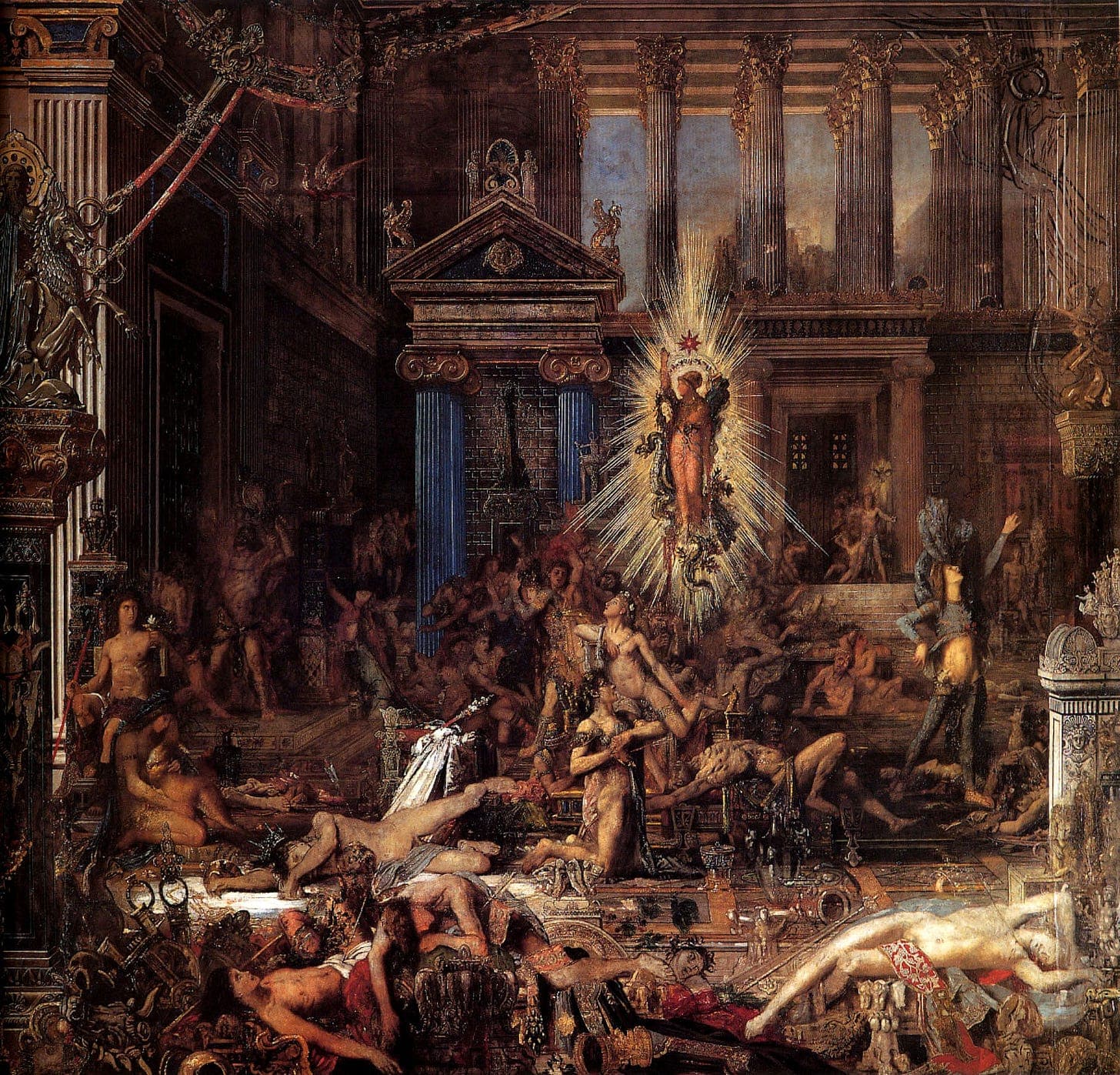
Husteron proteron homērikōs – ‘the later the earlier in the manner of Homer’. So wrote Cicero in a letter to his friend and publisher, Titus Pomponius surnamed Atticus (the Athenian). So write I now, in response to the siren-like invitation to write about any work of art, ancient or modern, that significantly changed or shaped my view of Homer’s Odyssey.
I started learning ancient Greek at 11, at my London private school. At senior school I remained firmly immersed in the classical (Greek, Latin, ancient history) ‘scholarship’ stream, along which I flowed relentlessly on to undergraduate days at Oxford. There it was that in 1965-6 I first encountered Homer, ‘the poet’ as the ancient Greeks knew him, full-on, firsthand, in his unique, esoteric, artificial ‘dialect’ (never spoken outside a bardic recital). Reading all 28,000 or so verses of the Iliad and Odyssey was a minimum preparation for the – purely translation – exam exercise that was to follow in spring 1967. Practice makes perfect – well, quite fluent. Thanks partly to Homer’s happy addiction to repeated formulaic words and phrases, even whole sentences and paragraphs, I progressed my reading speed up to about 300 lines an hour. That is, for the whole lot, 90 solid hours, almost four whole days, give or take. About the same time it would have required for an ancient bard (aoidos) or bards to deliver the whole of either poem in prolonged continuous session.
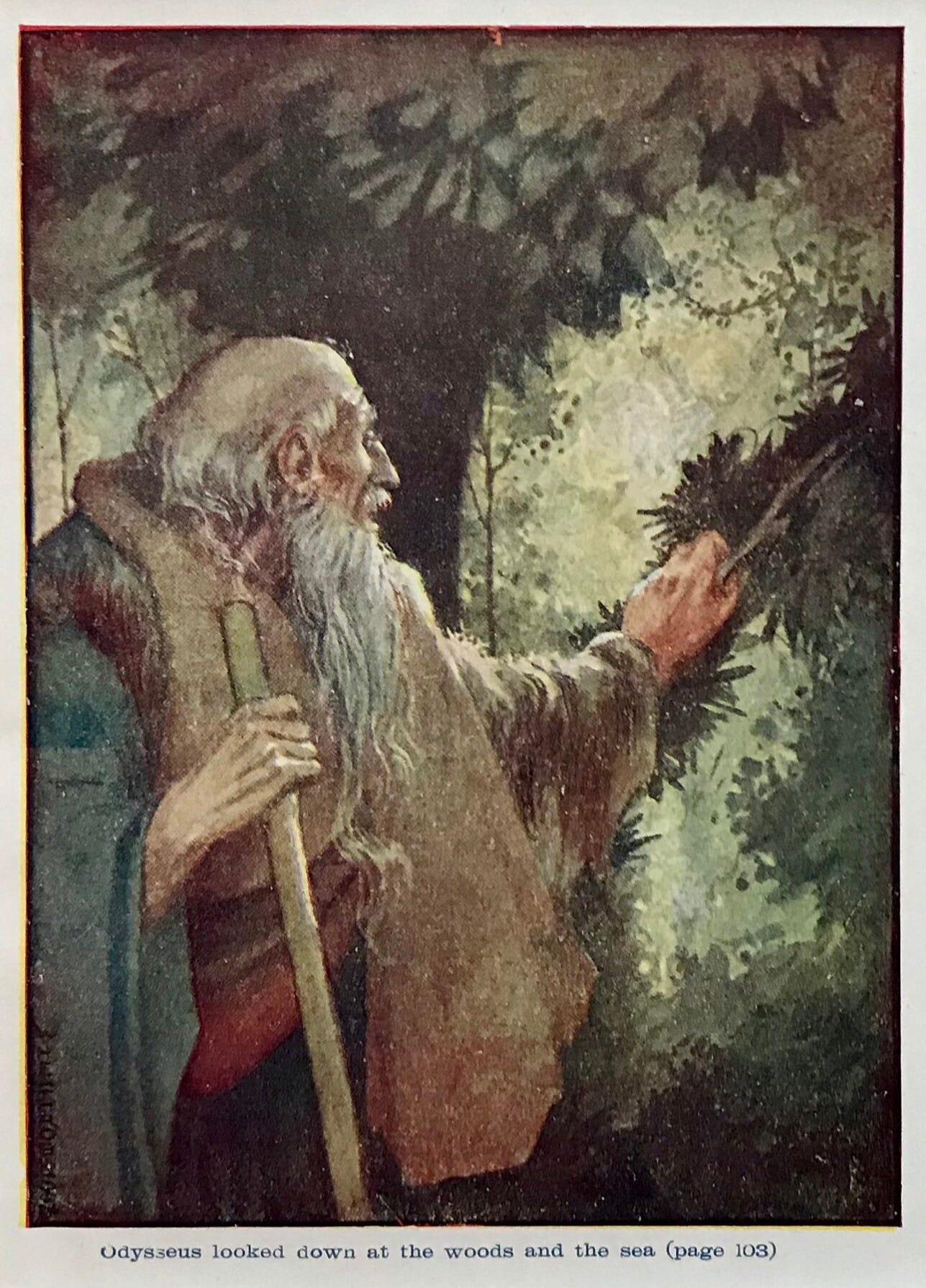
But how did it ever come to that for me? How, why, had it seemed a good plan to become a Classicist in the first place? To answer that, I must track back as far as 1955, just over seven decades, when I was gifted two little books that were to change my life forever. Both were titled ‘Stories from...’, respectively, the Iliad (1907) and the Odyssey (1906), and helpfully, encouragingly, subtitled ‘Told To the Children’. I still possess both. Not the least of their allure was their artwork, by William Heath Robinson, more famous for – indeed the eponym of – the absurdly intricate, unnecessarily complicated, makeshift mechanism. His Achilles resplendent in shiny new Hephaestus-made armour posed unblushingly as the Iliad frontispiece to arouse my youthful masculine spirit of adoration and emulation. But I was no less taken with the image that adorned the jacket cover of my reprint of the TTTC Odyssey: a grotesquely menacing Cyclops set against a Turneresque backdrop.
It was the picaresque Odyssey more than the blood-and-thunder Iliad that aroused the Classicist as yet dormant within me. And that was due of course to words rather than any visual image, the words not of Homer (whoever he/they might have been) but of Jeanie Lang (1867-1932). Classicists of a certain age on hearing the name ‘Lang’ are likely enough to think at once of the duo ‘Butcher & Lang’ – or of ‘Lang, Leaf & Myers’, the Lang being in both cases the Classically educated folklorist Andrew Lang who jointly translated into prose both the Iliad and (with Butcher) the Odyssey. Jeanie, sister-in-law of Andrew, was a considerable scholar in her own right with a special knack of being able to talk to but not down to her children readers, a teller of tales that even I aged eight was able at least to follow and possibly even appreciate.
This all came back to me recently when I was asked to contribute a Foreword to Erica Stevenson’s remarkable The Odyssey Effect (which followed hot on the heels of Sam Akbar’s The Odyssey Mindset, also 2026. Eat your heart out, homerically, Christopher Nolan. This was already the Year of the Odyssey well before your movie hit the airwaves.) I make no apology for returning to what Alexandrian scholars determined we must call Book 17 of the 24. To recap: Odysseus has endlich made it back to his native land – wherever or whatever his ‘Ithaca’ was. Thanks to the magic of his divine mentor, Athena, his already somewhat wasted body has been transmogrified into a physical form suitable for a beggar, and clothed in a beggar’s rags. As such, he is unrecognisable to two-legged humans, but not to four-footed canines, at least not to one particular furry old friend.
Odysseus is directed towards what was once his palace, long since besieged by exactly 108 ‘Suitors’, a polite term for a singularly unappetising bunch of yobbish and surprisingly bachelor young aristocrats each angling for the hand of Odysseus’s loyal Spartan-born supposed widow, Penelope. Before beggar Odysseus gets to enter through the main entrance, he encounters - in a backyard area where the kitchen garbage is thrown out to form a very messy midden - a very sorry-looking male hound, infirm, diseased, riddled with ticks, by name Argos. ‘Shining’, ‘bright’, ‘glistening’, hence ‘swift’- once upon a time long ago, when Argos had been his master’s champion hunter, that nomen had been an omen, as faithful enslaved swineherd Eumaeus explains in answer to Odysseus’s question as to the dog’s pedigree. Now, alas, most of his senses had been either lost or impaired, but not that of smell. For Argos blearily recognised his old master from twenty years back, despite his disguise, and displayed the classic signs of canine recognition with his tail and ears. But it was all too much for him. And for me. Odysseus brushed away a concealed tear. I howled for half an hour uncontrollably.
No wonder Nolan in a Saturday Night Live interview has called the Odyssey the greatest dog-story. In silent if ineffectual tribute to Jeanie Lang, perhaps, Ralph Hardy published for children in 2016 Argos: The Story of Odysseus as Told by His Faithful Dog. Far better, though, to read and re-read the Homeric original – in a decent, that is poetic (Fagles, Fitzgerald, Lattimore) translation: even if that means that you, like me, end up a Classicist.
Paul Cartledge is Emeritus A. G. Leventis Professor of Greek Culture at the University of Cambridge.
Originally published in In Medias Res on Substack. Read it there or subscribe to get new articles by email.