

A Fever of Intellect: Prometheus Bound and its Authenticity
Tom Hendrickson·December 15, 2020
The Uncertainty about the Play’s Authorship is One More Gift of Prometheus
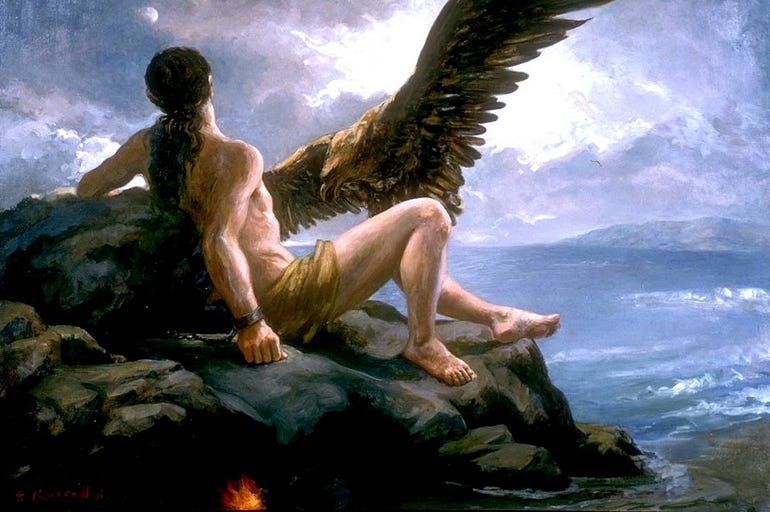 The punishment of Prometheus (source).
The late Anna Morpurgo Davies, chair of comparative philology at Oxford, once told the story of a scholar whose last words were: “Remember, Prometheus Bound cannot have been written by Aeschylus!”
This scholar apparently believed that the play differed from the other six Aeschylean plays in having a greater proportion of “weak” (kappa-stem) perfects, like πέπεικα, to “strong” (o-grade) perfects, like πέποιθα. Since the o-grade perfects come from an earlier stratum of the Greek language, he believed that Prometheus Bound must therefore be later than the others.
Like most of the theories disputing the authorship of Prometheus Bound, this one was technical, detailed, and ultimately unconvincing: there can be a lot of factors that might explain differing proportions of perfect stems. Although considerable intellectual energy has been exercised on the question whether Aeschylus was really the author of Prometheus Bound, the answer remains unknowable.
The very question of authenticity was born during an era of scholarly hubris when the field of classics was selling itself as a scientific discipline. Perhaps it was wishful thinking to put such faith in the power of knowledge, but it’s a faith clearly shared by the author of Prometheus Bound, whoever it was. Prometheus Bound is a celebration of the triumph of knowledge, although it also carries with it hints of the limits of knowledge, and the dangers intertwined with knowledge.
ΠΡΟΜΗΘΕΥΣ· πυρός … διδάσκαλος τέχνης / πάσης … καὶ μέγας πόρος.
PROMETHEUS: Fire … a teacher of every art … and a mighty resource. (109–110)
Prometheus Bound is set on a desolate mountainside. In the opening lines, personified Domination (Kratos) and Violence (Bia) restrain Prometheus as Hephaestus chains him to a cliff. Zeus, having newly overthrown his father, has decided to punish Prometheus for giving humans the “blaze of fire, source of every art” (παντέχνου πυρὸς σέλας). Over the course of the play, a series of visitors will find Prometheus: the daughters of Ocean, who form the chorus; Ocean himself, a friend and fellow-titan; Io, who has been assaulted and tormented by Zeus; and finally Hermes, Zeus’ sleazy subordinate. Prometheus himself remains bound, immobile through the whole play. At the end, further punishment rains down from Zeus like a tortoise from the heavens (we’ll deal with tortoises from heaven in a later article).
Why didn’t Zeus want humans to have fire? Prometheus’s gift to humans made them powerful and gave them an honor “beyond their due” (καιροῦ πέρα, 507). Prometheus himself is characterized not just by his defiant trust in the power of his knowledge, but by his outright arrogance. At one point Ocean gives him some advice: maybe try shutting your mouth instead of continuing to threaten the king of heaven, after all, “this (punishment) is what all your big talk earned you” (τοιαῦτα μέντοι τῆς ἄγαν ὑψηγόρου / γλώσσης … τἀπίχειρα γίγνεται, 320–21).
The play is an exploration of knowledge (represented by Prometheus) and strength (represented by Zeus), and of their competing claims to power. Since Zeus has taken dominion, no one can stand up to him. The other immortals can only do his bidding, whether unwillingly, like Hephaestus, or eagerly, like Hermes. Prometheus alone is undaunted. He has a piece of secret knowledge: a prophecy of what could cause the overthrow of Zeus.
Ultimately, knowledge is triumphant. Zeus’s strength is brutal and unjust, but Prometheus knows that he will have the upper hand in the long run: eventually, Zeus will come to barter Prometheus’s freedom for the prophecy. Throughout the play, Prometheus’s gift to humans, fire, stands in for knowledge, and the heart of the play is a catalogue of all the benefits that Prometheus has provided humankind, from architecture to astronomy.
ΕΡΜΗΣ· ὤμοι; τόδε Ζεὺς τοὔπος οὐκ ἐπίσταται.
ΠΡΟΜΗΘΕΥΣ· ἀλλ’ ἐκδιδάσκει πάνθ’ ὁ γηράσκων χρόνος.
HERMES: Zeus doesn’t even know the word “oh no!”
PROMETHEUS: Time, as it ages, gives a hard lesson in everything. (981–982)
It was, ironically, a belief in the triumph of human knowledge that led scholars to start to doubt the authenticity of Prometheus Bound. The nineteenth century saw the birth of Classics as a field that viewed itself as a science. As the march of scholarly knowledge moved forward, detailed metrical studies made clear that Prometheus Bound was different from the other surviving tragedies of Aeschylus, which led first to the suspicion that the play had been altered in transmission, and then to the suspicion that it was not by Aeschylus at all.
The high-water mark of these stylometric critiques was Mark Griffith’s 1977 book, The Authenticity of “Prometheus Bound”, which provided a dazzlingly comprehensive analysis of the play’s meter and showed in detail how Prometheus Bound differed from the other Aeschylean plays. In line 593, to give one example of this technical and fine-grained analysis, the alpha in πατρός must be long, although there is no other instance of a vowel counting as long before a mute + liquid combination when used in dochmiacs in the rest of Aeschylus. Griffith concluded the play was not by Aeschylus, though he acknowledged the limits of stylometrics as a means of ascertaining authorship.
And indeed, these limits are serious. After all, a stylometric analysis can really only tell us how similar one work is to another work (or group of works). If the only surviving songs from The Beatles were from the 1969 Abbey Road album, along with the 1963 “I Want to Hold your Hand,” a stylometric analysis would likely conclude that the latter came from a different musical group. This problem is especially pertinent given that only six of Aeschylus’s plays survive (apart from Prometheus Bound), out of over 70 that are attributed to him. So, the case that Aeschylus cannot have written Prometheus Bound is not particularly strong.
Then again, we would be hard pressed to prove that Aeschylus did write Prometheus Bound.
The question is by no means one for cranks and conspiracy theorists, like those who claim that Shakespeare didn’t write the plays attributed to him. The reason for this difference is that the attribution of ancient works sometimes rests on shaky foundations, since our evidence is largely restricted to identifiable quotations preserved by contemporaries and to the ascription found in the oldest manuscripts, which are usually medieval. Yet there might be some works that contemporaries simply didn’t quote, at least in quotations that survive to us: Juvenal, for instance, wrote during the reigns of Trajan and Hadrian, but no other author quotes his work before Lactantius in the fourth century. And the attribution found in medieval manuscripts is sometimes highly suspect: a manuscript containing a series of biographies, for example, ascribes them to an “Aemilius Probus,” though the scholarly consensus is that they are the work of Cornelius Nepos.
Prometheus Bound was written in the mid-fifth century B.C., sometime between an eruption of mount Etna in 479 B.C., which the play alludes to, and 424 B.C., the date of a play by Aristophanes that makes fun of Prometheus Bound. The earliest references to the play as a work of Aeschylus probably come from ancient scholars who were active at the Great Library of Alexandria, roughly 250–150 B.C. I say “probably” because the evidence is indirect: it survives in marginal manuscript comments written by medieval copyists who had access to the (now lost) work of the Alexandrians. Assuming that these particular marginal comments really do preserve information that dates back to the Alexandrians, that still leaves at least 200 years between the production of the play and the earliest surviving attribution to Aeschylus — roughly the same amount of time between the present and when John Keats died in Rome from tuberculosis.
Were the Alexandrians correct in attributing the play to Aeschylus? Maybe.
The likeliest source of information for the scholars in Alexandria would have been the works of Aristotle, who was active in Athens in the middle of the fourth century B.C., about a hundred years after Aeschylus. Aristotle took an interest in drama, recording lists of victors at dramatic competitions and writing about a host of plays. Unfortunately, Aristotle makes only one surviving reference to a play about Prometheus (Poetics 18.1456a2), but he doesn’t mention Aeschylus, and it is not clear that the play in question is even Prometheus Bound. Perhaps Aristotle did write about Prometheus Bound in a work that no longer survives, but even then there are serious questions about what sources of information would have been available to him (though believe me, plenty of ink has been spilled on the subject).
In the end, while the case against Aeschylean authorship of Prometheus Bound is not especially strong, the case for Aeschylean authorship is hardly airtight. Instead of arguing one way or another, we may as well accept that the conundrum faces us with the limits of our knowledge. This simply isn’t a question that we can definitively answer with the evidence available. It’s an unsatisfying answer, but unsatisfying answers at least have the benefit of keeping us from a false sense of assurance.
ΩΚΕΑΝΟΣ· ἡ σή, Προμηθεῦ, συμφορὰ διδάσκαλος.
OCEAN: Your misfortune, Prometheus, is my teacher. (393)
Prometheus will prevail eventually. And perhaps eventually we’ll find a definitive answer to the question of who wrote Prometheus Bound. New evidence might turn up, or new methods might turn us onto something unforeseen. Or maybe this is as sure as we’ll be.
For all its optimism, the play ends not with the ultimate vindication of Prometheus, but with him enduring even worse suffering at Zeus’s hands. In the last line of the play, Prometheus cries out in anguish at his punishment for giving knowledge to humans, “You see the wrongs I suffer!” (ἐσορᾷς μ’ ὡς ἔκδικα πάσχω, 1093).
Tom Hendrickson is the author of Ancient Libraries and Renaissance Humanism, which won the Iozef IJsewijn Prize. Hendrickson teaches at Stanford Online High School, and he would like to thank the students of his Modes of Writing and Argumentation class for helping him think through some of the ideas presented here. Particular thanks are owed to Kylie Hu and Marilia Serodio for their detailed comments and feedback.