

Are There Really Monsters in the Odyssey?
Mark Buchan·August 13, 2026
The Skylla Riddle
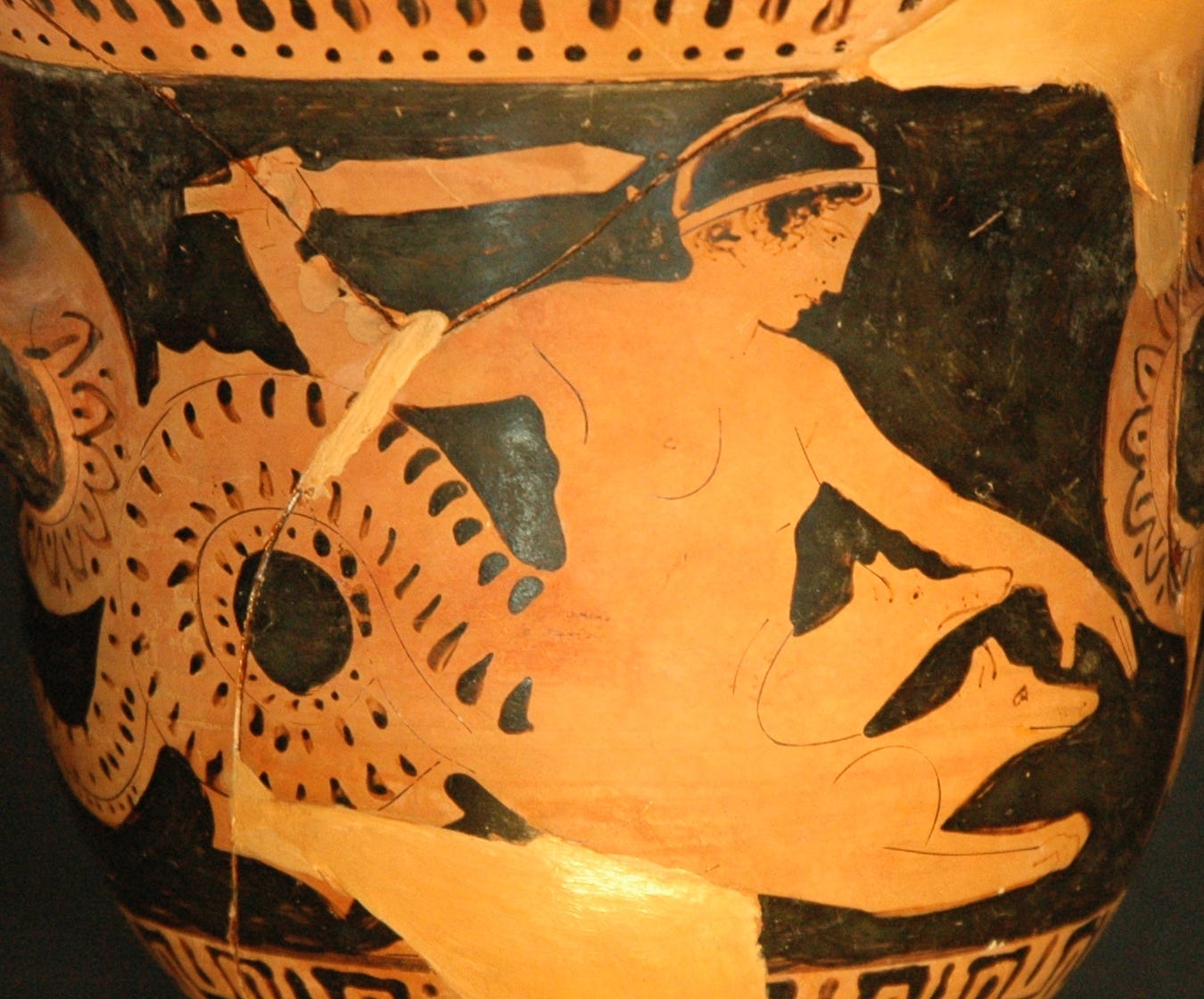
The Odyssey, so everyone tells us, is full of monsters. But what if it’s not that simple? As a test case, I will take a close look at one of the poem’s most spectacular monsters, the Skylla, not any old monster, but, in the words of Mary Beard in her Odyssey podcast, a ‘six-headed dog monster!’ But is she? As we will see, she is much more, and less, of a monster than you might think. I will use my reading of this monster to make quite large claims about The Odyssey. So stick around.
Circe first describes the Skylla, as she talks Odysseus through the journey ahead of him. He must travel between the Skylla and the whirlpool Charybdis (roughly, ‘The Belcher’ in Greek). Here is Circe’s description, and my translation, as literal as I can tell it:
Text within this block will maintain its original spacing when publishedἔνθα δ᾽ ἐνὶ Σκύλλη ναίει δεινὸν λελακυῖα. τῆς ἦ τοι φωνὴ μὲν ὅση σκύλακος νεογιλῆς γίγνεται, αὐτὴ δ᾽ αὖτε πέλωρ κακόν: οὐδέ κέ τίς μιν γηθήσειεν ἰδών, οὐδ᾽ εἰ θεὸς ἀντιάσειεν. τῆς ἦ τοι πόδες εἰσὶ δυώδεκα πάντες ἄωροι, ἓξ δέ τέ οἱ δειραὶ περιμήκεες, ἐν δὲ ἑκάστῃ σμερδαλέη κεφαλή, ἐν δὲ τρίστοιχοι ὀδόντες πυκνοὶ καὶ θαμέες, πλεῖοι μέλανος θανάτοιο. μέσση μέν τε κατὰ σπείους κοίλοιο δέδυκεν, ἔξω δ᾽ ἐξίσχει κεφαλὰς δεινοῖο βερέθρου…. Skylla lives in there, awfully screaming. Her voice comes into existence at about the scope of a newly weaned puppy, But she herself is an evil monster. Nor would anyone, Having seen her, rejoice, not even if a god met her. She has twelve feet, and all of them dangle, out of place. She has six very long necks, and in each neck There is a horrible head, and in it are three rows of teeth, Close together and stiff, full of black death. Her middle has plunged into the hollow cavern, And it pokes out her heads from the awful depth…
Why might one think she is ‘dog-headed’? The only dog reference is to her voice, which is not itself a dog’s, but is only likened in its range or size (ὅση) to a puppy’s voice, not a full-grown dog. We might also notice that the Greek word for puppy dog, skylax, puns on the Skylla’s name, and that the Greek contrasts the puppy dog voice with the Skylla herself: on the one hand there’s this voice of the scale of a puppy, but the Skylla herself is a monstrous evil. What sort of monster has a voice a bit like the scale of a puppy? The word used for the sound the Skylla’s voice makes is a relatively neutral word for ‘screaming’, though it is also used of birds; the adverb ‘deinon’ is notoriously difficult to translate, floating between ‘terribly’, ‘weirdly’, and ‘strangely’. Translators have pounced on the puppy-voice, and used it as an excuse to exaggerate the doglike nature of Skylla. Wilson, for example, instead of ‘screaming’ gives us ‘howling and barking’, in tune with Lattimore, who offers ‘howling.’ Finally, this is the only mention of anything dog-like in the whole description. If you are going to project the puppy onto the entire monster, it might make more sense to call it a 6-headed puppy monster, but this seems a little too strange for most, perhaps not living up to our ideas of what scary monsters look like. But what if we don’t do any projecting at all?
A second key detail is her feet. She has twelve, and they are ‘dangling’ or perhaps ‘out of time/place.’ This depends on how you understand the puzzling word ‘ἄωροι’, which some believe to be a participle from the verb to raise (hence ‘raised up’ or ‘dangling’), others prefer it as some kind of alpha-privative adjective with ‘ὥρα’ (hence ‘out of season/time/place). I’ve gone with both. The poet seems to be going out of their way to tell us how bizarre this creature is. If she really is some kind of dog, even the number of feet is strange. Shouldn’t a six-headed dog have twenty-four feet? This seems to drag her back to the realm of the human, with its twelve hands and feet; and deliberately so, as we shall soon see. But here there is another puzzle. As a student of mine, Leila Barr, pointed out to me in an email a very long time ago, her middle plunges down into a cave, which means if she is shaped like a human, with feet below her waist, how on earth can we know she has twelve?
So let’s bear these key details in mind as we see how Odysseus deals with the Skylla. She definitely has six heads, long necks, three rows of teeth, but has a voice the size of a puppy’s, and bizarrely out-of-place feet. But Odysseus doesn’t see her at first. Instead, he and his men are distracted by the Whirlpool, and stare into its depths. When Odysseus turns around, it’s too late.
Text within this block will maintain its original spacing when publishedἡμεῖς μὲν πρὸς τὴν ἴδομεν δείσαντες ὄλεθρον: τόφρα δέ μοι Σκύλλη γλαφυρῆς ἐκ νηὸς ἑταίρους ἓξ ἕλεθ᾽, οἳ χερσίν τε βίηφί τε φέρτατοι ἦσαν. σκεψάμενος δ᾽ ἐς νῆα θοὴν ἅμα καὶ μεθ᾽ ἑταίρους ἤδη τῶν ἐνόησα πόδας καὶ χεῖρας ὕπερθεν ὑψόσ᾽ ἀειρομένων: ἐμὲ δὲ φθέγγοντο καλεῦντες ἐξονομακλήδην, τότε γ᾽ ὕστατον, ἀχνύμενοι κῆρ. We, on the one hand, having feared death, looked toward her (Charybdis). But at the same time the Skylla captured six companions from the Hollow ship, who in respect of hands and strength were the best. But having looked to the swift ship and after that at the companions I already noticed their feet and hands being raised up on high Above: they made a sound, calling me out By my name, for the last time for sure, grieving at heart.
First, note that because we see the episode through the eyes of Odysseus we do not get a clear view of the Skylla herself before she captures Odysseus’ men. Odysseus and his crew are captivated by Charbydis. And when Odysseus turns around, what does he see? Twelve hands, yes, but also twelve feet, dangling in the air. The use of the verb ‘raised up’ returns us to the earlier, puzzling word ‘ἄωροι.’ So Circe was not painting a picture of what the Skylla looked like, but what she would look like to Odysseus after she captured her prey; ‘her feet’ were the feet of his companions. She knows what will happen in advance, her description fitting exactly what Odysseus will see the moment he sees it. If we are in search of the original monster, we have already removed one defining feature of the Skylla: her feet.
Let’s keep chipping away. After such emphasis on a puppy-dog voice, we should notice that the narrative seems not to pick up the detail. The Skylla herself doesn’t make a sound in the episode, whether bark or scream, and remains a strangely silent snatcher of men. But sounds do come from the Skylla. The companions make them when they call out Odysseus’ name. Now this might make us think of a companion episode to this one, where other members of Odysseus’ crew get eaten. For when the Cyclops snatches up Odysseus’ men for dinner in Book 9, he first smashes them to the ground ‘like puppy-dogs’ (Od. 9.290). So the Skylla’s voice, which is the scope of a puppy-dog’s, is explained by the previous death of the companions, smashed to death like puppy-dogs. The Skylla only speaks when other men, trapped by her teeth, speak for her, or perhaps through her. Her feet, and her voice, are those of her prey, momentarily attached to her. Now that’s a monster!
So what’s left of the Skylla? Take away her voice, her feet, and we still have 6 long necks, heads, and three rows of deadly teeth. In other words, we have tridents, emerging from a cave, though we don’t see their source. Let us return to the Cyclops episode, but from the perspective of Polyphemus. He is stabbed by a long pointed object, but he would have had no idea who had speared out his eye, nor where it came from - had Odysseus not boasted that he was responsible. But in this episode, any trickster who lies behind these tridents stays silent. We have the murder weapons, the six tridents, but the secret of what lies behind them remains buried in a cave.
Here is my critical wager. Far from an exception, all of the poem is like this. Episodes that seem simple contain all kinds of hidden, riddling possibilities, offering us an entirely different Odyssean world to the one seen through the partial eyes of Odysseus. Perhaps the surface world, more than enchanting enough in itself, will achieve its apex in Nolan’s visual extravaganza. But the other one? To understand these riddles, it is crucial to read the poem as literally as possible, not to project your own meaning (say, that the Skylla is a dog) onto what Homer says. Finally, even noticing that the Skylla is a riddle, that her monstrosity might be fake, only opens up more questions. The Odyssey’s deceptions and trickery go deeper than we might think. But why? What is this poem teaching us? About monsters, our fantasies of them, or about our fragile, strangely plastic bodies? Questions for another day, and perhaps another film.
Mark Buchan is the Editor of In Medias Res.
Originally published in In Medias Res on Substack. Read it there or subscribe to get new articles by email.