

Cather’s O Pioneers and Penelope
Kirk Ormand·July 23, 2026
A different version of the heroic narrative.
My students don’t like Odysseus.
Every few years for the past 25, I’ve taught a first-year seminar on the Odyssey and a set of works that interact with the Odyssey with a greater or lesser degree of tangentiality. We always start by reading the epic in English translation and discussing as we go. And increasingly, my students see Odysseus as a sham, a creep, an unfaithful husband who moreover loses all of his men and all of his ships on the way home, and who, conveniently, is always asleep when things go wrong. Clever yes, but narcissistic and self-serving and it turns out not all that good at his one job. Though my view of Odysseus is a bit more tempered than theirs, they have a point.
Over the last 30-40 years, meanwhile, a set of scholars have produced terrific work that focuses not on the eye-stabbing, cheese-stealing double-dealer, but his crafty, loyal, and potentially more-independent-than-Odysseus-thinks wife, Penelope. (I think here of some of my pantheon of scholars: Nancy Felson, Jack Winkler, Barbara Clayton, Bridget Murnaghan, Adriana Caverero). All of which is just a bit of context to explain why I’m going to discuss a somewhat surprising work in this context: Willa Cather’s O Pioneers.
At the end of my seminar, I’ve always made my students read O Pioneers. They are usually confused. Unlike the other things we’ve read in class, it has no direct connection to the Odyssey, or indeed any work of classical literature (though there are echoes of Pyramus and Thisbe at one point). I spend about two weeks trying to convince my students that it’s a version of a Penelope story – not a direct retelling like Atwood’s Penelopiad, or an in-your-face re-imagining like A.E. Stallings’ “The Wife of the Man of Many Wiles.” It is a different version of the heroic narrative, an attempt to imagine what kind of narrative could be produced concerning the woman who stays home, manages the men in her life, and makes things work while what’s-his-name goes off getting into trouble and making up unlikely stories to extricate himself.
O Pioneers is the story of the first settlers in a small town on the Nebraska plain. Alexandra Bergson is the only daughter in her family, and recognized by her father as more capable than either of her brothers, Oscar and Lou; and so when old John Bergson dies, he puts the farm in Alexandra’s hands. Alexandra grows up next to a slightly older neighbor, Carl, and as teenagers they are great friends. But when the region hits a series of droughts, Carl and his family leave, and Carl subsequently goes off to pursue Odyssean adventures: he hopes to make it rich in the Alaska gold rush, and when that doesn’t work, he hopes to become a famous artist. He is gone for many years.
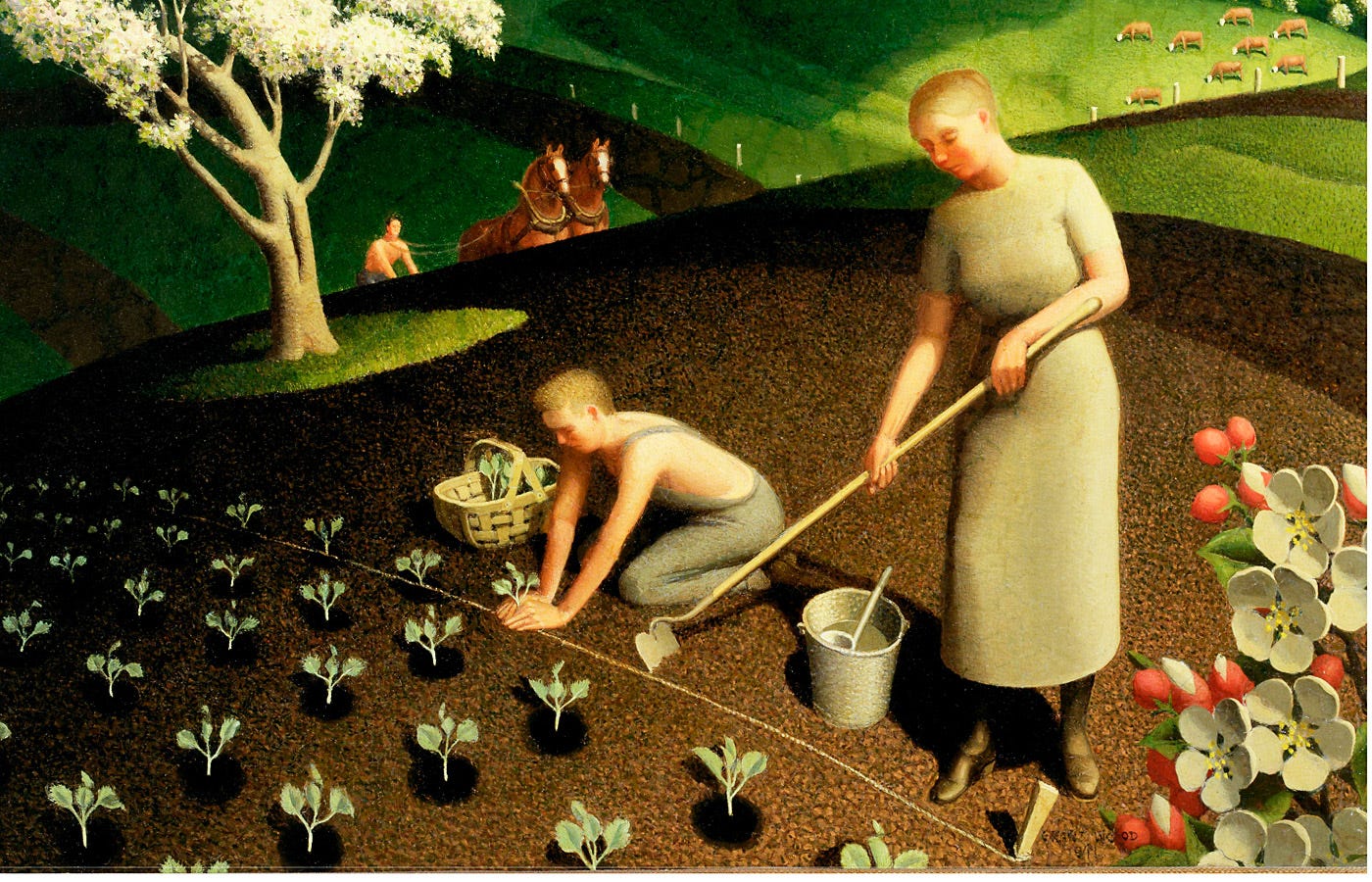
Alexandra, meanwhile, thrives. When others in the prairie give up, she buys up their land and expands the farm, managing her two older brothers (who both marry, and have children) along the way. She has no real romantic interest, unless it is with the land itself. At the end of part one, she watches the stars: “She always loved to watch them, to think of their vastness and distance, and of their ordered march. It fortified her to reflect upon the great operations of nature, and when she thought of the law that lay behind them, she felt a sense of personal serenity. That night she had a new consciousness of the country, felt almost a new relation to it… Under the long shaggy ridges, she felt the future stirring.”
Well, the future stirs, to be sure. And when Carl returns to The Divide, he recognizes that while he was off painting picture-lanterns, Alexandra has produced a form of art in the soil itself: ““I’ve been away engraving other men’s pictures, and you’ve stayed at home and made your own.’ He pointed with his cigar toward the sleeping landscape.”
Carl’s return home creates conflict. Oscar and Lou become angry with Alexandra for entertaining Carl; they suggest that it is unseemly for a woman of her age to think of marriage. Underlying all this is, of course, the fact that they had always assumed that Alexandra wouldn’t marry, and so their children would be able to inherit her land – the original homestead – when she died. In one of the uglier scenes in the novel, the two brothers argue that Alexandra doesn’t really own the farm, since it was their labor that made it a success. But Alexandra stands her ground. All of this, I would suggest, is not so distant from the question of what happens to Telemachus’ inheritance if Penelope were to marry one of the suitors. Carl leaves again, for a time, unable to shake the sense that he is a “little man” compared to Alexandra.

Other things happen, and the plot becomes distinctly un-Odyssean. In the end, Carl returns to Nebraska to comfort Alexandra in a moment of tragedy, and by the end of the novel they plan to marry. Two passages in the book point to the form of artistic creation that Alexandra embodies. When Carl first returns, he and Alexandra remember what it was like when they first came to the prairie, and think about the taming of the landscape since. Carl comments, “‘Isn’t it queer: there are only two or three human stories, and they go on repeating themselves as fiercely as if they had never happened before; like the larks in this country, that have been singing the same five notes over for thousands of years.’” Much later in the novel after a deep and perhaps unavoidable tragedy, Alexandra recalls this conversation: “You remember what you once said about the graveyard, and the old story writing itself over? Only it is we who write it, with the best we have.”
So this is the point where I confess that I’m a sucker for Cather’s overblown New American Romanticism. Certain lines in her novels resonate with me, and that last is one of them: there are men, like Odysseus, who go off and have their adventures and tell stories about them. And then there are others, in our society frequently women, who stay home, build a life, make a hostile land prosperous, and produce something of meaning. The old narrative doesn’t just happen. It is they who write it, with the best they have.
And that, for me, has become Penelope. For most of the Odyssey we barely see her. When we do, she’s often being bewitched by Athena or crying herself to sleep. But there are hints and suggestions in the epic that while Odysseus was off “knee-deep in blood, hip-deep in goddesses” (Stallings), she was managing a tricky household in Ithaca, raising her son, holding off the suitors, taking care of her father-in-law, weaving by day, unweaving by night, stopping time to wait for Odysseus (as Cavarero argues), waiting for her moment to control the plot. And as Jack Winkler showed a long time ago, when her moment comes, she proves more clever than Odysseus himself, and more faithful. These days, when I read Penelope, I tend to read her through Alexandra Bergson. Cather writes early in the novel “You feel that, properly, Alexandra’s house is the big out-of-doors, and that it is in the soil that she expresses herself best.” That’s not quite Penelope; but Penelope makes Odysseus’ return possible, creates the conditions necessary for his heroic story. I want my students to see that that is also a form of narrative, another plot, too long ignored, and worth re-imagining.
Kirk Ormand is the Nathan Greenberg Professor of Classics at Oberlin College, where he has taught for the last 25 years. He has published on Homer, Hesiod, Hipponax, the Hippolytus, and Heliodorus.
Originally published in In Medias Res on Substack. Read it there or subscribe to get new articles by email.