
Do Myths Survive Longer than Religions?
Ilias Kolokouris·January 6, 2019
The Cyclops Story Survives in Greece’s Christmas and Epiphany Traditions — While Christianity in Europe Fades
-He’s so ugly.
-Really ugly! -Somebody push a button.
-There’s a Cyclops.
-Can’t be. He’s got two eyes.
-Then it must be a bi-Cyclops.
- There’s another one. - A whole Cyclopedia.
- The Beatles, Sea of Monsters, Yellow Submarine film, 1969
Do myths survive longer than religions? And if they do, how does religion affect the survival of the myth? During Telepaideia once upon a time, we focused on the story of the Cyclops Polyphemus, following an intriguing and inspiring intertextual approach among ancient Greek writers. As with much of Greek culture, the theme led us on a journey lasting millennia, whose end is not at all clear.
First we read the most famous version, from the Odyssey. In the ninth book of the epic the Cyclopses are the children of pre-civilized nature. They are enormous, strong, and rather naïve. Something between human and animal, on their wooded isle. They don’t know how to use ships. They have the freedom to not follow any law, they don’t show any respect to the Olympians, they don’t abide by family coherence, social solidarity, or even the divine hospitality of Zeus, philoxenia. Polyphemus simply does not care. He is cruel, wild and unjust. He is the pre-civilized man who lives in a cave and doesn’t give a damn. A caveman who only knows how to milk his sheep and talks to them. He builds the cyclopean walls and lives only within them, following his brutal instinct against society.
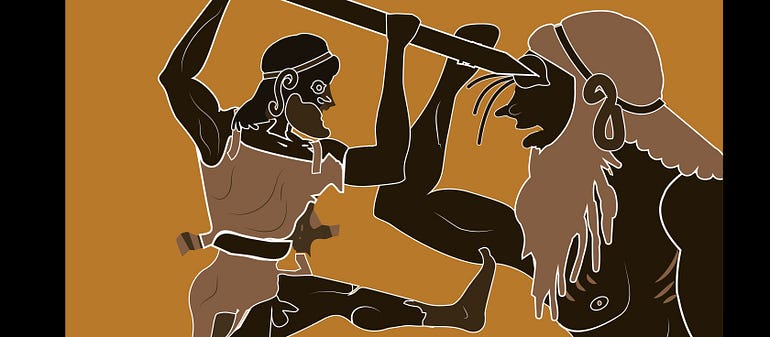
Against him and trying to overcome this world of Instinct comes the man of Reason, Odysseus. He is the civilized man, he wants to learn. Knowledge of the unknown island is what feeds him. He keeps going under the shield of the goddess of wisdom, Athena. First, he reacts emotionally: the monster brings terror to Odysseus and his comrades, with the deep voice of the primary self. They plaintively honor him, and ask for the gifts of the hospitality humbly. He does not recognize xenia and dashes the brains of Odysseus’ comrades and then eats them. Can Reason master Instinct? Can Odysseus overcome the Cyclops? Can human flesh survive the monster’s hunger? Of course he can handle Polyphemus. He gives him wine and gets the creature drunk. Polyphemus snorts and burps, and gets drowsy with wine. Meanwhile, Odysseus introduces himself “Noman is my name, Noman do they call me — my mother and my father, and all my comrades as well.” The Cyclops promises to honor the man of Reason by eating him last, and falls asleep. Odysseus grabs the club of an olive tree and thrusts it in his eye, the blood flooding around the heated thing. He and his comrades run away, while the Cyclops curses the man of Reason.
From an anthropological point of view, can we accept Odysseus’s thirst for knowledge as ethically good? The world of pre-civilized nature is generous, whereas the man of Reason can act brutally — for the sake of knowledge. Odysseus is telling the tale, and gives himself the glory; but Homer does not really take sides. The Cyclops is a monster that lives outside society and without any rule, but he is not bad. The cave belongs to the civilization of shame. The Cyclops feels dishonored by the way he was fooled, but the poet still does not judge him morally. He is not bad, he is just himself. We are not yet on the civilization of guilt, as E.R. Dodds describes it on his classic The Greeks and the Irrational.
Euripides’ satyr play Cyclops is tricky to understand today — but in general, it’s full of uncouth humor (some farting, and a rape joke; see Donna Zuckerberg’s article about it in Jezebel). Theocritus also writes about Polyphemus the Cyclops, giving him the same primitive character, but in a different situation, that of being shamelessly yet gently in love. Neither of the two versions that came after Homer contained any moral judgement towards the beast. In fact, in the Odyssey, the blinding of the Cyclops gets the man of Reason into trouble. Not morally, but as a result of the gods’ anger. Georg Danek, in Epos und Zitat considers the act of Odysseus as a “frevel,” a sacrilege, an unholy act of sin. But Odysseus acts following Athena’s will and even the other Cyclopses accept Polyphemus’s reaction as a mania sent by the gods.
Wilhelm Grimm of the Grimm Brothers in Die Sage Von Polyphem investigated the survival of the Polyphemus myth in later literature, such as the tales of Sinbad found in the Thousand and One Nights. There are multiple later versions. Is there a point on which we can say that the bipolar good and bad comes in? First, let’s look at a much later fable and then we can compare.
A medical doctor and observational traveler from Patras, Christos Koryllos (1842–1930), published multiple travelogues during his life. Written in a progressive katharevousa form of Greek (a Greek dialect between ancient and modern forms of the language), his books also preserve many tales he encountered in demotike (what we call in English Modern Greek). In his 1891 volume Apo Patron eis Kalamas (From Patras to Kalamata) Koryllos hikes through the mountains of the Peloponnese, complaining humorously about mosquitoes and the rural way of life. While hiking up the Arcadian hills, he meets a teacher who tells him a story, “The Devil’s Bridge,” which he had heard from an uneducated shepherd. I present it to you here.
The Devil’s Bridge
This bridge is called Diavologefyron, because, according to the fable, it was built by the Devils. And this is how:
During the celebrations for the birth of Christ, which, as we all know, people call the Dodekameron and which end on the day of Epiphany, the Devils that are called Kallikantzaroi or Katsiboucheroi have limitless power and enter all places, polluting cooking pots and all household jars, pissing in them and causing a mess. That is why the priest blesses the house before Epiphany and the Devils go away singing: “Run away, run, for the goat-priest is here, he gave us the blessing and it’s freezing.”
During these twelve days, it is forbidden for the mentally ill to enter mills. For these people are considered daemonic and during the twelve days the only demon who can grind is the Devil himself — not even the miller.
But a miller from Dirvi, Yannaros was his name, owned a mill close to a river. Before the bridge even existed, he visited the mill during the Twelve Days Celebrations in order to grind. After pouring his grist in the mill, he skewered the pork meat he had brought along, and began turning it above the fire, in order to roast it. Not much later, the Devil showed up in the shape of a man, and proceeded to suffuse the meat on the skewer with a frog, which he had tied on a stick, stating that “I am mixing the fat with the weak, so that we will eat together!”
The miller, assuming the man was the Devil, began a friendly conversation, found out his name and fraternized with him. When the Devil asked the miller for his name, he introduced himself with the weird name “Kaika atos mou” which means “I burned myself.”
“What did you say?” asked the Devil.
“Kaikatosmu,” the miller replied. “Iburnedmyself.”
Once the grist had been ground, the miller handed the spit with the meat to the Devil, so that he would turnit. After bagging up the flour, he took the spit from the Devil’s hands in order to check, ostensibly, whether the meat was done. With the spit he poked and thrashed the Devil harshly on the eyes.
After that, riding his horse with his two ground sacks the miller left. Upon the hearing of the Devil’s screams, his demon-colleagues approached him and asked him: “Who hurt you?”
And he replied, “Kaikatosmu!” “Iburnedmyself!”
“Well then,” they told him, “if you burned yourself, serves you right!” and they left blaming him for his carelessness. But later, when he was still screaming, they understood that someone else had wounded him and came out looking for the miller. They caught up with the miller’s horse, saw the two sacks of flour, but couldn’t find the miller. When the Devil himself came over, he felt everything with his hands, and said, “Here is the horse, and here are the sacks. And here must be the bastard coming from the back!” But then the roosters began to crow; it was time for Devils to depart.
Emboldened by this success, when the Devil showed up again at his mill, the miller traced a cross on the Devil’s forehead, which nailed him to his human shape. He gave the Devil to his wife as a servant and ordered him to carry out superhuman tasks, such as the digging of an enormous drain that crossed craggy lands and helped irrigate the fields. The drain still survives partially. The Devil also built the Devil’s Bridge (Διαβολογέφυρον) with a little help from the other Devils. But to the miller’s misfortune, his wife, on Holy Saturday, after beautifying her household, let her servant take a bath, and the cross that had been traced on his forehead washed off, restoring the demon’s magical powers. The Devil resumed his diabolical form and immediately farted and intoned the curse, “Wherever my farts go, there go my deeds!” And at that moment, the drain collapsed and nothing but the Devil’s Bridge survives to this day.
The similarities between the late 19th century fable and the Odyssey are quite interesting, one could say. The Cyclops becomes the Devil. Therefore, from a ethically neutral beast, he becomes Evil itself. In the fable, it is the Devil that is the intruder. Instead of blindness, now we have the Cross burned and inscribed on the Devil’s forehead. Does the fable tell us that faith is blindness in a way? Or that to believe is to be blind? And does that farting come from Euripides’s harsh jokes? Let’s remember, Polyphemus in the satyr play thought of himself as stronger than Zeus, because his fart was stronger than the Holy Thunder. Pretty much as the farting of the Devil. Last, the curse of the Devil ruins the drain. Closely enough, Polyphemus prays to Poseidon that Odysseus never reaches his homeland, or even if he does, may his ship be ruined and his comrades lost.
The part that remains the same, though, is the word play, the Outis that Odysseus utters while introducing him self, that becomes Kaikatosmu in the late fable. Linguistically, the second name contains also a verb apart from the pronoun and the wordplay is even more obvious. The miller manifests the naivete of the Devil more apparently. But there is also the fact that he is the Devil. To be naive is conflated to some extent with evil.
As the current crisis of Greece has proved, continuity of a nation may not be entirely reliable: nations, after all, may just be “imagined communities,” as Benedict Anderson argues. Hellas could not avoid being also an imagined community. Imagined in the minds of the Philhellenes, imagined in the minds of Hellenes or Greeks themselves.
One thing that we cannot argue about, though, is the survival of myth. Against all ethics that religions graft onto it. Against all different forms of language. Against lack of education or even illiteracy. The shepherd that narrated the tale of “The Devil’s Bridge” most probably could not read. Despite all that, he still knew the story from the Odyssey, probably without being aware that it was from the Odyssey. Now we can understand how Heinrich Schliemann was overwhelmed while in the island of Ithaca in 1868, shamelessly fantasizing, “I sent my guide with the horse and I walked down the old road, the road that crosses the fields of the father of Odysseus. I reached the fields of Laertes and sat down to take a rest and read Ω [the last book, book 24] from the Odyssey.”
But how does the myth survive today in Greece? Well, Epiphany is here, the end of the Dodecameron. I would not say these demons are currently a part of modern Greek culture. But up until the 90s they used to be. Their presence showed the demonic nature of man, “demonic” like the daimonion of Socrates in the Apology. That little divine something inside. That little divine something which is able to do both the bad and the good. It is a matter of choice.
Later culture made a simplification and connected that little demon only with evil. We cannot judge whether this connection worked out in the end, because killing every demon, both the good and the bad left us with what?
Anyhow, up until the 90s, as a kid, I remember celebrating before Christmas these little demons that lost their battle against Saint Vasileios. They were believed to live underground and to try every year to saw down the world tree, so that the Earth will collapse. But every time they can’t finish the job. Christmas comes and some Saint will stop them from their misdoings and the trouble they bring to the mortals. Of course they look like what we call the Devil today. But not only.
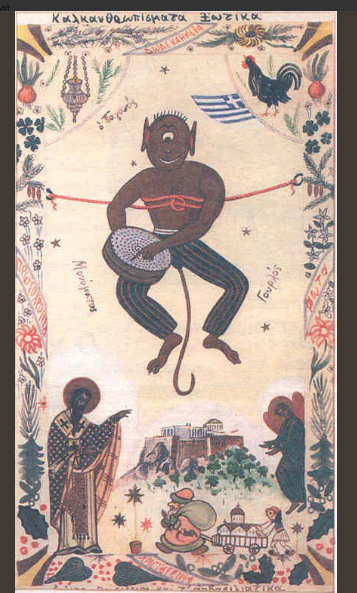
Their name was Kallikantzaroi. Their looks ? Hairy, with burning eyes, or one eye, goats’ or donkeys’ ears and legs, tongues hanging out and huge heads. Scary little monsters. Their habits? Tricks and farts and annoying the good Christians. The little devils that eat frogs and worms. The funniest one was named Monomatos Gourlos, which you can see in the picture, right in front of Saint Vasileios and Santa Claus, and the Acropolis. Monomatos, the single eyed, like the Cyclops Polyphemus, was of a primitive nature and stole the sieve, blocking the cooks from preparing the flour for the holy breads of Christmas. He made noise knocking the sieve and made the city of Athens crazy. But Saint Vasileios (a Classicist himself), stopped the Monomatos Kallikatzaros and blessed the flour and the city of Athens.
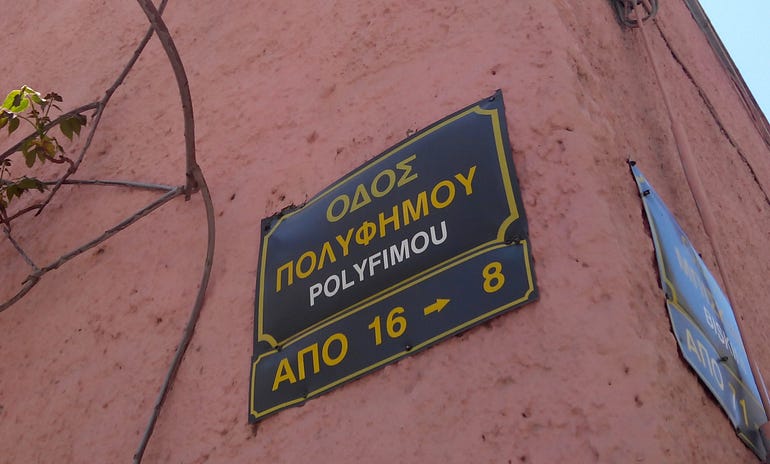
The crossroads fables go on and on and on. Cycling and recycling. It is about the Cyclops after all. The myth will continue, change, develop, the road will still whirl and wind, down the Odos Polyphemou crossroad.
Ilias Kolokouris is a Ph.D. student in Classics at the University of Athens and New College, Oxford. He teaches in Paideia’s Living Greek in Greece Program.