

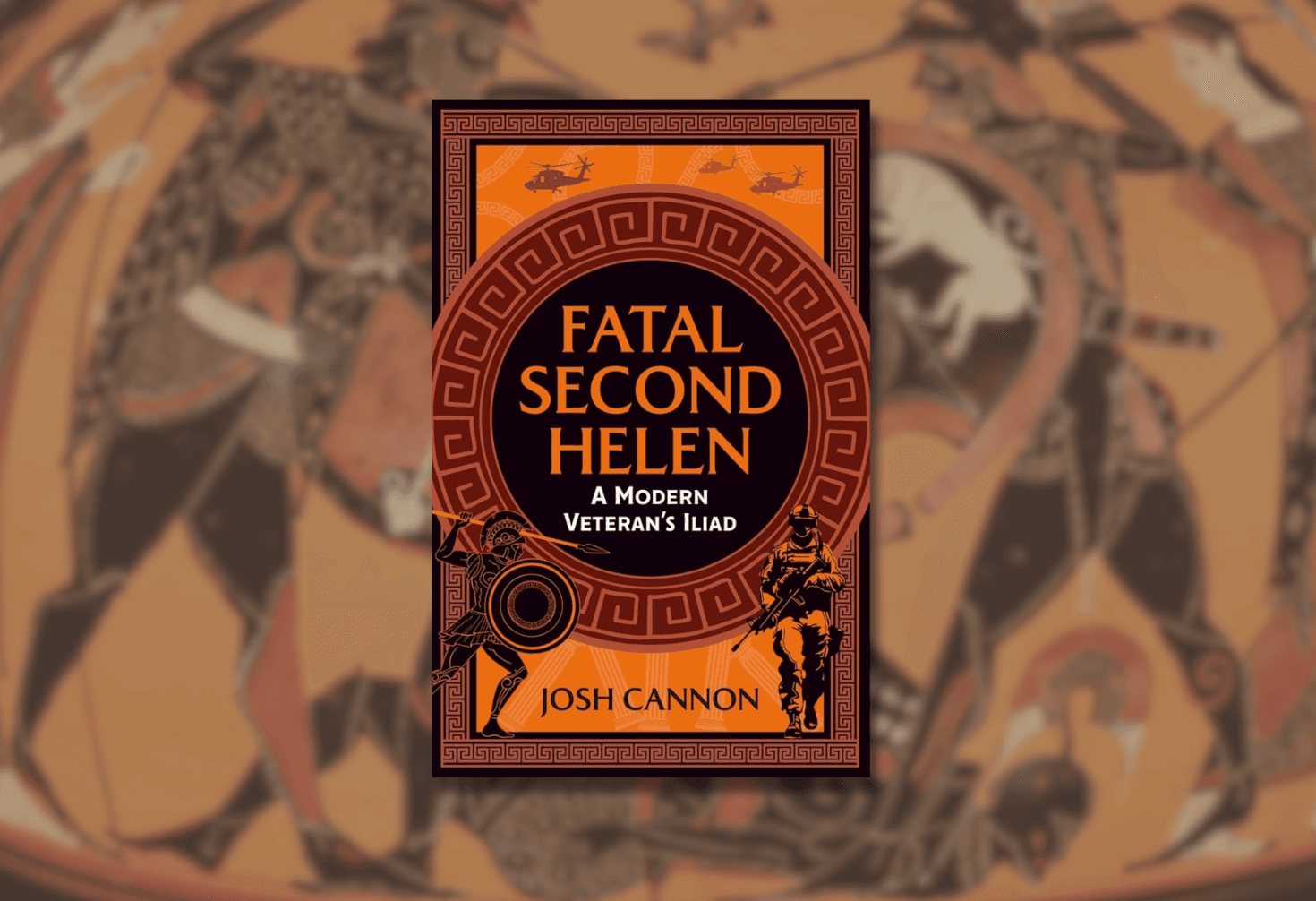
Fatal Second Helen: A Modern Veteran’s Iliad
Joshua Cannon·July 21, 2026
Excerpts from an Iraq War veteran's retelling of Homer.
Join the Paideia Institute on Saturday, July 25th at 12:00pm ET for a free online lecture with Joshua Cannon, on his new book Fatal Second Helen: A Modern Veteran’s Iliad.
What does the Iliad get right and wrong about actual combat? How do today’s combat veterans feel about the Iliad’s representation of war? Dr. Josh Cannon enlisted in the Marine Corps in 2000 and, as a corporal, was part of the 2003 invasion of Iraq. As a sergeant, he went back to Iraq in 2004, leaving finally in 2005. He is now a faculty member in the Classics Department at the University of Pittsburgh where he teaches the Iliad, among other topics. This talk is about his perception of the Iliad as a combat veteran, Classics professor, and archaeologist.
RSVP here.
Book 10 of the Iliad is an odd one. Many scholars believe it was included after the first version of the Iliad was written down. I don’t have a strong opinion on this matter, but I certainly agree that Book 10 stands out; it takes place at night and involves espionage and murder. In a poem predominantly about heroes fighting gallantly on the field of battle during the day, this story about heroes sneaking around and murdering at night is out of place.
The book starts with Agamemnon, once again, unable to sleep. Deciding to consult Nestor about how to turn this war around, he dons his massive lion-skin pelt and walks out of his tent. Coincidentally, Menelaus is also awake, also nervous about the war. He dons a leopard-skin pelt and leaves his tent to find his brother. The two meet as Agamemnon is putting on his armor (over the lion pelt?). The other leaders are roused, Diomedes with a kick to the side from Nestor. Nestor then goes to check on the guards of the camp and is pleased to find them alert.
Guard duty is a painfully common aspect of military life. It is necessary, but it is a chore. The Marine Corps calls it “fire watch” or, when guarding the barracks, just “duty.” Marines also guard U.S. embassies worldwide. The other services have guard duty as well. Service members on guard duty primarily watch buildings, perimeters, and gates and entrances. It is a boring duty, though often one has a partner or two. This is not always true. I had barracks duty while studying Arabic at the Defense Language Institute, and that is a twenty-four-hour duty, no sleeping, and you’re on your own. There are usually superiors that you answer to, but if you’re the low-ranking guard, they only check on you. I was once Corporal of the Guard for II Marine Expeditionary Force (MEF) headquarters at Camp Lejeune, North Carolina. This meant I was the on-the-ground Marine in charge of the four guards for that building.
Generally, people in uniform are not stopped at the entrances, but people out of uniform had to show ID. One night, a man came through the main entrance and jogged through the foyer. As he was in civilian attire, I ran over to stop him and check his ID. He was surprised to see me coming, but he said nothing and calmly gave me his military ID. I looked immediately to the rank and saw that it showed “O9” — this man was Lt. Gen. Henry P. Osman, commander of II MEF and the highest-ranking person on Camp Lejeune. I remember how my breath caught when I saw that “O9.” The “O” is for “officer” and the “9” is for ninth rank (out of ten). I calmly handed the ID card back to him, said, “Carry on, sir,” then nearly ran back to my guard office. He carried on without giving me a second look. Guard duty, especially stateside, is generally painfully boring. But this night gave me something to think about. It was as if I had carded Agamemnon as he was trying to re-enter the Greek camp.
After checking on his own guards, Nestor suggests to the other Greek leaders that they send spies to the Trojan camp. Diomedes, of course, is the first to volunteer. He selects Odysseus as a companion. They pray to Athena, then sneak into the night.
A similar conversation occurs in the Trojan camp. Hector calls for a spy to go to the Greek camp, and a man named Dolon volunteers. He sets out but is almost immediately spotted and captured by Diomedes and Odysseus. Dolon begs for his life, and Odysseus tells him not to worry about death. Dolon then reveals that the Trojan camp is not guarded and tells them of all the Trojan allies who are in the camp. Diomedes cuts off his head, and Odysseus takes his weapons.
Diomedes and Odysseus creep into the camp of the Thracians, Trojan allies about whom Dolon had spoken. They spot the king of the Thracians, Rhesus, and his famous horses. Diomedes kills twelve sleeping Thracians, then kills Rhesus as well. Diomedes and Odysseus flee back to the Greek ships with Rhesus’ horses, under Athena’s protection.

While this was ostensibly a spying mission, the real success was the murder of Trojan allies in their sleep. Diomedes and Odysseus gather intel on the Trojan allies, but this is of no great value. The Greeks will learn of this as soon as they return to battle, and it does nothing to help with the real problem, which is Hector. The reality is that this story is part of a tradition of raiding stories where the heroes make off with livestock, as Diomedes and Odysseus do with Rhesus’ horses. If you’re familiar with Irish mythology, you may know of another raid in this tradition: the story of Cú Chulainn, who famously stops the army of Connacht from stealing the mighty bull of Ulster in the epic Táin Bó Cúailnge. Cú Chulainn is often called the Irish Achilles, as he is, by far, the greatest fighter on the field. Like the heroes of the Iliad, he engages in many one-on-one battles and wins them all. Also, like Achilles, he has a dear companion in Ferdiad, though they eventually become enemies and Cú Chulainn kills him in single combat.
Greek mythology has many examples of livestock raids, like when Hermes steals Apollo’s cattle, Odysseus raids the cattle of Helios, and Heracles, for his tenth labor, has to retrieve the cattle of Geryon that had been raided. In the Iliad, stealing horses was so important that heroes would stop fighting to make sure the captured horses were safely taken back to the camp. Livestock was a significant form of wealth and, since it could be herded away from its owner, a form of movable wealth always under threat. Guards were important for preventing trouble. It is not a coincidence that guarding and raiding are both a part of Book 10.
The other theme of this book, espionage, allows the raiding of Rhesus’ horses to make more sense in the story, but is somewhat shoehorned in. Book 10 does nothing to advance the plot of the Iliad, and it depicts Diomedes and Odysseus in a fairly ignoble light. Diomedes kills warriors in their sleep, and Odysseus promises a captured spy his life just before Diomedes cuts his head off. Spies certainly existed in ancient times, but espionage was not valorized in the same way as cutting down enemies face to face in the daylight.
Today, intelligence gathering is a major part of warfare. Entire units are dedicated to this work, such as the 2nd Radio Battalion, which I was part of from 2002 to 2005. Our mission was to intercept enemy wireless transmissions, decrypt them when necessary, translate them, then report the intelligence gathered. This was most of what I did during my two deployments to Iraq. At times I engaged in another form of intelligence gathering, such as when I was asked to accompany a commanding officer meeting with local authorities. I would stand in the background, appearing to be part of the CO’s team, but, in reality, I was listening in on the conversations the local leaders were having with one another in Arabic. The idea was that they might let something slip if they were not aware that one of the Marines in the room spoke Arabic. I never caught such a slip.
Josh Cannon, PhD, is the Director of Research for Pitt’s Frederick Honors College and is faculty in the Classics Department. His new book ‘Fatal Second Helen: A Modern Veteran’s Iliad’ shares his perspective on the Iliad as a USMC Iraq War veteran.
Originally published in In Medias Res on Substack. Read it there or subscribe to get new articles by email.