

Ferguson As Greek Tragedy
Marco Romani Mistretta·September 22, 2018
“Antigone in Ferguson” Comes to the Harlem Stage
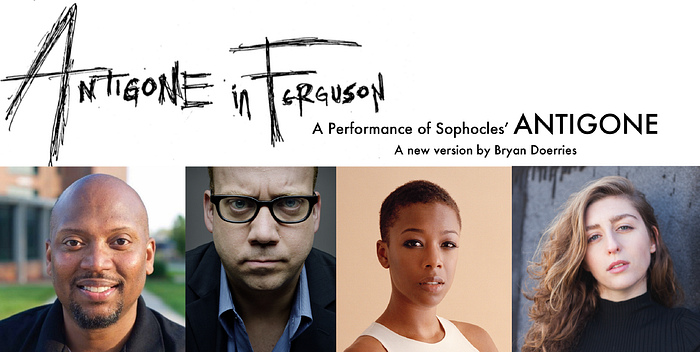
Sophocles first came to Ferguson, MO in 2016, two years after the fatal shooting of Michael Brown, which ignited one of the most controversial series of protests in contemporary America.
This fall, Bryan Doerries and Phil Woodmore’s Antigone in Ferguson comes to Harlem for a five-week marathon of free performances sponsored by the Stavros Niarchos Foundation. Once more, Classical Athenian tragedy is summoned to help us grapple with modern America’s open wounds.
Trying to reflect on the death of Michael Brown through the prism of Greek drama may appear an impossible task. Paradoxically enough, Antigone in Ferguson accomplishes this by sticking close — nay, almost philologically close — to the ancient text. In New York City, as in Thebes, Antigone is a teenage girl whose wrenching family conflict quickly grows into a battle of civic and political relevance.
In the iconic industrial-archaeological space of Harlem Stage, which Ella Fitzgerald inaugurated in 1979, a handful of actors give a memorable dramatic reading of Doerries’s American-English translation while a chorus of “citizens of Thebes” (the Bethel Gospel Assembly) stands behind them and comments on the tense, rapidly evolving situation. The audience is mesmerized as the choir’s powerful Gospel voices soar high to invoke the purification and deliverance of the city from the brutal violence that keeps piling “death upon death” around king Creon.
The soloists’ singing is generally uneven, but this reviewer is positively struck by the mellow, full-bodied low register of the mezzo-soprano (De-Rance Blaylock) and the bright, clear timbre of the tenor (Detective John Leggette). Particularly interesting in terms of the contemporary context is the fact that community activists and St. Louis police officers are directly involved in the performance alongside a stellar cast of professional actors.
This week, Creon is masterfully portrayed by Frankie Faison, whom many readers will remember from the 1988 hit movie Coming to America, while a very energetic Ato Blankson-Wood (alias Hakeem in Spike Lee’s new film, BlacKkKlansman) is on triple duty as a Guard, a Messenger, and Creon’s son Haemon.
“The price of good fortune is calamity,” as the chorus repeatedly warns — a violent destiny inexorably destroys families, communities, and civil societies. Hence, the citizens of Thebes remain shocked and astounded as king Creon puts to death the guilty and the innocent alike. “Everyone screws up, especially kings,” is the biting remark of the blind prophet Tiresias.
Yet this is not the end of the story: the chorus mourns for Oedipus’ daughter Antigone not as a hapless victim, but as a tragic hero whose fate sparks a melodious hymn to Love. The number, staged as a moving, quasi-operatic duet, leads the performance to an exuberant finale dominated by the solo saxophone (Sergeant Ja’Mes Davis).
The show, which lasts about forty-five minutes, is followed by a panel and audience-based discussion facilitated by the director and the soprano / social worker De-Andrea Blaylock. The moderators recall how the Ferguson rendition of Sophocles’ play is largely indebted to Martin Luther King’s 1968 speech “The Drum Major Instinct,” and invite panelists drawn from the local community to share their direct experiences of such pressing issues as racism, social inequality, and abuse of force.
Numerous members of the audience respond both vocally and physically. Beyond their astonishment and bitterness, beyond even some graphic narratives of personal and collective dramas, what becomes tangible in the room is the unchanged power of Greek tragedy to catalyze emotional purification from violence in all its forms.
Antigone in Ferguson runs on the Harlem Stage in New York City from September 13th to October 13th.
Marco Romani is Outreach Manager for the Paideia Institute. He lives in Manhattan.