

Pius Odysseus
Joy Connolly·August 21, 2026
Who can complain about a summer blockbuster that brings Homer to theaters drowning in infantile schlock? If Christopher Nolan convinces people that time with the Odyssey is time well spent, I’m glad and grateful. Good books need all the help they can get. Like the Classics Illustrated series of my parents’ childhood (its Odyssey appeared in 1951), cinematic adaptations of ancient literature help recruit new readers to great works. I’m grateful to him for that.
Nolan made Sinon, a character from Vergil’s Aeneid, a key player in the action around the Trojan horse. That’s the clue that his movie is a Vergilian take on Homer, full of loss, grief, uncertainty, and regret. He models his Odysseus on Vergil’s pius Aeneas, a man of few words, self-controlled and loyal.
This choice shows thoughtfulness on Nolan’s part, and as someone who loves the Aeneid, I appreciate it. But it means utterly abandoning the Homeric Odysseus and his distinctive intelligence — something Vergil did not do. Homer’s Odysseus can spin a great story, devise (and see through) tricks, fight bravely on the battlefield, keep his men together, and get his wife and kingdom back – and do anything, including sacrificing the men and sneaking into the royal home and killing scores of people when he reaches home, to achieve the last item. Call it craftiness or resolute cunning, this is the core of Odysseus’ heroic character.
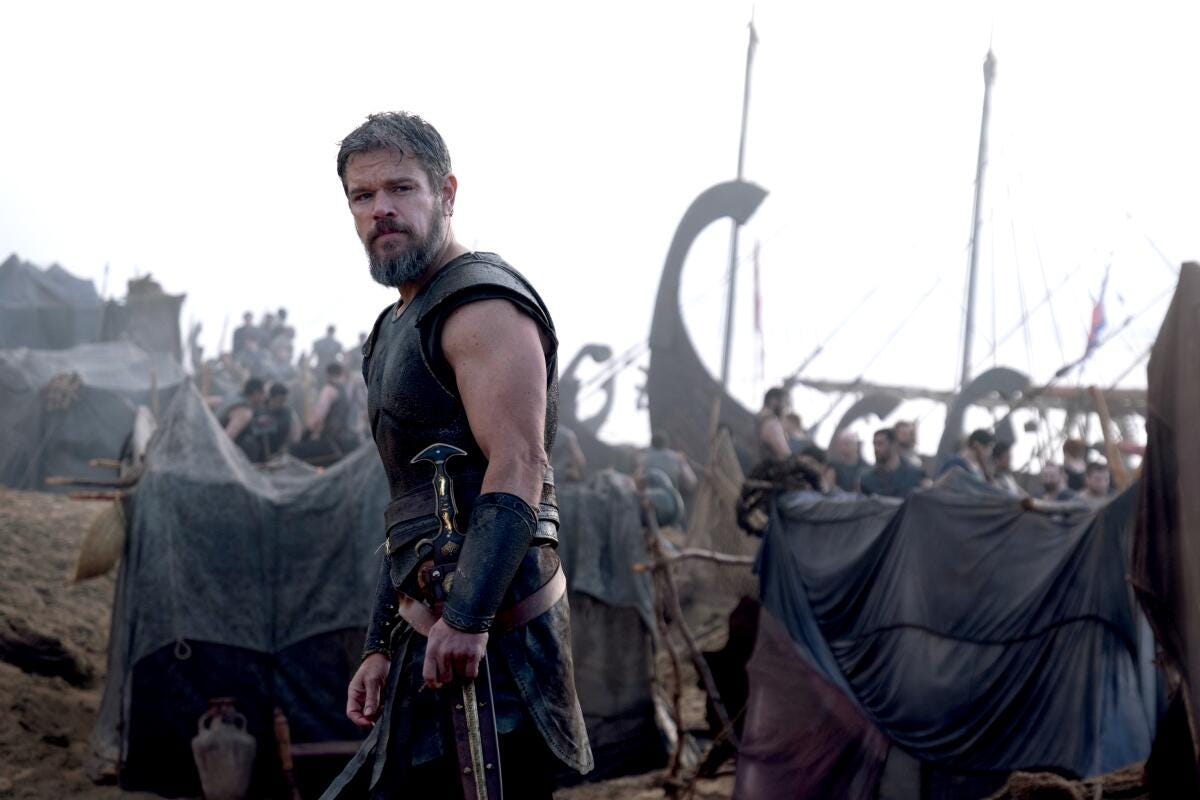
Matt Damon is not crafty. His actorly persona is smart, even canny. But as far back as thirty years ago, in Good Will Hunting, Damon was best at playing straight man roles whose relationship to intelligence was (with apologies to Emily Wilson) complicated. Will Hunting could use his mind as a weapon at need, to defend a friend or show off to a woman, but its sharpness was a source of shame. Damon’s Tom Ripley doesn’t plot with the warped gusto that Alain Delon brought to the role in Purple Noon. In later roles like Jason Bourne and the stranded engineer of The Martian, he projects cleverness of the quick-on-the-feet sitrep type.
As Damon has aged, integrity and reliability have engraved themselves on his visage and bearing. You can’t imagine him spinning a story. Nor is he asked to do so in this movie, for Nolan has given him very little to say. Which came first, one wonders: did the script encourage Nolan to cast the staunch and mostly silent Damon, or did Damon’s persona force Nolan to pare down the script?

Odysseus’ ability to speak in several registers (sometimes more than one at the same time) is his main survival tactic in Homer’s epic. The movie has erased every hint of this. No shout to the Cyclops that his name is “Nobody,” no long and possibly deceitful tale to the Phaeacians, no reference to his diplomatic efforts to make peace between Achilles and Agamemnon. He doesn’t even moan to go home, as he does for years on the isle of Calypso, since Nolan has made him amnesiac, forgetful of the wife and kingdom he has been seeking.
To be fair, there’s little memorable dialogue in the film for anyone. The only exception is Circe’s lacerating monologue, which begins as a spell she mutters while roughly molding Odysseus’ stew-slurping shipmates into pigs and evolves into an enraged defense of her magicking. This is speech that matters, but it’s squeezed into a single short episode. Odysseus’ longest speech in the film, which he makes to Penelope, is the opposite of crafty: it’s a heart-rending honest revelation of his self-hating recriminations for being crafty!
Clearly this is intentional. The general pressure to simplify anything that might resemble a meaningful script is likely the same that gave us the Marvel Cinematic Universe: the financial incentive to make a global blockbuster accessible to viewers who don’t speak English or who are too young to appreciate dialogue in any language.
But I mainly chalk it up to Nolan’s rejection of the idea that words matter – that to be a good human, one must command the arts of language. It’s a concept difficult to explore on film in this moment of emojis and five-second Instagram distractions. The art of persuasion has been kicked out of the house of democracy like the old dog Argos, compromise has been branded as girly and weak, elected politicians babble nonsense or talk like robots programmed by polling machines. And Nolan’s Odysseus, who has lost the artful tongue that sparks the imagination and makes us grapple with the grayest areas of human interaction, has no hope for us or even for himself, except to sail away into the sunset.
While I watched the movie, particularly during the pointless visit to the island of the armored Laestrygonians, I couldn’t help indulging myself in fantasizing alternative casting that would have added another dimension to Odysseus, even if everything else in Nolan’s vision remained the same. As Stringer Bell, Idris Elba spun dreams, persuaded and bullied, and lived more than one life at once. Humphrey Bogart as the hero repressing his longing for home in Casablanca could devise a plot to thwart the Nazis and also make you weep with his own flashback love story. I’ve already mentioned Alain Delon – a beautiful and beautifully convincing seducer, assassin, and leader of thieves. Javier Bardem, Tony Leung, or Robert Pattinson, who played the suitor Antinous here…perhaps none of these actors would make a perfect Odysseus, but they bring to the screen a winning way with words, craft, and a capacity for action that together are the essence of Odysseus.
One final thought about Nolan’s multi-ethnic casting, which has come in for a lot of criticism. Ironically, given the hysterical tone of the accusations of “wokeness,” it’s one of the most historically sensitive aspects of the film. Nolan accurately evokes the reality of ancient Eurasia, where trade routes and cultural exchange stretched thousands of miles over land and sea, from the Indus Valley to Mesopotamia and the eastern Mediterranean. I saw it as a visual indicator of the fantastical cobbled-together dialects of Homeric Greek, which no Greek would have spoken in everyday life. Anyway, whatever the original audience thought Odysseus looked like, it wasn’t Matt Damon — or Ralph Fiennes, Sean Bean, Armand Assante, Kirk Douglas, or any other movie star cast in the role.
Joy Connolly is the President of the American Council of Learned Societies.
Originally published in In Medias Res on Substack. Read it there or subscribe to get new articles by email.