

The Newest Ancient Greek
Michael McOsker·September 17, 2026
“The Spanish-American War looked nearly over, the Dreyfus case had taken another turn, the Prince of Wales’s knee had been treated with ‘the X rays’, Rugby and Marlborough had drawn at Lord’s. The Times of 29 July 1898 noted these facts; it noted also, under ‘Books of the Week’, the publication of The Oxyrhynchus Papyri, Part One. From this austere grey volume, the reviewer singled out ‘The Sayings of Jesus’, one leaf from a totally unknown Gospel; and a tattered poem in which Sappho prays for her brother’s safe return—a poem not seen by human eyes since the fall of Rome. These papyri had turned up a year earlier, at a Greek site in Egypt, not from houses or offices, but from the sand-covered rubbish-dumps which circled the city. Two young excavators from Oxford, B. P. Grenfell and A. S. Hunt, had found, mixed with debris in accumulations 30 feet deep, the entire life of a town encapsulated in its waste paper.”
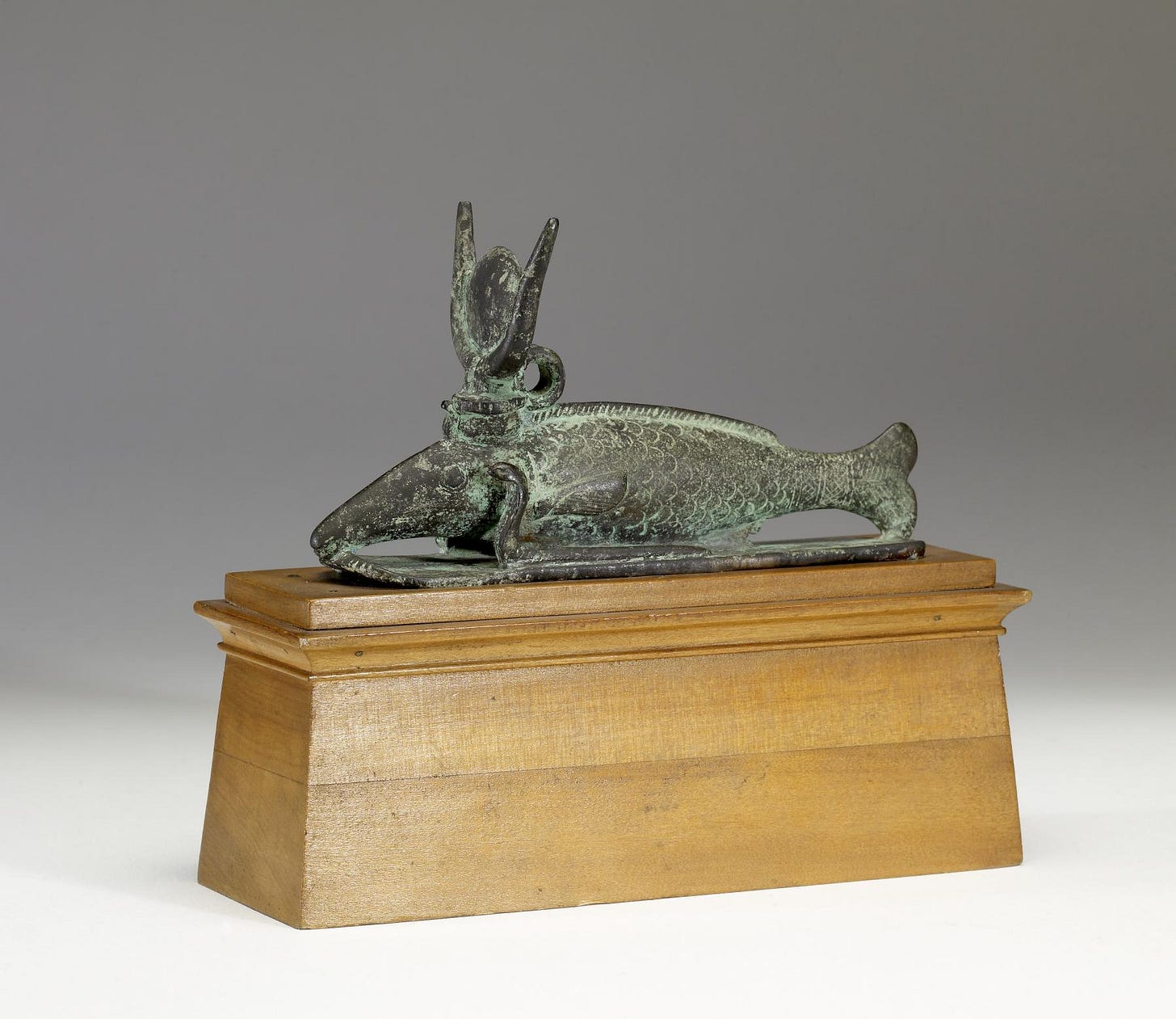
So Peter Parsons’ prologue to his wonderful book City of the Sharp-Nosed Fish. This book is a well-written and friendly guide to the city of Oxyrhynchus—Greek for the “sharp-nosed” fish that was known in Coptic as the medjed, a kind of elephantfish which has a downturned, pointed snout and which is also a bit electric. He presents snapshots of the inhabitants’ lives as seen from the papers they threw away: chapters cover the city administration, the first Christians in town, and some interesting and poignant moments in the friendships and love-lives of the Oxyrhynchites. Papyri with Egyptian and Greek texts—and the rare Latin one—had been known to Europeans for a while by the 1890s, but archaeologists had only recently begun to dig for them in an organized way. The desert dryness of the garbage dumps outside Oxyrhynchus (Al-Bahnasa today) preserved a huge number of papyrus scraps, which Grenfell and Hunt—by then, experienced trackers of papyri—found and excavated from 1896–1906. The material includes tragedy, comedy, satyr play, history, letters, tax documents, lost Gospels, court records, philosophy, receipts, epic poetry, and shopping lists.
This post is the first of a series that will present these papyri as they are published—the “newest ancient Greek” that we can read—and explain their importance and interest.
Publication of the Oxyrhynchus Papyri series began in 1898, and the 2025 volume was the 88th; 5,681 papyri have been published over the last century and a quarter, an astounding number, given the labor it takes to edit them (and volume 89 is at the printer’s). Each had to be cleaned, flattened, and conserved. A scholar reads the text as best as possible and makes a transcript. Uncertainly read letters are noted with a dot printed below them, sometimes called “the papyrologist’s conscience.” Each text is translated and given a brief commentary explaining points of detail and difficulties; the dates of the manuscript and of its composition, its authorship and title, and other matters are discussed, so far as it is possible to do so, in an introduction.
Papyri tell us several different things. Most famously, some papyri contain bits—sometimes very extensive bits—of otherwise unknown but famous lost Classical literature: pages and pages of the lyric poets Sappho, Alcaeus, and Bacchylides; a nearly complete comedy by the dramatist Menander called Dyscolus, or The Grouch; and Aristotle’s history and description of the Athenian government, the Constitution of the Athenians. Extensive finds of new literature like this were always rare and at this point can only come from new excavations. (Recently published, fairly extensive bits of Euripides and an Orphic purification rite in hexameters come from digs.) Much more common are smaller finds: a few scraps or columns of an interesting but unidentifiable bit of a history, philosophical work, epic poem, or the like. Very frequent are fragments of “known” texts—those that were transmitted from antiquity in manuscripts. These papyri are important to textual critics, who can use them to help correct the texts. Ancient literature was copied by hand over the centuries, and scribes inevitably made errors. Older copies help remove these mistakes. They have other uses as well: the frequency of papyri of Homer, Menander, Demosthenes, and Euripides betrays their importance in the ancient educational curriculum. And all literary papyri can potentially carry traces of how they were used: quick, informal, or cursive handwriting suggests a personal copy made by the owner for private purposes; very large letters suggest a display copy—an ancient coffee-table book—and awkwardly formed, slowly written letters betray student work.
Non-literary texts are primarily of interest to historians. Individual tax receipts and sales contracts tell us very little, but hundreds of them covering a range of centuries help us reconstruct state policy and the history of the economy. Letters provide charming windows into ancient lives: we read parents writing to their children, new recruits in the Roman army writing home, business partners plotting their next move, estranged spouses arguing or trying to make up. These less formal writings bring the ordinary people of Greco-Roman Egypt back to life.
In this series, I’ll be highlighting points of interest in each volume of The Oxyrhynchus Papyri as it appears, as well as those in other publications. (For instance, I’d like to get into the Roman legal dispute found in the Judaean Desert that was recently published. And we can always go back and look at some of the greatest hits and overlooked B-sides of the Oxyrhynchus papyri another time.) I won’t mention every detail or even every piece, but I’ll try to give you a good idea of what’s new and interesting in the world of Ancient Greek.
By hallowed tradition—from the beginning of the series—a volume of The Oxyrhynchus Papyri begins with theological texts (both known and new), then moves on to new literary texts, then known literary texts, and finally documentary texts (letters, business documents, legal documents, etc.). In fact, P.Oxy. I 1 (a page of the Gospel of Thomas, though they did not know that then)—the first papyrus published—was also the first found, on the second day of excavations. Since the volumes are organized in this way, so too shall this series be. Next time, we’ll look at some quite recently published—almost the “newest”—papyri that contain theological texts, published in Volume 87 (nos. 5573–5631) and Volume 88, which is fresh off the press, and consider why these matter. Then we’ll turn to literary and documentary texts in future installments.
Michael McOsker is a papyrologist of both Herculaneum and Egyptian papyri and a researcher in the Department of Greek and Latin at University College London in the “Hexameters Beyond the Canon” project.
Originally published in In Medias Res on Substack. Read it there or subscribe to get new articles by email.