

The Odyssey Naked
Mark Buchan·August 6, 2026
When I first encountered Mike Leigh’s film Naked, which reimagines The Odyssey as the wanderings of a brilliant, terrifying, working-class, near-tramp Northerner called Johnny, traveling aimlessly alone through central London at night, I was already developing my own, self-consciously iconoclastic view of Homer’s poem. Inspired by the work of the critic Edward Said on literature and imperialism, I wanted to read The Odyssey ‘from the perspective of its victims’ – the Cyclops, The Phaeacians, the conventional ‘bad guys’ the suitors. What happens if we view them, not through the narrow, moralizing eyes of Odysseus (and the vast majority of Homer critics), but on their own terms? In the case of the suitors, is there not the beginnings of a proto-egalitarian society on Ithaca, facilitated by the absence of the king? The suitors use the artificial, prolonged interregnum caused by Odysseus’ absence to create a community of equals, with any competition to find the winner of Penelope’s hand in marriage, a marriage which would restore hierarchy and threaten that equality, perennially postponed. For those who seek the origins of later Greek democratic norms in Homer, why not start here? This community allows Penelope herself to live a much more public life, appearing before the suitors quite regularly, it seems, while the maidservants’ sex with the suitors, seen as heinous assaults on his own property by Odysseus, could just as easily be the beginnings of a more egalitarian sexual world, where shared pleasure flattens out class difference. Of course Telemachus hates all this. But what uber-rich, entitled, incel of a nepo-baby is ever happy with his future wealth being tampered with? Did I mention that my defense of the poem’s bad guys goes hand in hand with a some criticism of the conventional good guys?
Enter Mike Leigh. His Ithaca is a rented house in Dalston, where Johnny’s Penelope, his ex-girlfriend Louise, lives together with a fellow-nurse Sophie, who stands in for Odysseus’ maidservants. The suitors? They take the form of a viciously hedonistic, entitled, iron-pumping aristocrat and banker, Sebastian, who treats the world as nothing more than the source of his own pleasures, and takes great joy in calculating ways of maximizing them. His is the utilitarianism of a master, his pleasures pursued as if the world is duty-bound to fall in step. Instead of a community of sharing, we have Sebastian’s monomaniacal narcissism, instead of sexual freedom, we have an aristocratic posing as a landlord, treating another’s home as his own, the women there as his property, constantly available for rape. But what was most disquieting, for me, was the way this vision of life on Ithaca without Odysseus rang entirely true. I don’t think Leigh’s Ithaca destroys my own, quasi-utopian vision of the suitors’ world. But it at least forced me to think through how complex and open The Odyssey’s text is, that it somehow has space for both visions, and how easily a world of endless pleasure can turn imperceptibly into something shudderingly awful. Once you’ve met Sebastian, the suitors will never be the same.
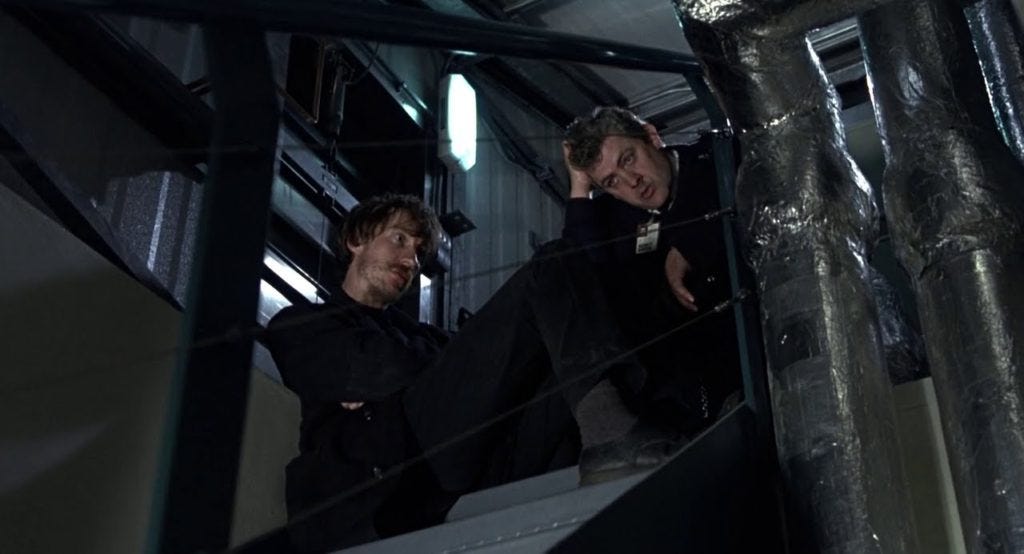
The film offers other jaw-droppingly inventive takes on Homer. Leigh’s Cyclops is an all-night security guard, supervising an office building emptied of people. He meets Johnny/Odysseus as he takes shelter outside the building’s doorway, and their encounter kicks off with dialogue that encapsulates the key moral problem of The Odyssey itself.
Guard: ‘No place to go then?’
Johnny: ’I’ve got an infinite amount of places to go; the problem is where you stay.’
How many of The Odyssey’s key problems does this little exchange touch upon? Why Odysseus leaves Calypso, why he leaves Penelope at the poem’s end to go on another journey, why he seems addicted to wandering and curiosity at the expense of a prompt return home. It’s a commentary on the Cyclops himself, the quintessentially incurious non-traveler, happy at home on his island where the crops grow themselves by themselves, gloriously self-sufficient, better even than the gods – until Odysseus’ arrival changes everything.

Johnny ‘blinds’ – well, nearly blinds, as he can’t quite go through with it - this security-guard-Cyclops by taking away what matters most to him. At night, we find the guard is obsessed with a woman in a window opposite, who offers up exhibitionist erotic dances for his gaze. Johnny simply walks across the road, knocks on her door, and starts seducing her. When he looks back at the security guard’s building, he is guardedly looking at him through a perfect circular, Cyclopean-eyed window - until he has to look away. Once you watch this, and return to Homer, Odysseus’ blinding of the Cyclops seems all the crueler, even eroticized: Odysseus offers the Cyclops a brutal lesson in the laws of desire. He doesn’t simply blind him; he takes away something from him, his eye, that he can never get back, leaving him as an eternally unrequited lover. Search as you might, he tells Polyphemus, you will never heal the wound of your lost eye.
But Leigh’s tour-de-force is Johnny himself, an Odysseus as charismatic as he is terrifying, as intellectually curious as he is violent, as likely to pull women under his spell as he is to abuse and abandon them. He cannot give up on the idea of home, nor can he commit to it. He is fundamentally dangerous, and makes himself vulnerable to the violence of others because of this: we half want to kill him, half to protect him. To turn to a pun made on his own name by Odysseus (Od.19.406ff.), he is the kind of man who incurs the hatred of others, even as he causes that hatred. On this dark and troubling version of Odysseus, Leigh and I are in perfect agreement.
Mark Buchan is the Editor of In Medias Res, Paideia’s online magazine for lovers of the Classics.
Originally published in In Medias Res on Substack. Read it there or subscribe to get new articles by email.