

The Return of the Smiting King
Understanding the Structure of the Odyssey
John Byron Kuhner·August 4, 2026
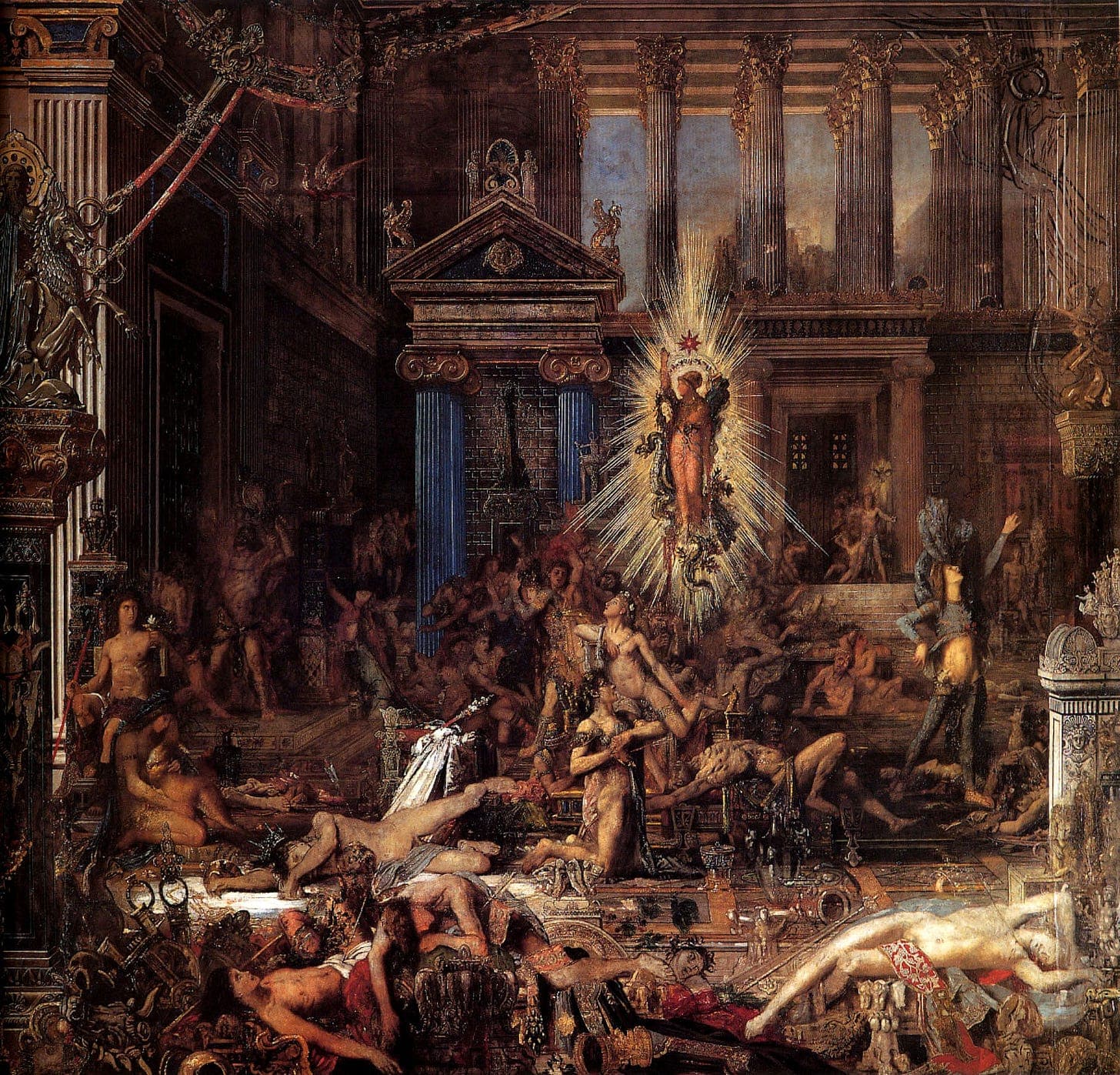
Why does the Odyssey end the way it does? It is extremely odd. Everyone knows that the poem involves the return of a man to his home, where he is reunited with his wife and son. Many know that the man, Odysseus, is King of Ithaca, and he must restore order in his kingdom. J.R.R. Tolkien used elements of the story for his Return of the King. But The Lord of the Rings does not close the way the Odyssey closes, with King Aragorn in a murderous rage, bent on killing not only the men who wooed his wife but their families as well, who have rebelled against the returned king. The intended butchery is the last thing Homer makes us see of Odysseus. He is only stopped from massacring his subjects by a lightning bolt from Zeus. The gods pass an act of oblivion for the death of the suitors, and impose a peace between the king and his people, and the poem is abruptly over.
If a divinely thwarted attempted massacre seems to jar as a finale – and after all, it appears that the ending is supposed to be happy, as Odysseus does reunite with his loving wife, and he seems to genuinely connect with his son and even revivify his aged old father – the beginning is no less strange. There are four books of the Odyssey where Odysseus doesn’t even figure at all – it’s instead about his son’s quest for news of him. That’s fine, you might say, writers do this sometimes – you build up suspense by talking about a character at length, before finally introducing him. Didn’t Dahl do this for Willy Wonka? Or Schiller for Wallenstein? You create a legend: then bring him onto the stage.
Yet Homer seems intent on doing precisely the opposite. Odysseus can’t even get up to “make” an entrance at all. Calypso has to go find him:
She found him by the shore, sitting there: nor did his tears
ever dry, since the sweetness of life was trickling away
As he grieved for his homecoming. For the nymph had ceased to please him.
Night after night he lay down in the hollow caves beside her,
Compelled by the goddess to do so, he unwilling, she all too willing,
While during the day he would sit on the rocks by the edge of the sea
Weeping and moaning and tearing his heart to shreds in despair,
The tears pouring down as he stared at the restless wastes of the sea. (5. 151-159, trans. Mendelsohn)
Isolated, sedentary, idle, weepy, joyless, trapped – he has a life so unheroic it might almost belong to the internet age.
Why does Homer start Odysseus’s journey here? Anyone else would have started with the sack of Troy – which interests people – or sailing away from the sack of Troy – also interesting. My professors told me, “Well, who wants to start at the beginning?” and “It’s more complicated to start in the middle and work both forward and backward – that’s reason enough.” Yet Odysseus, when telling the tale of his own wanderings, starts by sailing away from Troy – and this is probably the most compelling part of the entire poem, told chronologically from the end of the Trojan War. Most effective books move forward in time without any need for extended flashbacks. As for concluding with Odysseus attacking and attempting to massacre his own discontented subjects, there has been a robust tradition of questioning the ending. Ancient Alexandrian scholars suggested that the poem should end with Odysseus going to bed with Penelope, in book 23. Philologists could find no evidence of distinct authorship for book 24, however, and now tend to take the Odyssey as we have it. So is there any meaning to this structure? Or is it just narratological complexity for narratological complexity’s sake?
It took me years of questioning to find an answer. Rather by chance I was looking through an old mass-market paperback of the Odyssey – I made it a point to collect as many translations of this poem as I could – and started reading the introduction, by Howard Porter. This introduction to a mass-market paperback, not available online but alas still in copyright, remains the single most insightful bit of Homeric scholarship I have ever read. It provided an answer, to me satisfactory, to the question of why the Odyssey is built the way it is.
Porter thought that the beginning and ending of the Odyssey – which he admitted were unusual and baffled critics – contained the key to interpreting the entire poem.
The Odyssey begins as a study of absentia, a man defined by the hole he leaves behind. He is nobody, as he described himself to the Cyclops. He is a mere topic of conversation, a memory, a rumor, a story of the way things used to be. We never even see him. The gods in council report he is unhappy and should come home. Nestor believes it is possible that Odysseus might yet return, and “pay the suitors back in full,” so great a warrior is he. Menelaus says the suitors are like deer laying around in the den of an absent lion, who may well return any minute and massacre them all. There is a son, who looks and speaks like him, but he may lose the kingship if a new husband marries his mother the queen; and it is not clear that he can hold the kingship by himself, if challenged.
In book five we finally see Odysseus for the first time. He is sitting by the sea, crying. Apparently he does this every day. He has a goddess consort but has no joy of her: he longs for his wife. He lives on a pleasant tropical island but has no joy of it: he longs for his home. It is an unhappy Eden. It is isolated: Homer mentions that no one visits. It is called Ogygia, located at “the navel of the sea,” and the goddess is Calypso, “the Hider, the Coverer.” Odysseus is utterly unused, a treasure buried in a field, a lamp under a bushel. But his apocalypse, his “uncovering,” is about to begin. By decree of the gods he is given an axe and permission to depart. Alone he builds a raft and takes to the open ocean.
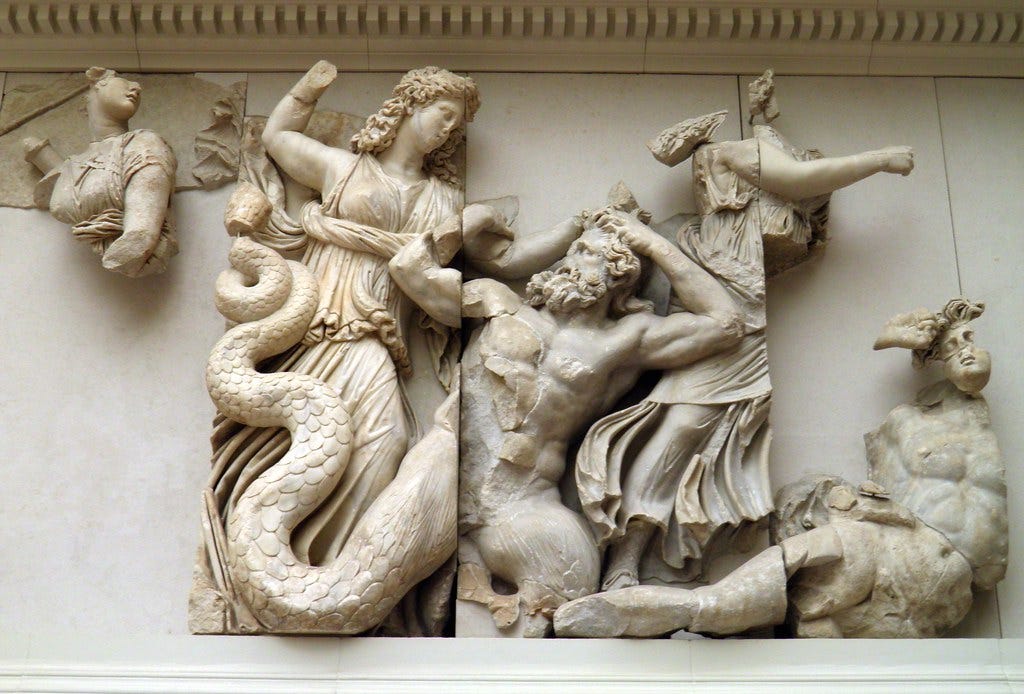
He has left Eden now. His raft is wrecked in a storm, and with great difficulty and some divine help Odysseus arrives with the surf naked in the land of Scheria, home of the Phaeacians.
He will remain here for seven books, almost a third of the whole tale. The Phaeacians live in a kind of technological paradise. Their fruit trees bear all year long. They have self-steering ships that would be the envy of a Silicon Valley billionaire. They are peaceful and kind, but they are utterly unheroic:
Though we hardly take first place in boxing or wrestling,
We run like the wind in the footrace and have no equals at sailing,
And we’re always happy to feast and enjoy the lyre and dancing
And a clean change of clothes, a warm bath, and getting into bed. (8.246-9)
They impress Odysseus with their dancing, but among their athletic contests they have discus-throwing, and in this they are no match for Odysseus, whose brute strength in throwing amazes them.
Here Odysseus has come to a world of light sport and talk, where his wit and cunning can win him renown. His conversation with Nausicaa wins her goodwill, and she provides him with clothing and advice, which gets him a seat at the feast in the palace of the Phaeacians. His courteous speech to the king and queen, and his entertaining tale of heroic exploits, win him a journey home and many gifts. But it is a land of recreation and talk, no more. When asked to regale the guests with a story, Odysseus tells the tale of his wanderings, whose recurrent theme is escapism and utopianism in various forms: the lotus-eaters with their drug-addled lives, the Cyclops with his “every man a law unto himself” primitivism, the Sirens with their alluring promises of knowledge, the underworld with its endlessly interesting lifelessness. Odysseus wants to tell the Phaeacians about the women he met in the house of Hades – probably a humorous dig at their lifestyle – but their king interrupts him, asking if he met any heroes. This too is a dig. The Phaeacians love heroes – or at least talk about heroes.
This is a world for Odysseus’s cunning. But it is not enough. And so even though he is once more offered a beautiful consort – Nausicaa – and a fine house – he makes it clear that he wishes to return home, and they bring him back to Ithaca.

On Ithaca we recapitulate the general motion of the poem so far. Odysseus does not recognize the place at first, and begins to cry; the goddess Athena consoles him and sets him on his way to his own pig-farm, run by his slave Eumaeus. There his cunning words ensure him some food and a place by the fire; he then begins building a coalition to help him recover his kingdom, beginning with his son. He comes to his own palace, where he is treated with contempt and mockery by the suitors. He defeats Irus, a beggar, in a boxing match arranged by the suitors. Odysseus knows how to kill his opponent, and he considers it, but he opts to restrain himself for the present. That comes soon enough. Through a combination of cunning, valor, skilled allies, and the assistance of Athena, he kills one hundred eight suitors in his palace, and then has twelve disloyal female servants hanged. He reveals himself to Penelope and the two sleep together in their bed.
He then goes to see his father at his olive orchard, and there we have the final battle: the families of the suitors come to avenge the death of their sons. Old Laertes kills the leader of the rebels with a single spear cast, and Odysseus lets out a great battle-cry, “‘swooping like an eagle’ down on his enemies”. This is where Zeus stops the contest with a thunderbolt.
The contrast with the first picture of Odysseus is studied and thorough: charging versus sitting; shouting versus weeping; with his father and son versus alone; in his ancestral olive orchard as opposed to on the beach of a nowhere desert island. The poet of the Odyssey could have begun his story almost anywhere; he chose to begin it at the point of maximum passivity, isolation, irrelevance, and inertia. He could have ended it in many places; he chose to end it at the point of maximum activity, connection, impact, and effectiveness. Once you see this pattern, you realize that the entire poem is organized along these lines, to show a character occupying a larger and larger space in the world, gaining increasing scope for increasingly dramatic impact on those around him. Because the voyages show him with great scope for action - though only as a warrior and leader, omitting Odysseus’s fullness as a father or son or husband or homeowner - they are adapted into the scheme by becoming mere stories, the kind of tales - lying or veracious - which win men renown. Odysseus becomes a poet, and poetry fits in with the kind of reduced, pleasant existence of Scheria.
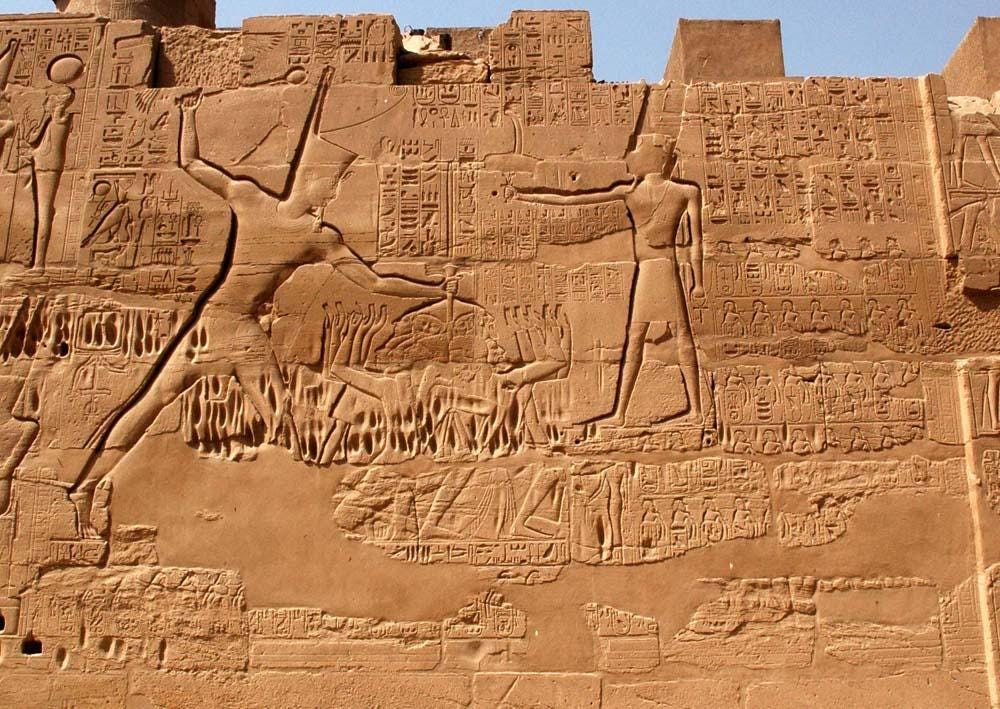
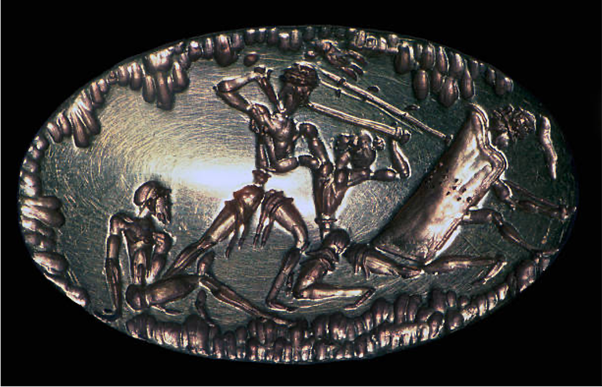
The culminating image of potency is the victorious warrior attacking his enemies. This image, which closes the Odyssey, has a long Mediterranean lineage. It is known as the Smiting Pose, and it is one of the standard ways to depict the Pharaohs of Egypt. It is found on the Narmer Palette in the 31st century B.C., and in the reliefs of Seti at the Great Temple of Karnak twenty centuries later, around the time of the Trojan War. The Smiting Pose is found on the walls of Nestor’s Palace at Pylos, and on Aegean signet rings from the Homeric Age. That this was a contemporary image of powerful kingship confirms Porter’s general thesis that the poet of the Odyssey considered the Smiting Pose the climax of his tale about Odysseus (though Porter himself does not connect this with the Smiting Pose in art – that is my contribution). This is almost the opposite of what people usually think the Odyssey shows. They think it shows a warrior returning from war to domestic and civilian life. In fact, the poem is structured to show an isolated, powerless nobody become a warrior and leader of men.
Homer’s greatest imitator structured his poem the same way: Vergil introduces Aeneas as a crying figure on a foundering ship, slack-limbed before a wave; he concludes the poem with Aeneas smiting Turnus, another ending so abrupt it has been accused of being unintentional and unfinished. I would contend that we are seeing a different – and to us unusual – way of structuring a poem, and presenting powerful kingship.
It is, however, almost the opposite of the way we would structure a narrative today. Our stories begin with struggle and difficulty and arrive at some timeless repose where struggle is eliminated: “And they lived happily ever after.” Homer suggests there is no such life for us. A full human being would not be happy there. Odysseus rejects immortality with a goddess, in purposeless eternal pleasure. He rejects marriage to a beautiful young princess, and a life of dances, assemblies, feasts, baths, clean clothes, and regular bedtimes. He chooses to come to a place - Ithaca - where as soon as he arrives, he has to worry about thieves and protecting his treasure. He comes to a place where there is insult and abuse and humiliation, where his own wife has to be won over, where his subjects rebel, where life is hard and everything is a struggle. This is what makes Homer the greatest realist of our literary tradition, the most pro-life writer of all. This is why the lush descriptions of food and sailing and building things belong in the narrative. This poem is one of the few great artistic celebrations of human life as it truly is. Odysseus gives up everything human beings think they want just to be back home again, no matter how difficult it will be.
Such a tightly controlled, purposeful narrative at this kind of scale naturally leads us to further conclusions about the nature of Homeric authorship: this kind of structure really belongs only to the world of books, where twenty-four scrolls’ worth of material – dozens of nights of recitals – can be forged into a single highly unified narrative, with an intelligible beginning and end and continual development between the two points. Homer’s treatment, appearing at the dawn of Greek literature, reads today as highly idiosyncratic; but it bears all the hallmarks of genius.
Originally published in In Medias Res on Substack. Read it there or subscribe to get new articles by email.