

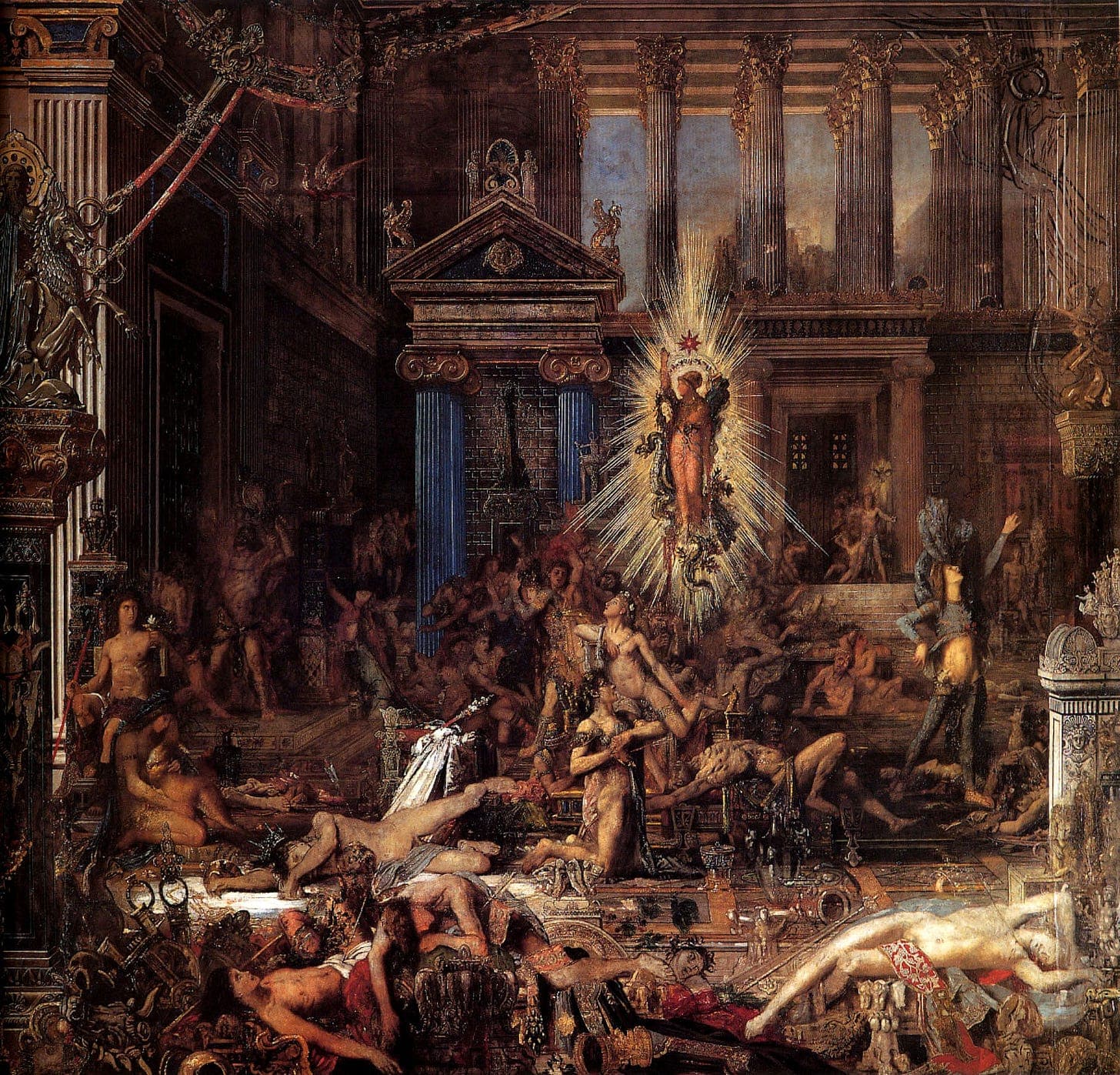
Tragedy in the Face of Apocalypse
Marco Romani Mistretta·December 13, 2018
Berkoff and Turnage’s “Greek” Rocked the BAM Stage
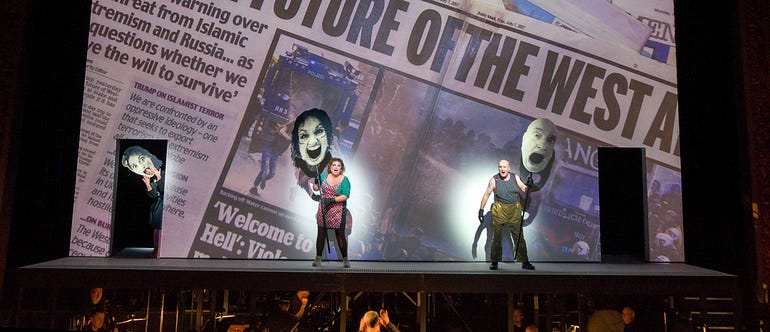
In a dystopian London vaguely reminiscent of Cuarón’s Children of Men, Oedipus is reborn as an awkward, cockney-accented Tufnell Park boy.
This month, after decades of astonishing success in the UK, Mark-Anthony Turnage’s operatic reworking of Steven Berkoff’s play Greek (premiered at the Half Moon Theatre in 1980) came to the Brooklyn Academy of Music for a limited engagement to shake up the atmosphere of the incipient holiday season.
And the piece is ideal for shaking things up. Cheeky, provocative, irreverent, at times simply outrageous — Greek makes Sophocles’s most celebrated tragedy (Oedipus the King) disturbingly present in our time and all too close to the audience’s sensory experience.
Building on numerous transparent references to the social effects of Thatcherism, the play combines bewilderment and brutal disgust into a bitter satire of the alienation of everyday life in the age of populism and cynical disillusionment.
Here, Apollo’s Delphic oracle becomes a gypsy fortune-teller whom the protagonist’s working-class father consults during a town fair, while the self-proclaimed “Greek chorus” is nothing other than a bombarding series of media headlines and newspaper articles, appearing on a large background screen by means of an old analog projector.
The plague which afflicts the city is not so much an epidemic disease as a chaotic outbreak of urban riots, strikes, and police violence: or rather, as Eddy/Oedipus’s foster parents put it, “the city sits in a heap of shit” (how’s that for an East End version of Oedipus Rex 179: ὧν πόλις ἀνάριθμος ὄλλυται). Laius, finally, is a cafe manager killed in a vulgar brawl by his unaware son.
Meanwhile, Turnage’s music, which some have likened to Kurt Weill’s Brechtian compositions, alternates haunting woodwind lines and col legno string passages with hammering percussion and coarse, heavy brass dissonances (not without some predictable Stravinskian resonances).
Clad in activewear and proud of his voice’s sharp timbre, baritone Alex Otterburn is a very convincing Eddy/Oedipus, while soprano Susan Bullock and baritone Andrew Shore deliver an impressive performance in the complementary roles.
Versatile mezzo Allison Cook, vigorously singing the Waitress/Jocasta’s ambitious aria “Your face is like all Greek / carved in ancient marble”, ushers in the well-known incestuous relationship, which the actors portray in explicitly physical ways.
As the fortune-teller had prophesied, Eddy/Oedipus gets “a bunk-up with his mum.” This parallel coexistence — which at times becomes an intermingling — of the sublime and the ridiculous, of lyrical and farcical (even scatological) language, is a leitmotif of the entire piece.
Berkoff, who played a detective in Stanley Kubrick’s 1971 dystopian classic A Clockwork Orange, never hesitates to elicit viscerally repulsive emotions while simultaneously appealing to intellectual sophistication.
Emblematic in this regard is Eddy/Oedipus’s dialogue with the Sphinx, a two-bodied, punk-looking dark lady who extols the virtues of an ultra-feminist society in which women exercise absolute domination over men.
Once so much tension has been accumulated on stage, the play’s irenic finale in the name of unbridled love is something of a disappointment. Overall, however, Berkoff and Turnage’s hyper-modern adaptation of the single best-known of all ancient Greek tragedies is a hit.
The libretto does not shy away from explicit re-use of Sophocles’s text, which often adds to the estrangement effect of the performance as a whole. Indeed, Berkoff self-consciously acknowledges the Sophoclean quotations through meta-theatrical irony: thus, “Fate makes us play the roles we’re cast” is the memorable dictum concluding act one.
It is tempting to compare, for instance, Wajdi Mouawad’s play Incendies (2003), which inspired Denis Villeneuve’s 2010 movie of the same title. Mouawad’s take on Greek drama is based on a diametrically opposite approach, creating a modern retelling of the Oedipus tale which privileges distant echoes and veiled references over open neo-Hellenism.
In Berkoff and Turnage’s “domesticated” version, by contrast, the cumbersome ghost of Sophocles looms over the scene like a constant, agitated warning. One wonders whether Greek is not an operatic monument to the discontents of modernity and to the anxiety of influence alike.
Greek, part of the 2018 BAM Next Wave Festival and co-presented by the Onassis Cultural Center New York, played at the Brooklyn Academy of Music from December 5th to 9th, 2018.
Marco Romani is Outreach Manager for the Paideia Institute. He lives in Manhattan.