


An erotic epiphany (but for whom?): Ovid, Amores 1.5.9-10
Stephen Hinds·March 12, 2026

A love poem rarely read the same way twice.
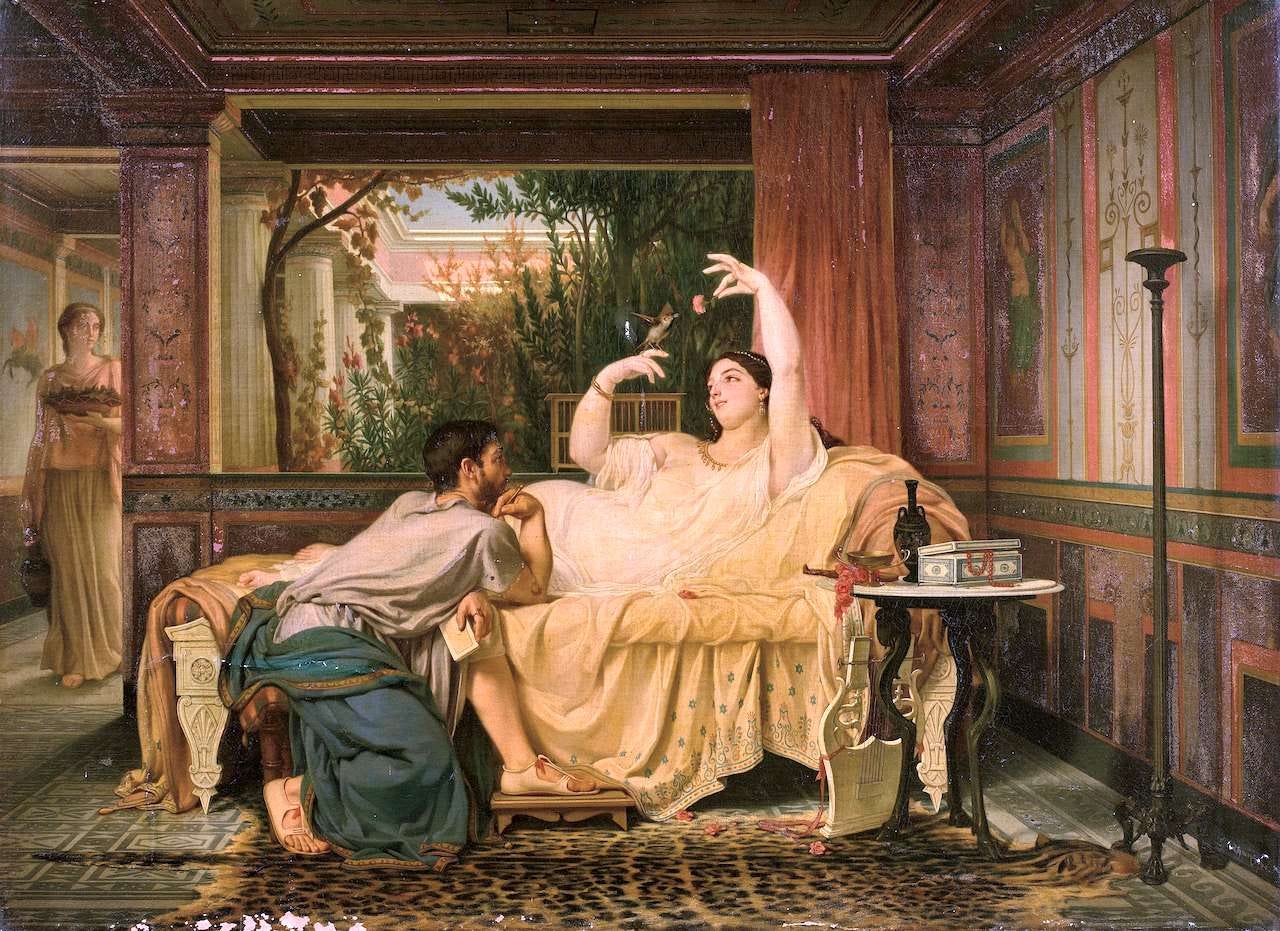
Elegiac love poetry in Latin begins when Catullus’ coy mistress steps across the threshold of a house prepared for an erotic tryst (68.70-2):
quo mea se molli candida diva pede
intulit et trito fulgentem in limine plantam
innixa arguta constituit solea
There with gentle foot my shining goddess made an entry, and set her radiant step upon the worn threshold, pressing on her sounding sandal
A pivotal moment, and, in mea...candida diva, an act of erotic deification.
Thirty-some years after Lesbia, just past midday, another mistress crosses another threshold, entering a room in which, at siesta time, another Latin poet awaits. Yes, it is Ovid, in Amores 1.5, his half-shuttered bedchamber glimmering with proto-metamorphic possibility (‘the light was such as oft in a woodland, or like the faint glow of twilight when Phoebus is taking his leave...’). The visitor advances (Am. 1.5.9-10):
ecce, Corinna venit tunica velata recincta,
candida dividua colla tegente coma
Lo, Corinna comes, draped in an ungirt tunic, with divided tresses covering a shining neck
But wait, play that couplet one more time:
ecce, Corinna venit, tunica velata recincta,
candida div...
Is the echo heard? An incomplete vision, a divided goddess, a fleeting epiphany as the Catullan phrase hovers on the threshold of definition, observable by a trick of the light...but now it’s gone.
candida dividua colla tegente coma
Not quite a shining goddess after all, then, just as the candida diva of Catullus 68 was in her own way an illusion in the mind of a wishful poet. Wishful, and knowing: after a wild ride through seventy lines of mythological comparison and digression, that earlier erotic fantasist was to withdraw (though not to erase) his divine analogy (Catullus 68.141):
atqui nec divis homines componier aequum est...
And yet it is not reasonable that humans should be compared with gods...
So (back to Ovid’s candida div-) no goddess here either; but, for all that, a lovely pentameter, with adjectives, nouns and strands of hair arrayed across the line with casual elegance: it is thus that the vision of Corinna begins to take shape.
Forty years have passed since that Ovidian turn between adjacent verses first opened up for me. A mere pun: but also, one of those moments when a small rupture of expectation seems to open up a time-portal, allowing a private joke to slip across the millennia.
However...if poets can get disillusioned, readers can too. Experience has taught me that Amores 1.5 is rarely read the same way twice. Ovid’s poem is that unusual thing, a Latin erotic elegy built around connection and fulfillment rather than around separation and frustration. But fulfillment on whose terms? The moment, and the narrative, are controlled by the poem’s only speaking voice, that of the poet. And in a 2020s classroom the move that defines this elegy is often felt to be the one that follows next (Am. 1.5.13-16):
deripui tunicam – nec multum rara nocebat;
pugnabat tunica sed tamen illa tegi.
cumque ita pugnaret tamquam quae vincere nollet,
victa est non aegre proditione sua.
I tore off her tunic – not that, being thin, it was much of an obstruction; but all the same she struggled to keep it on. Even while thus she struggled, she seemed to wish to fail, and was easily vanquished by her self-betrayal.
A mock battle of mutual consent? Or, in the unavailable point of view of the other person present, something more uncomfortable, a practiced containment of partner aggression? The question can be restated, rather than answered, by calling to mind a couplet in Ovid’s older elegiac contemporary Propertius, in which the same ‘battlefield’ is sketched in terms of para-Homeric combat (Prop. 2.1.13-14):
seu nuda erepto mecum luctatur amictu,
tum vero longas condimus Iliadas.
...or if, her dress snatched off, she grapples naked with me, then to be sure we compose long Iliads.
Back here in Ovid, fast-forward to the end of our poem (Am. 1.5.25-6):
cetera quis nescit? lassi requievimus ambo.
proveniant medii sic mihi saepe dies!
Who does not know the rest? Exhausted, we both lay quiet in repose. May I be granted many more middays like this!
A mutually satisfactory outcome to the tryst, and to the elegy? Perhaps one more reading, or one more translation, can resolve the matter. Perhaps not.
Originally published in In Medias Res on Substack. Read it there or subscribe to get new articles by email.