

Was Ovid Really Apolitical?
Sulmona, Corfinium, and the Poet Who Wouldn’t Say “Philippi” (Part I)
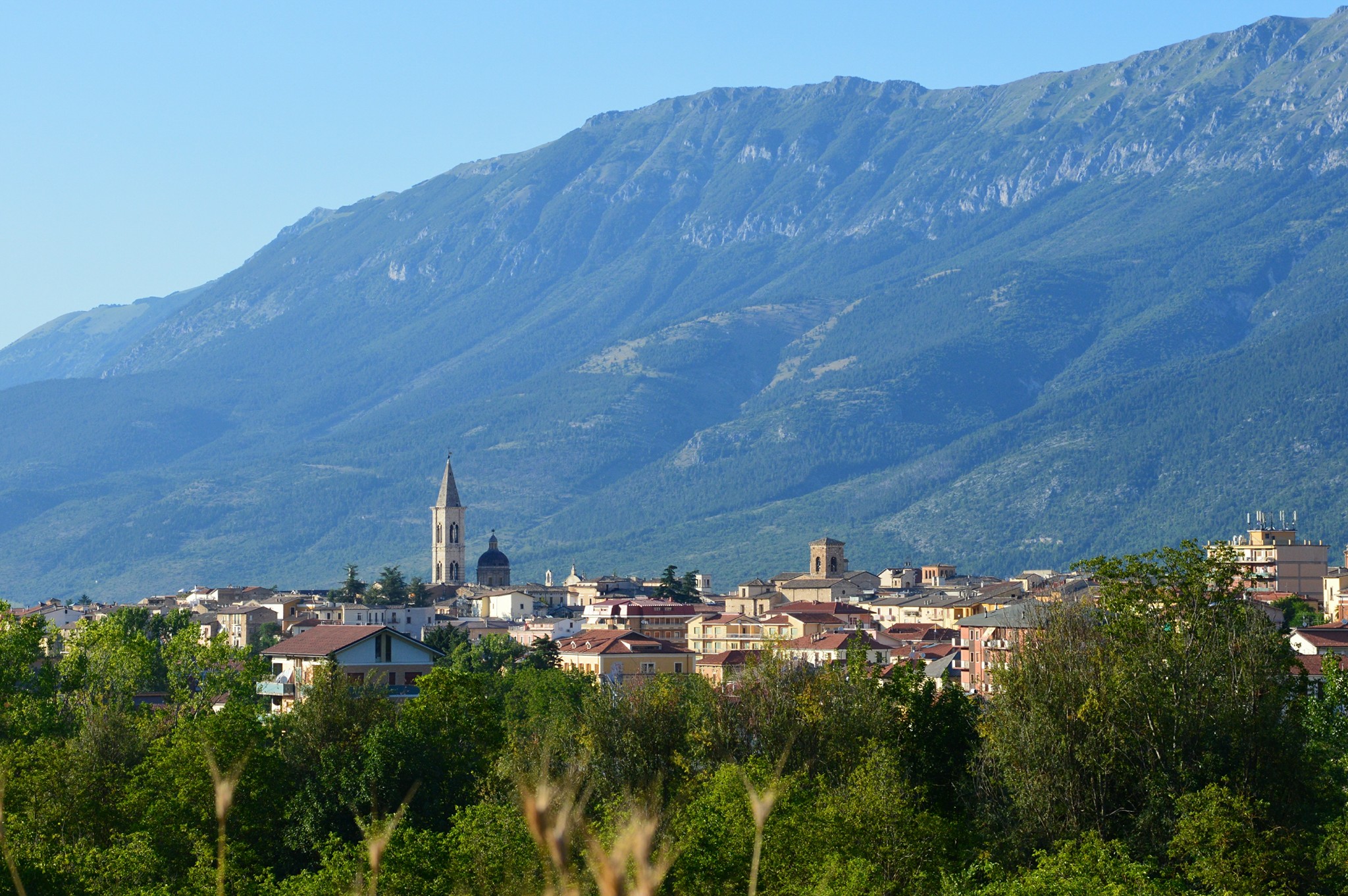
In Sulmona, Ovid’s hometown, a local once told me the poet was an idiot because he never wrote about Rome’s civil wars. These two essays ask whether Ovid did something subtler and more Roman: whether, instead of naming history, he buried it in myth.

“Lui era stupido.” (That guy was an idiot.) So said a man who approached me in the main piazza of Sulmona, Italy, in summer 2016.
I was in Rome for the summer leading Paideia’s Living Latin in Rome, and I had a day off, so I hopped on the train and traveled the three hours it took to reach the birthplace of Ovid (“90 miles from Rome,” as he proudly puts it in Tristia 4.10).
What is there to see in Sulmona? Not much, it turns out, but they do have a very cool statue of Ovid in the center of the main square.
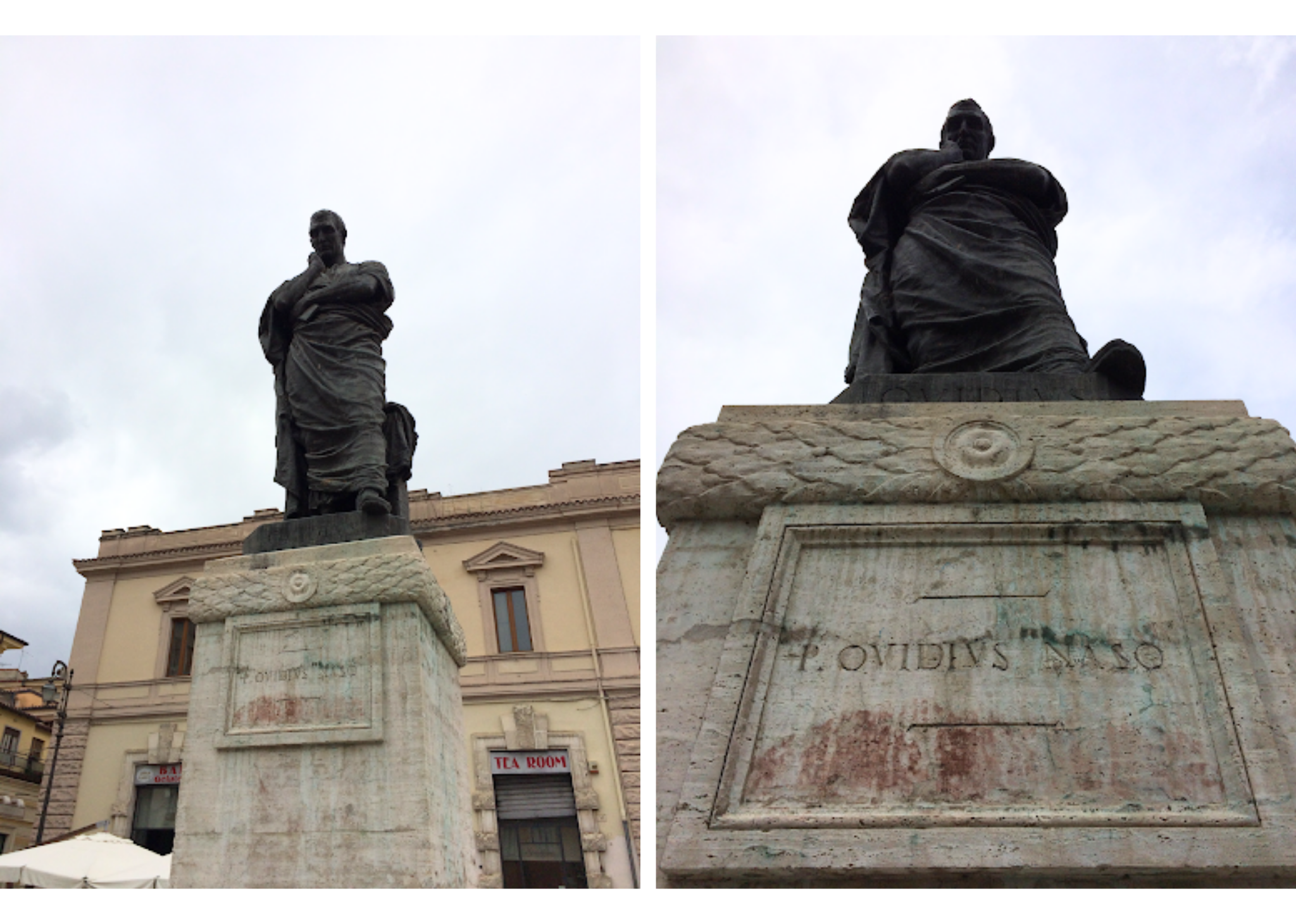
It started raining lightly just as I got there, so I parked myself at a table under an archway across from the main statue till it stopped. The place was empty. That’s when the local man came over to me, pointed over to the statue of Ovid, and without further ado, pronounced a great poet stupid.
Why? I asked, trying to steady my quickening pulse. (My Italian is pretty good, but it had been over a decade since I’d held a one-on-one conversation of any great length, as it was clear I was about to do. And this guy was already interesting.)
Over the next 90 minutes I learned a lot.
The main takeaway—and this is the point the man wanted to impress on me when he learned I’m a professor of Latin—is that Sulmona is just down the street from the town of Corfinio. It’s only about eight or nine miles away.
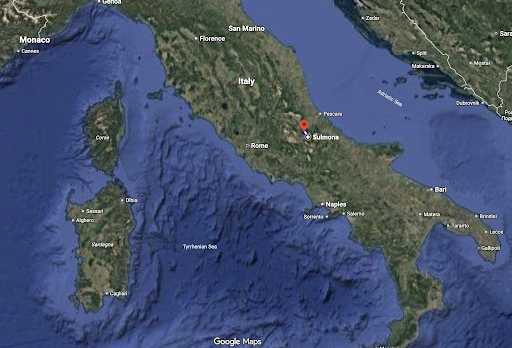
Sulmona to Corfinio: 14 minutes away by car.
I must have given him a blank or stupid stare because I clearly couldn’t see his point. So he began to lay it out for me:
It matters, the man said, as we continued downing espressos, because Corfinium was the rebel capital city established during the Social War of 91-88 BCE.
It wasn’t just any old town during Rome’s Social War (or, as it’s sometimes jokingly called, “The War of Dependence.”) No, Corfinium was the insurgent Italians’ counter-Rome, the place where they planted a flag, built a senate, and declared, in effect, that Italy was a nation and not merely Rome’s manpower reservoir. Renaming the city “Italia,” they forged a political symbol as bold as any in Republican history, a declaration that citizenship, dignity, and power must be shared or fought for. From this Paelignian stronghold Rome’s socii (allies) coordinated both war and ideology, turning rebellion into a rival state and forcing Rome, at last, to rethink the meaning of the word Roman. The geography tells the story too: this was no distant frontier but the very heart of Italy, beside ancient Sulmo, in the country of Rome’s own soldiers and poets.
Nice lesson, I said. So what?
Don’t you see?, the man insisted. Here we are, eight or nine miles down the road from this momentous, historic town. Ovid grew up in its shadow, right in the heart of a region that should have had reason to resent Roman strongmen and political abuses and the new order they created.
It would be like growing up in the shadow of Gettysburg or Appomattox under Reconstruction.
And that, the man insisted, triumphantly, is why Ovid was an idiot: because, instead of ever mentioning or even alluding to any of it, he spent his genius writing silly poetry about strategies for hooking up and made-up stories of people changing into different shapes.
In all his career, Ovid never had a word to say about Corfinium and what it might have represented: freedom from Roman authoritarianism.
No Lucan, he!
Well! Although we didn’t get into it then, I’ve since learned that the local man’s attitude is pretty widespread. It certainly prevails among first-time readers of the Metamorphoses.
And yet scholars have done a pretty amazing job of suggesting the opposite: that Ovid was trolling Augustus, and almost constantly, in the early books of the Metamorphoses. Some even think that the Metamorphoses is the poem that later got Ovid into hot water with Augustus, rather than the Ars Amatoria that he constantly teases it was. (Chronology positively favors this interpretation, though it’s a minority view today.)
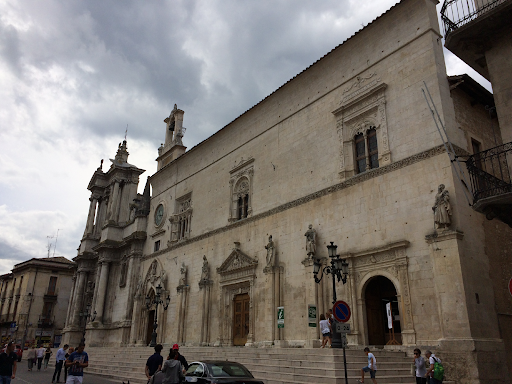
The main square (piazza) of Sulmona.
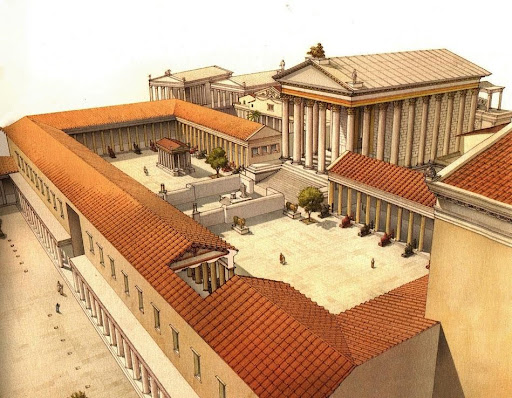
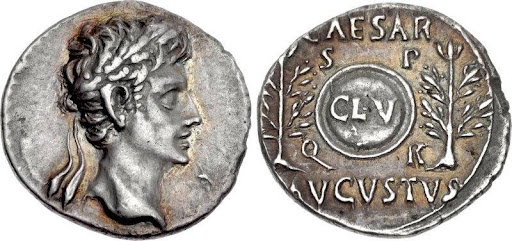
Some of the examples of Ovid trolling Augustus are famous, and others are blindingly obvious once they’re pointed out. In the Metamorphoses, Ovid quietly overlays myth with Augustan Rome. It begins in Book 1 when he calls Jupiter’s palace the “Palatine of heaven” (Palatia caeli), aligning the king of the gods or Apollo with Augustus, who lived on the Palatine Hill and had built a temple of Apollo next door, and Olympus with imperial Rome.
From that moment, divine rule is repeatedly shown as violent, unstable, and morally compromised:
-
- Jupiter attempts to annihilate humanity after Lycaon, the “wolf” man who represents Romans, misbehaves;
- Apollo’s super-creepy attempted rape of Daphne produces the laurel—the very emblem crowning Augustus;
- the reckless driving of the solar chariot by Phaethon, the maybe-maybe-not son of “the Sun,” nearly destroys the world;
- Jupiter’s serial rapes (Callisto, Europa, Io) normalize predatory sovereignty;
- Actaeon is arbitrarily destroyed by Diana, the twin sister of Apollo;
- and the mutilation and silencing in Tereus and Procne foreground anxieties about speech under power.
By embedding Augustan symbols (Palatine, Apollo, laurel) inside stories of abuse and misrule, Ovid sustains a pattern of oblique criticism by lacing his myths with plausibly deniable political speech. This, as my late colleague Fred Ahl was fond of pointing out, is the “art of safe criticism.”
And so on. The point is that Ovid’s poem contains enough of these oblique political gestures that we’d be silly not to wonder if there are more—especially since Roman writers themselves knew that fable and myth could conceal what could not safely be said openly. No one makes this point more cleanly than the poet Phaedrus, writing a generation after Ovid (book 3 prologue):
Nunc, fabularum cur sit inventum genus,
brevi docebo. Servitus obnoxia,
quia quae volebat non audebat dicere,
affectūs proprios in fabellas transtulit,
calumniamque fictis elusit iocis.
Now let me give you a little lesson
On why fables, as a form, were first invented.
Slaves are exposed to incessant hazards.
Unable openly to express what he wanted,
One of them projected his personal opinions
Into fictional fables and found shelter
From carping critics in comic inventions. (tr. P. F. Widdows)
In that spirit I want to make a new suggestion. Maybe it’s crazy, maybe not. But if I ever make it back to Sulmona and find that journalist, I’d love to run it by him.
To wit: what if Ovid’s tale of Pyramus and Thisbe quietly remembers Philippi?
End of Part I. To be continued.
Sign up to receive email updates about new articles

Comment
Sign in with