

Did Ovid Bury Philippi in a Love Story?
Mike Fontaine·April 23, 2026

Pyramus, Thisbe, and Rome’s Most Tragic Mistake (Part II)

In Sulmona, Ovid’s hometown, a local once told me the poet was an idiot because he never wrote about Rome’s civil wars. These two essays ask whether Ovid did something subtler and more Roman: whether, instead of naming history, he buried it in myth. (Read Part I here.)
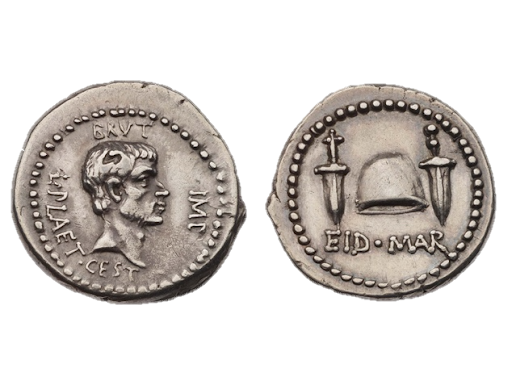
Let me try a new idea. Maybe it’s crazy, maybe not. But if I ever make it back to Sulmona and find that man in the piazza, this is what I’d want to tell him:
“Ovid may not have written an epic about civil war. He wasn’t Lucan. But he may have written something stranger. He may have written a completely unrelated myth whose structure quietly mirrors the most tragic double suicide in Roman history: namely, the Battle of Philippi.”
Since more readers know the Ides than Philippi, here’s a quick refresher:
Caesar is assassinated on the Ides, stabbed 23 times; the ringleaders Brutus and Cassius proclaim liberty, but have no plan for what to do next (Cicero says they have “the spirits of men, but the foresight of children.”) Eventually they slink away from Rome, leaving a disastrous power vacuum that Mark Antony and Octavian soon fill. Two years later, on the battlefield of Philippi in northeastern Greece, liberty dies. Having amassed an enormous army, Brutus and Cassius (the “liberators”) faced off against the combined forces of Antony and Octavian, the future Augustus, and lost. It was one of the largest battles in Roman history, spanning three weeks and involving some 200,000 combatants. The poet Horace himself was among them! (He threw away his shield and ran—no warrior, he!)
Now, what is so remarkable about the Battle of Philippi is that it didn’t end simply with defeat. It ended with two suicides—the first of which was born of a mistake. Cassius, believing Brutus had lost, ordered his own death. Weeks later, after a second engagement, Brutus followed him.
In other words, the Republic collapsed not only under military pressure, but under the weight of a fatal misreading.
That is the decisive narrative element, and we must not lose sight of it.
Now return to Ovid.
In Metamorphoses 4, Ovid tells the story of Pyramus and Thisbe, the two Babylonian lovers who live in adjoining houses, are forbidden by their parents to marry, whisper through a crack in a wall, and arrange a secret nighttime meeting under a mulberry tree. Thisbe arrives first, sees a lioness fresh from slaughter, flees in fear, and drops her veil. The lioness, her jaws still bloodied, tears the veil and leaves it stained. Pyramus arrives, finds the mangled cloth, concludes that Thisbe has been killed, and, acting on that conclusion, stabs himself. Thisbe returns, finds Pyramus dead, and kills herself in turn. Their blood permanently darkens the fruit of the mulberry tree.
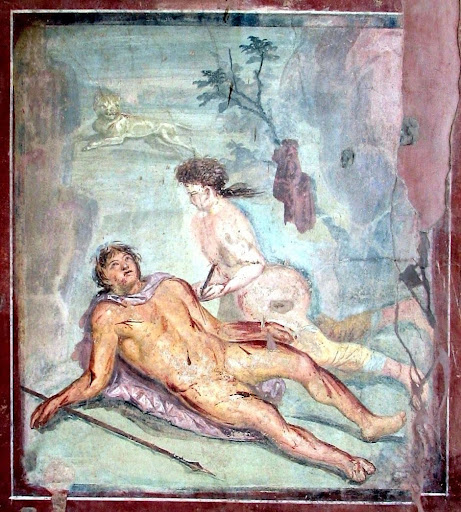

The crucial feature isn’t simply that both die, but why they die.
Pyramus kills himself because he believes Thisbe is already dead. Thisbe kills herself because Pyramus is in fact dead. The entire tragedy hinges on a false inference that becomes reality.
That is precisely the logic and tragedy of Philippi: Cassius didn’t kill himself because Brutus had lost, but because he mistakenly believed Brutus had lost. The first suicide was triggered by misinterpretation. The second followed from the first. This structure is unusual enough to demand attention. Greek myth offers suicides prompted by false evidence, such as Aegeus throwing himself into the sea when he sees black sails and assumes Theseus has died, but those cases produce a single death rather than a paired cascade. And Greek tragedy does offer chains of suicide, as in Antigone, but there the initiating death is real, not falsely inferred.
The closest parallel to this situation in Roman history is that of Antony and Cleopatra a few years later, after the Battle of Actium, where Antony kills himself after being told Cleopatra is dead and Cleopatra follows him. That example shows that the mechanism belonged to Roman cultural memory.
That said, Antony and Cleopatra differ in one decisive respect. Their bond was public and royal; they married and had children. So as Han Solo would say, these aren’t the droids we’re looking for.
Pyramus and Thisbe, by contrast, like Brutus and Cassius, are defined by secrecy, by a union that must be concealed, by whispered communication and clandestine planning: in other words, a conspiracy. Their tragedy unfolds in the shadow of fear and prohibition.
That conspiratorial texture matters. Ovid introduces the lovers with the striking line contiguas tenuere domos…taedae quoque iure coissent, sed vetuere patres. (They lived in adjoining houses; they might have married, but the fathers forbade it.) Everything about the relationship depends on evasion. They speak through a crack in a wall. They arrange a hidden meeting. Each acts alone, on partial knowledge. It is precisely this isolation that makes misinterpretation fatal.
In that sense Pyramus resembles Cassius more than Antony. Both read fragmentary evidence, act decisively, and discover, too late, that the sign was wrong. The mistake proves fatal.
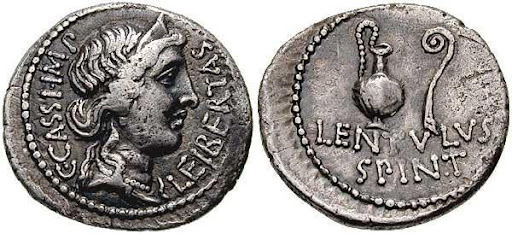
Cassius and Leibertas on a coin of 42 BCE, the year of Philippi (source)

In this light, we can (arguably) make sense of an oddly specific detail in Ovid’s story: the lioness. Ovid lingers on her arrival:
venit ecce recenti
caede leaena boum spumantis oblita rictus...
A lioness comes, her jaws still foaming from a recent kill. She frightens Thisbe but harms no one. Instead she transfers her blood to a veil. The result is symbolic violence mistaken for real violence. It sounds a bit like the Encyclopedia Britannica’s description of the first clash at Philippi:
On October 3, Antony and Octavian launched a frontal assault. Octavian’s troops were repulsed in disorder, and Brutus captured his camp. Antony broke through Cassius’s defenses but had to pull back to aid Octavian. Cassius, however, committed suicide, thinking that his army had lost the battle.
Why a lioness, and why blood without a victim? According to Pliny, during the civil wars the young Octavian used a sphinx signet—a female-headed lion.
Now, I wouldn’t claim that Ovid’s lioness is Octavian in disguise. But it is striking that in a poem already so willing to overlay myth with Augustan imagery, a lion-woman produces the misleading sign that sets catastrophe in motion. The lioness doesn’t actually kill anyone; she merely creates the evidence of killing.
That’s exactly what happened to Cassius at Philippi: smoke, rumor, and distance produce the appearance of death and defeat. The battlefield becomes an interpretive trap.
I’d make just one more point. After the deaths, Ovid tells us how mulberries (mora) got their characteristic color:
purpureo tinguit pendentia mora colore.
The hanging mulberries, once white, are stained with purple—the color of blood, and also of Roman power. Civil war leaves marks that cannot be washed away.
And because I’m me, it’s hard not to notice that mora is an anagram of Roma. No, most of the forced or absurd anagrams that scholars keep saying they find in Latin literature probably aren’t intentional. But this one is at least tempting, and Roman poets certainly do sometimes use anagrams. Ovid himself plays on amor and Roma pretty much ad nauseam.
In this connection, Emily Gowers has observed something similar in Horace. In her reading of the Satires, the word lippus is so often associated with black marks and blemishes that it may function as a covert pun on “Philippi,” the blot on Horace’s past, without naming it.
Even more to the point, a couple decades before the Metamorphoses Horace himself, in Odes 2.1, warns a man that writing about the civil wars is like walking over embers hidden beneath treacherous ash. The blood of those battles, he suggests, isn’t yet expiated. Civil war remains hot, and naming it openly is dangerous.
If that’s true for Horace, it’s not unreasonable to imagine that Ovid, writing under Augustus, might approach the same trauma obliquely. Rather than narrate Philippi as history—much less a history he might be seen to sympathize with—he may refract its logic into myth.
None of this proves that Pyramus and Thisbe is a coded political tract. It doesn’t require that Pyramus equal Cassius or Thisbe equal Brutus in a one-to-one schematic allegory. No tinfoil hats necessary!
What it does suggest, though, is that Ovid builds his tragedy around the very mechanism that defined the Republic’s final catastrophe: a double suicide set off by false belief. The lovers’ secrecy, their dependence on fragmentary communication, and the permanent stain left behind together produce a narrative shape that resonates uncannily with Roman memory of Philippi.
If that’s not an echo, it’s at least an extraordinary coincidence. Why choose this precise architecture, this peculiar cascade of misreading and self-destruction, if all Ovid is doing is composing a sentimental aetiology about fruit—fruit that once was white but is now permanently stained the color of blood? And about fruit called mora in Latin?

Mulberries (mora), forever stained with Pyramus and Thisbe's blood
So maybe Ovid didn’t ignore civil war after all. Maybe he did what Roman poets often did when speaking plainly was dangerous. He touched history in passing, transformed it, and buried it in myth, where it could be remembered without being named. If Pyramus and Thisbe preserves even the faintest echo of Philippi, then Ovid—the boy who grew up down the street from Corfinium, the failed rebel capital of the Social War—wasn’t silent about Rome’s greatest tragedy. He was doing something subtler and more Roman, turning history into story so that the stain would remain even when the name was forgotten—and could be plausibly denied if he were ever called to account.
If I ever meet that Sulmona journalist again, that’s what I’ll tell him. Maybe I’ll add that sometimes the most political poetry is the poetry that never says so aloud.
Maybe I should go back to Sulmona and look for him. My Italian’s worse now, but I have more to say.
Originally published in In Medias Res on Substack. Read it there or subscribe to get new articles by email.