


From Ithaca to Cinecittà
Tatiana Eva-Marie·September 3, 2025
Godard’s Disintegration of the Homeric Journey
Jean-Luc Godard’s Le Mépris opens with a man’s voice reciting a list of production credits followed by a naked woman’s recitation of her body parts to her husband. The overture feels like a eulogy — beautiful, detached, and already in mourning. The couple agree that each of her body parts is perfect, that it represents their complete love. But they seem aware that this perfection is fragile, perhaps suffocating, and already gone. Like The Odyssey, Le Mépris is a journey through haunted landscapes. Godard’s Capri is no vacation postcard — it collapses both Eden and underworld into one stage for psychic unmooring. The Villa Malaparte, perched like a temple above the sea, becomes an impossible space — all staircases and blind turns, each one a possible momentous error, and in light so harsh it burns. In Homer, Odysseus must pass through Hades to speak to the dead and learn his fate. In Godard, the characters are already ghosts, drifting in and out of shadow, of memory, of a love they can no longer name.
Paul Javal (Michel Piccoli), the screenwriter at the film’s center, is an anti-Odysseus. He lacks the wit, the power, the cunning, and above all, the longing. While Odysseus sails storm-tossed seas to reclaim Penelope, Paul watches his wife Camille (Brigitte Bardot) drift out of his life without so much as throwing a lifeline. The American producer (played with grotesque vulgarity by Jack Palance) wants a blockbuster. Fritz Lang, playing himself as the weary, stoic director, pushes back, in the name of Greek culture. ‘When I hear the word ‘’Culture’’ the producer says, ‘I reach for my checkbook.’ Between the two, Paul tries to reimagine a third version that can explain his own failing marriage.The Odyssey is about the long and winding road home; Le Mépris is about what happens when the home collapses before the journey even begins.
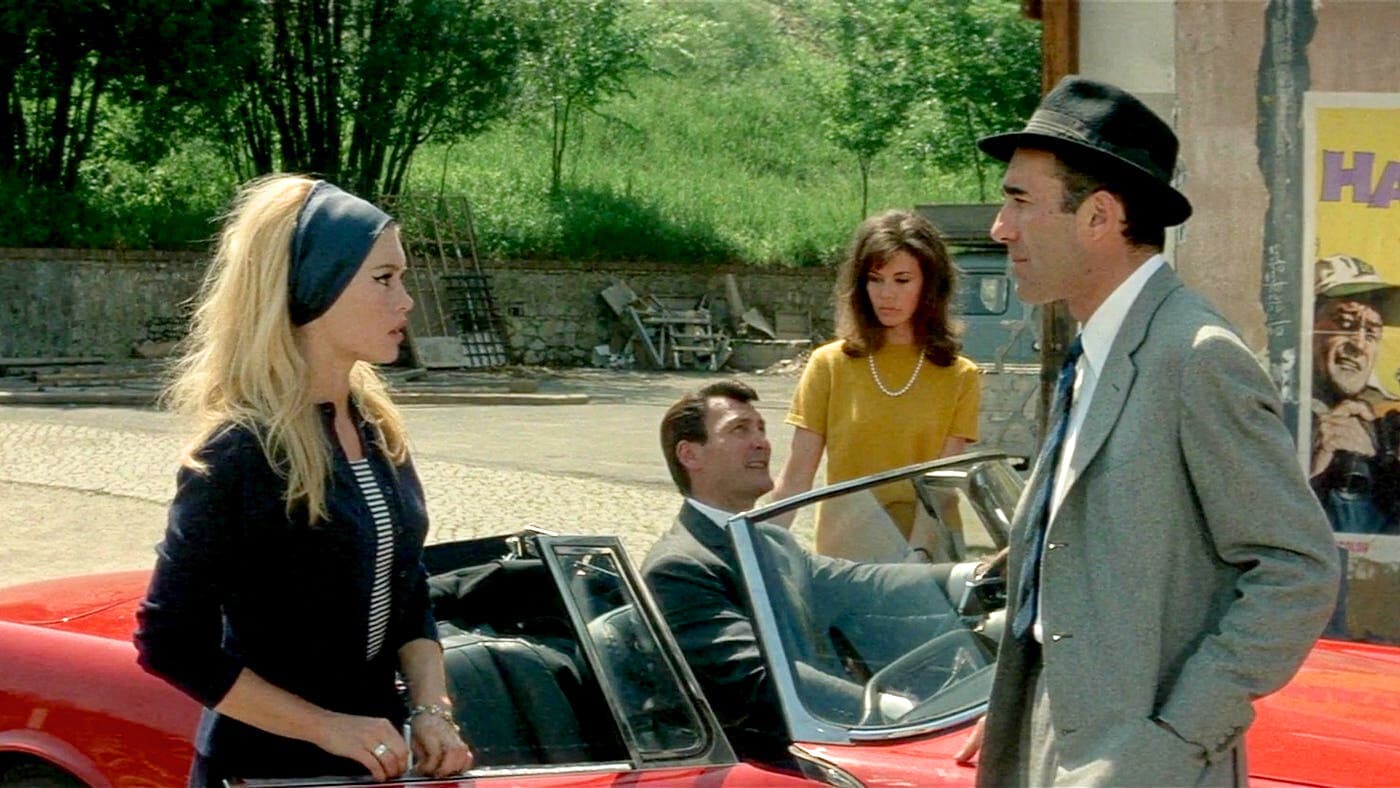
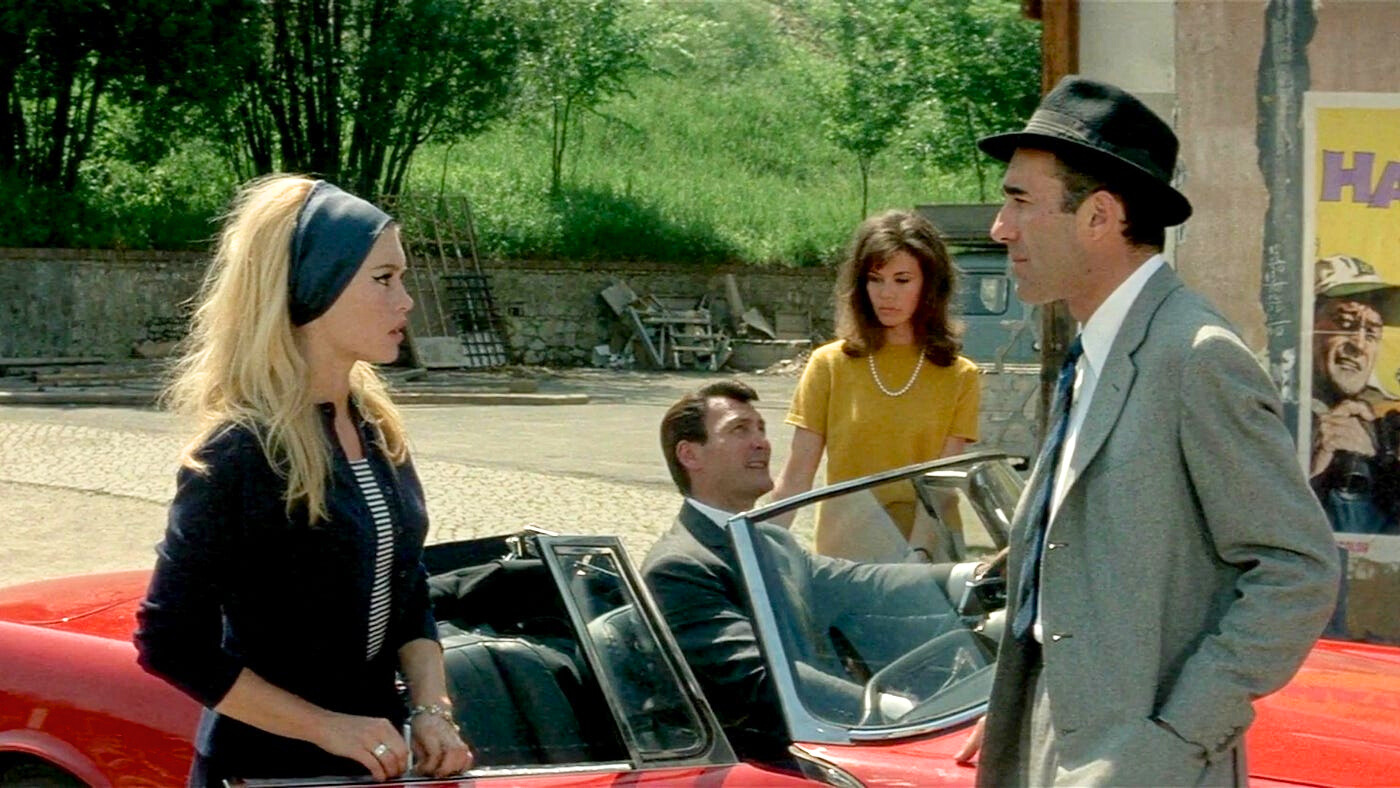
On its surface, Godard’s film is a melancholy portrait of a relationship’s demise — yet it is also a mythic journey where the self dissolves en route and the destination is obscured. Homer’s epic charts the return of a man to his wife and homeland. Le Mépris, by contrast, charts the dissolution of that bond with its own mini-version of the story. It starts with something seemingly trivial. The producer suggests a drink at his house, opens the door of his sports car to usher in the wife, only to point out to the husband there is no space for three. Paul, at first oblivious to the eternal math problem of coupledom, unsurprisingly does nothing, simply encouraging her to go, agreeing to take a taxi on his own. But as she appears increasingly uncomfortable, his passivity becomes aggressive, and he almost pushes her into the car. To compound matters, he arrives late to the house; not twenty years late, but in this parable, an hour is more than enough to leave his wife alone with a suitor, and with unknown consequences. And so her contempt of him begins, and his half-hearted efforts to understand it.
Godard locates this unraveling in the stark and mythic landscape, where blue sky and white stone suggest Olympus but function as sun-lit purgatory, laying bare the souls of the characters. The architecture is brutalist, the dialogue minimalist, the silences punishing — here there is no hospitality, no codes, no xenia. Everyone is miscast: the American producer is a petty tyrant, the director is a jaded seer, and Paul, a poor mediator between art and commerce. He, in particular, seems desperately in search of some kind of cultural code. We find he has joined the Communist Party, but there seems no real reason behind it. He tries to play the pure artist (who really wants to write for the theater), but has little conviction. He is as out of water as a romantic, adoring husband as he is as a bourgeois provider.
In both works, miscommunication is the true antagonist. Odysseus must disguise himself, lie, and manipulate his way back to Ithaca, while Penelope answers in riddles and tests. But their deception, at least on the surface, is strategic — a means of survival until they reunite. What such lies might do to a couple is hinted at but not explored. Paul and Camille, by contrast, fail not because they deceive each other, but because they refuse to speak plainly. The language barrier isn’t just between French and English or Italian — it’s between desire and pride. The couple moves through their apartment in Rome, half-naked, half-honest, unable to reach each other despite their proximity, their marriage dying in a thousand tiny fragile shrugs.
Odysseus’ talent for life lies in his ability to shed disguises and eventually reveal himself. It is precisely this capacity for self-disclosure that Paul lacks. He spends the entire film dodging confrontation, speaking in platitudes, outsourcing intimacy to silence. Camille does not simply grow distant; she watches him fail to act, fail to speak, fail to fight — and she despises him more and more for it. Anti-Odysseus or inverted Orpheus, Paul not only fails to retrieve her from the otherworld, he pushes her in. He allows Camille’s contempt to solidify, then justifies his passivity as noble. There’s no lyre-song here to charm the gods, no descent to plead with fate. Only the banal tragedy of masculine pride — of not knowing how to love and being too proud to ask how. In fact, it is Camille who embarks on the epic journey through loss, through mourning, through the dilemma of staying or leaving when love has gone sour. She is a new Penelope, a loyal wife who expected total devotion, but one who has the courage to withdraw her love once betrayed. And her contempt is final.
Godard doesn’t merely reference The Odyssey; he lets Paul project himself onto it, rewriting the story to find solace for his own failings. Paul imagines Odysseus not as a homesick hero but as a man who went to war to avoid his wife. “Had he been happy, he’d have stayed home,” Paul insists, as though ancient epics were merely a mirror for modern marital malaise. Or, perhaps, had he been happy, he wouldn’t have pushed his wife into the car of a boorish playboy? This cynical reinterpretation frames The Odyssey not as an epic of fidelity but as a tragedy of belated recognition: that Odysseus was too cautious, too calculating, and that Penelope — “at heart a simple woman,” Paul says, with an unmistakable note of condescension — eventually stopped loving him for it. To Paul, the massacre of the suitors is a last-ditch performance to try to reclaim her love: he kills the suitors to prove that he can act. But as Lang explains, “Death is no resolution.”. It’s a subtle indictment not just of Odysseus, but of Paul himself, who performs none of the heroism yet harbors the same delusions — that the damage done by inaction can somehow be fixed through an act of artistic integrity, and pulling out of the script. Paul, ever the middlebrow masquerading as a philosopher, mistakes evasion for complexity and silence for nuance, but, unlike Odysseus, Paul won’t even attempt the voyage back.
Le Mépris is not simply a film about estrangement — it is a meditation on the weight of return, and what it means to fail to come back to oneself, to another, to the life you were promised. In Homer, Odysseus is heroic not for his conquest, but for his refusal of immortality and his commitment to return, in full knowledge of the grief that awaits him. The journey is not toward glory, but toward the possibility of going back to “real life”. Paul, Godard’s modern anti-Odysseus, shares none of this clarity. He does not struggle against temptation — he shrinks from conflict. Faced with his wife’s contempt, he offers accommodation, passivity, distraction, and lets her slip from his grasp. If The Odyssey is about choosing mortality and re-entering the world of shared human obligations, then Le Mépris is about what happens when a man chooses to drift into oblivion. Paul is not swept away by sirens or gods; he surrenders to banality, to the small humiliations of compromise, to a kind of emotional entropy. And the cost is not just his marriage, it is the loss of home, story, belonging.
Godard isn’t offering a post-modern epic, he offers its ruins. No hero, no journey, no apology, no quest. No wrestling with gods and monsters. Only Cinecittà and the quiet hum of filmmaking. Yet perhaps The Odyssey lives on — not in Paul, but in the act of retelling. But what becomes of myth when the gods are reduced to executives? When destiny belongs to financiers rather than storytellers? In Homer, the gods meddle endlessly: Poseidon curses, Athena rescues, Hermes intervenes. In Godard, the gods are less divine and more banal — producers with yachts, deadlines, and cigar smoke. And they wield their own brand of power. They shape destinies, bankroll epics, and crush intimacy beneath the weight of commerce. Myth becomes a backdrop for the commodification of story, love, and even longing itself. If The Odyssey was about earning one’s return, Le Mépris is about realizing too late that you’ve already sold your soul. It mourns the absence of the heroic gesture — the apology not made, the question not asked, the journey not taken. It’s about what happens when the lover does not row back across the sea. Maybe the real odyssey isn’t measured in distance, but in intimacy. In what it costs to find your way back to someone you once knew, even — especially — when they no longer recognize you.
Tatiana Eva-Marie is a Swiss-American musician and author. She holds an MA in English language, literature, and civilization (LLCE) from the Université Paris-Sorbonne, where she specialized in medieval studies, focusing on symbolism in Beowulf and the Arthurian legend, with a minor in Shakespearean studies. She previously taught French at the French Institute of New York. A former editor of Shrine Magazine—now continued as her Substack on film—she is also a published poet and the author of two musicals and two opera libretti. Alongside her writing, Tatiana tours internationally as a jazz singer and bandleader. She divides her time between Paris and New York City, and enjoys globetrotting, collaging, learning Italian, and listening to 1930s music.