


Gazing on Ulysses
Paul Cartledge·March 26, 2026

Theo Angelopoulos' Odyssey of Balkan Identity.
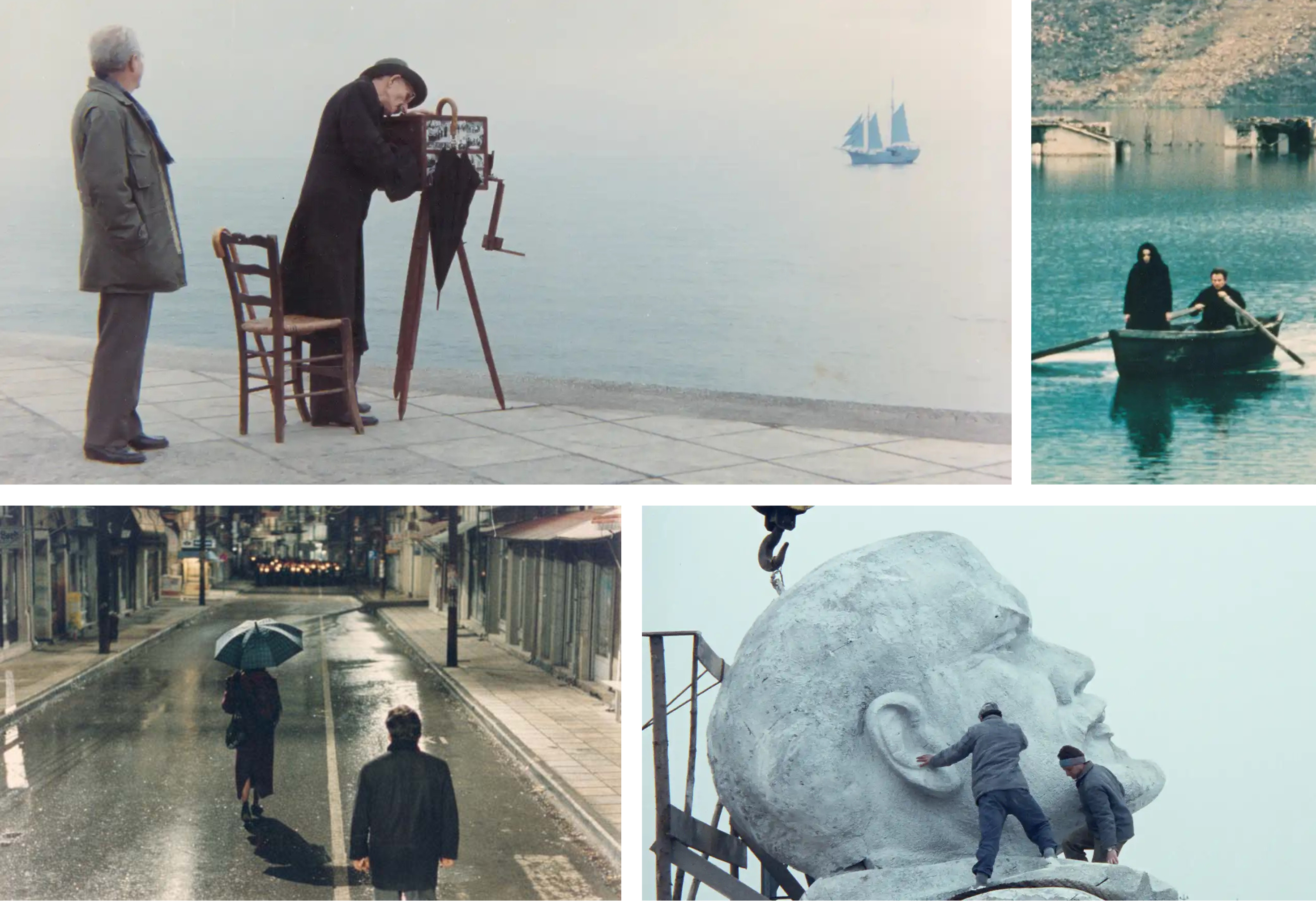
Homer's Odysseus was a (fictional) man of many things: twists and turns (polu-tropos), sufferings (polu-tlas), and wiles and guile (polu-mētis). What may not be so well known is that he was also a man of many names. 'Odysseus' is thought to be a kind of 'speaking' name, related etymologically to a Greek verb for grieving. He was also known, in Greek, as Oulixes, Oulixeus, Olysseus, Oliseus, all dialectal variants, all with 'l' for 'd'. As such, they point the way to his name's reception into a fellow Indo-European language, whose original native speakers, Romans and other inhabitants of Latium (today's Lazio), had chosen to borrow a dialectal variant of the Greek alphabet to transcribe their own phonemes. In Latin, Greek Odysseus became transmogrified into 'Ulysses', and it's as such that I'm interested in him here, in a short essay on his contemporary reception in the world of Greek moviemaking. For my subject is, in its English translation, Theo Angelopoulos's Ulysses' Gaze (1995).
In (modern) Greek the movie's title is of course 'Odysseus' Gaze (vlemma)', and the clue to that choice lies in our most widespread use of 'odyssey' today - to mean a voyage, a journey, including ones with, yes, many twists and turns, wiles and guiles, and indeed ... travails (that word is a direct calque on 'travel' - which can often be, well, painful). For Angelopoulos (1935-2012) was a filmmaker with a strong penchant for making movies about travelling and travellers: most famously, perhaps, The Travelling Players (1974/5, in Greek Thiasos, which means something rather different, a troupe with a common ritual, often religious purpose and identity), but also 1980's The Voyage to Cythera (a small island off the southern tip of mainland Greece). Ulysses' Gaze lacks the idea of travel in its title, but its content is instinct with it, especially the roamings of its lead character, a modern Odysseus.
Few movie directors, let alone Greek movie directors, merit a dedicated biographical filmography. One of the few who do was Angelopoulos, and in American academic Andrew Horton he found a devoted follower and interpreter: in 1997 he published The Films of Theo Angelopoulos: A Cinema of Contemplation, in the same year he edited The Last Modernist: the Films of Theo Angelopoulos, and in the spring 2012 issue of CINEASTE magazine he 'remembered' him comprehensively and comprehensibly in short compass. Angelopoulos (literally 'the chicken of a messenger') had been tragically knocked down and killed by a motorcyclist aged 76.
For Horton, all Angelopoulos' films from his earliest b/w efforts to The Dust of Time (2008) by way of Eternity and a Day (1998) and The Weeping Meadow (2004), among others, matter because they dare to cross a number of borders: between nations, between history and myth, the past and the present, voyaging and stasis, between betrayal and a sense of community, chance and individual fate, realism and surrealism, silence and sound, between what is seen and what is withheld and not seen, and between what is "Greek" and what is not. In short, they travel. And they often did so to the accompaniment of a soundtrack composed hauntingly by Eleni Karaïndrou, as does Ulysses' Gaze. In 2025, the golden jubilee of Travelling Players, London's Institute of Contemporary Arts staged an overdue retrospective of all of them, nicely written up by Michael Brooke for the BFI (British Film Institute).
Angelopoulos was anything but laconic - Travelling Players ran to 230 minutes; but by comparison Ulysses' Gaze is short (under three hours). Short but by no means entirely sweet, which reflected the challenging political circumstances of the auteur's own life's trajectory. (For a visual record, see here.) The year after his birth, Greece underwent a first period of twentieth-century dictatorship, interrupted by the ghastly Nazi occupation that the Second World War inflicted on his native land (especially harshly on his home city of Athens), which in turn was followed by three years of civil war (as many as half a million may have been brutally killed). A brief respite of fairly stable, if authoritarian government was again dissolved in a miserable seven-year dictatorship (1967-74). It's only since 1975, by when Angelopoulos was 40, that Greece has enjoyed a period of relatively normal, if often testing, politics. He was lucky not to live to see Greece at the mercy of the 'troika', an EU-spawned supervisory body presiding over Greece's near-bankruptcy.

Turbulent times can produce the greatest art - consider Florence in 1500 CE or Athens in 430 BCE (the year or near enough of Sophocles's Oedipus Tyrannus, and the completion of the Parthenon temple). For the scenario of Ulysses' Gaze Angelopoulos (who co-wrote it - one of his co-writers was outstanding crime novelist Petros Markaris) combined his fascination for multiple-dimension voyaging with his academic passion for the history of cinema, Greek cinema not least. Its lead character, simply 'A' (for Angelopoulos - but also alpha male?), was played beautifully by Harvey Keitel. He is a long-exiled filmmaker returning to his native south-east Europe in order to track down (one of Sophocles's satyr-dramas was titled Trackers) three undeveloped reels of film from the dawn of Greek cinema. Think the pioneering Lumière Brothers - but in this case the Aromanian Manaki brothers. In the movie he finds that accessing Sarajevo (in Bosnia-Herzegovina) is not the easiest - this is at the time of the war in the former Yugoslavia. In real life Angelopoulos found that for safety reasons he was unable actually to film there.
'A' begins his odyssey by travelling from Greece to Albania. From there he voyages, drifts rather, to North Macedonia (not to be confused with the Greek province of Macedonia, capital city Thessaloniki), to Bulgaria, to Romania, and to Serbia. His quest is for the roots of cinema, of memory (Mnemosyne was mother of the nine Muses), and of a Balkan identity, but, as was the case for Homer's original, A is pulled inexorably, inevitably, towards disaster, decay and death. In Sarajevo, finally, he meets the curator of an underground cinema archive, a man with the Jewish last name of Levy (cast originally on the wonderful Gian Maria Volonté but whose death necessitated a replacement - the film is dedicated to his memory). And he does there recover the three - miraculously preserved - reels. With Levy's family A then explores the city of Sarajevo, only to encounter armed troops who execute him.
A leitmotif recurring throughout is an image of a colossus, a statue of Lenin (of course), but ... a statue that is often incomplete, fragmented, symbolic of a real world in ruins that the movie so painfully shadows. Another is of the head of legendary master-poet Orpheus (like Odysseus a living visitor to Hades who successfully returned to the earth above) floating down a river. The original Odyssey ended enigmatically, but more hopefully than not - after a truly dark passage of slaughter and the recovery not of movie reels but of the hero's longsuffering and no less crafty Spartan wife Penelope. A is more of an everyman hero, and his story, his journey, ends in unrelieved, unrequited melancholy. All the same, this outstanding movie is and will long remain a superb contribution to Odyssey-reception, what my Trinity College Dublin Greek professor, W. Bedell Stanford, labelled The Ulysses Theme (1954, new edn 1968).
Originally published in In Medias Res on Substack. Read it there or subscribe to get new articles by email.