

Improvising over the Odyssey
How many spare cloaks does Eumaeus have?
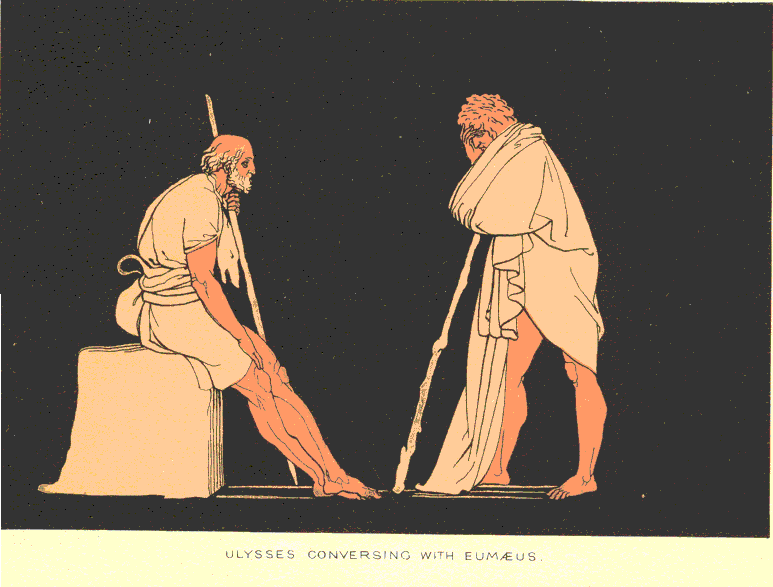
About 50 miles northwest of Peterhead in the Northeast of Scotland, my hometown, where I’m currently passing the summer, lies a beautiful coastal town called Cullen. Its current claim to international undying fame is that it is hosting the film crew at work on Christopher Nolan’s new film, The Odyssey. Matt Damon, apparently a regular visitor to Cullen’s antique shops, is the Odysseus-in-waiting, with the film due to be released in July 2026.
For secular classicists, The Iliad, The Odyssey and The Aeneid form something like a holy trinity of texts; that one of Hollywood’s most interesting and accomplished directors, fresh from the triumph of Oppenheimer, has chosen to dramatize the epic is more than enough to make this jaded heart gently skip a beat. IMR has already published the winner of this year’s high school essay contest, on the topic of the ongoing relevance of the poem, so it seems a good time to declare next (academic) year ‘The Year of The Odyssey’. Which is only to say that IMR will be particularly open to publishing essays about both the poem itself, and its cultural afterlife, not least other films about The Odyssey. I am also open to suggestions to any events or related topics that might be of interest to readers. Get in touch! At the very least, I hope contributors can be involved in some form of discussion and appraisal of the film when it’s released.
To start things, I’ve written a short piece on how I’ve approached reading the poem. It’s a poem that still puzzles me as much as excites me, and one I’ve taken a great deal of pleasure in struggling to understand. I hope this works as an open invitation to readers to read the poem, for the first time or for the hundredth, and join me at IMR on this particular, ever unique literary journey home.
Mark Buchan, In Medias Res Editor
To begin the ‘Year of The Odyssey’, I’ve been trying to formulate how I approach the poem. First and foremost, The Odyssey is a work of literature, a statement which can, in the scholarly world, be a bit controversial. We’ll get to that. But let me dig my hole deeper. It is not just a work of literature: it is a highly sophisticated, learned, self-reflexive, at times enigmatic and obscure text, and an ongoing provocation to our imaginations. It’s not the same as, say, a T.S.Eliot poem, if that’s your modernist idea of sophisticated literature. But it has much more in common with it than you might think, not least in its embrace of opaque, puzzling language. When we see puzzling things, we should first assume, as with any work of literature, that something complicated and interesting is going on. We can then start to improvise around its possible meanings. In my teaching experience, non-scholars do this more naturally than scholars; questioning the text comes intuitively to the curious, which is why, again in my experience, there is so much imagination in undergraduate and high-school writing on Homer.
I thought of this when listening to Damion Searls’ interesting talk about his book, The Philosophy of Translation for Paideia, and in particular his view that nothing is untranslatable. Think of a complex, idiomatic phrase in English that a non-native speaker might struggle to understand. Maybe, ‘a bird in the hand…’ Presumably any such phrase was once a puzzle to the native speaker, so translating it into another language, far from an impossible procedure, re-enacts a process that native speakers once went through. Searls’ argument made me think of an aphorism from Hegel: ‘The secrets of the Egyptians were secrets to themselves.’ The ancient Egyptians, certainly for the Ancient Greeks, were synonymous with secret truths. But our fascination with their wisdom blinds us to the way no culture is complete, sewn up neatly with correct cultural answers. To return to The Odyssey, we can provide important historical context; it’s hard to teach the Homeric poems without explaining, for example, the concept of ‘guest-friendship’ or xenia. But whatever informal rules and regulations cluster around the concept of xenia, it is because it’s already a problem for the Greeks. One can see the Homeric poems as a series of improvised tales on the topic of how difficult it is for humans to deal with strangers. Good luck solving that problem, either in or out of Homer! A translator, of course, has to end the process of translation by making a specific choice. Literary critics have more freedom to speculate, play, improvise around our text.
In this essay, I want to try out some critical improvising around a ‘minor inconsistency’ that the translator Emily Wilson has found in The Odyssey that involves guest-friendship, and in a way that mirrors the poem’s own spirit of inquiry. I should confess that I find these supposed errors a critical challenge, and, as is my wont, prefer to over-interpret them, rather than let them lie. Here, in Wilson’s words, is the problem, along with her solution:
These are written texts that display the legacy of a long oral tradition…Moreover, there are small inconsistencies in the narrative itself, which usually pass unnoticed by the casual reader (such as a slight confusion about how many cloaks Eumaeus possesses, and an apparent switch in who sets up the axes for the contest in which the suitors and Odysseus compete for Penelope’s hand). The inconsistencies could mark the text’s emergence from multiple different earlier versions of the story of Odysseus, or they might suggest multiple stages of composition and revision, by one poet or by many. Yet despite their mixed language, and despite the few inconsistencies, both The Iliad and The Odyssey display striking structural coherence.
Strictly speaking, everything said here might be true. But the emphasis is in all the wrong places. The assumption is that the original oral nature of the poem, told and retold over hundreds of years without a set, written text, naturally produces inconsistencies that the ‘structural coherence’ of the poem hides in the final version. This, in turn, sets up two different kinds of readers: the ‘casual’ one, who doesn’t even notice, and the careful one, who with their scholarly x-ray vision, notices, but only to ignore it. It also sets up a dichotomy between a careful, sophisticated, literary text, and an oral one that is careful about its broad structures, but careless about the little things. But we can, and should, turn this upside down. What if these ‘small inconsistencies’ (the ancient critics would call them problemata, things that ‘stick out’ and require discussion) are not errors, but are already literary traps, puzzles, which we are meant to notice and think about?
To make this all less abstract, let’s go into some detail on the confusion over how many cloaks Eumaeus possesses. In Book 14, Odysseus, still disguised in rags, and officially unknown to anyone on Ithaca, is entertained by his (former?) slave Eumaeus. A little drunk after dinner, he tells a tale that hints that he needs a cloak to keep warm through the night. Eumaeus replies by saying that his tale will get him a cloak, but he can only borrow one, for there are ‘not many’ extra cloaks, there is only one cloak for each man, but that soon Telemachus will return and give him an extra permanent one. This all leads up to the inconsistency, when it turns out later than Eumaeus does have an extra cloak! I give the seemingly unremarkable Greek when Eumaeus outlines the problem, and the translations of Lattimore, Wilson, and as literal a translation as I can manage.
οὐ γὰρ πολλαὶ χλαῖναι ἐπημοιβοί τε χιτῶνες
ἐνθάδε ἕννυσθαι, μία δ᾽ οἴη φωτὶ ἑκάστῳ. (Od 14.513-4)
There are not many extra mantles and extra tunics
Here to change into. There is only one set for each man. (Lattimore)
We have only one outfit each, no spares. (Wilson)
For there are not many cloaks and tunics that can be swapped/exchanged
To wear here, but there is one cloak for each man. (My literal version)
Wilson’s translation seems to be clear about the ‘inconsistency’. ‘No spares’ sets up the later unraveling of the statement, when Eumaeus does have a spare. It’s a bit puzzling, this appearance ex nihilo of a cloak, but presumably casual readers don’t notice. Eumaeus’ response is confusing. But let’s give it some thought.
If we translate line 513 literally, there is no straightforward inconsistency at all. There are ‘not many’ spare cloaks, but each man gets one. Eumaeus sets up an ethical principle: ‘‘We’re egalitarian here, as well as thrifty, so we don’t waste cloaks, and also share them fairly.’ But he also says there are ‘not many’, which is at least ambiguous. It could be an understatement, as if Eumaeus shrugs his shoulders and says, ‘You think we have loads of spares?’ But it says that there are some spare cloaks, and this previews what will happen later: Eumaeus will give the disguised Odysseus his own extra cloak for one night, the one he keeps for particularly cold evenings. Wilson has chosen not to translate line 513, and so has created the very inconsistency she blames on the oral tradition: there are no spares, and yet Odysseus gets a cloak! So is her translation just a mistake? No! I think her instincts, to highlight the paradox of ‘no spares, but Odysseus will still somehow get one’ are good. But we can at least rule out the idea that this is some kind of ‘minor inconsistency’ in the tradition. So why is it useful to place the focus on the ‘no spares’ problem? Let’s give a little more context.
The disguised Odysseus’ tale that evokes Eumaeus’ response is about conjuring a cloak out of nothing. He tells of a Greek spying mission to Troy he once was a part of, where at night the party of Greeks go to sleep near the city. But the night is freezing, and requires a cloak for warmth. One of the Greeks forgot his, and is now scared he may die of cold. He tells Odysseus, one of the expedition leaders, who in turn makes up a fake mission: he contrives to get one of the party to rush back to the main body of Greek ships for reinforcements. Andraimon volunteers, leaves behind his cloak, and hey presto, a cloak appears! We have a solution to the zero-sum game of cloaks. The beggar’s implied message in his drunken tale to the gathering is that he too needs a cloak. Perhaps he also suggests that procuring that extra cloak might take some imagination, as if laying down an intellectual challenge.
What, conceptually speaking, underlies the disguised Odysseus’ wartime spy story? It depends on a rethinking of the concept of ownership. If we stick to one man owning one cloak, we’re lost. We need to think less of the cloak as a possession, and instead something that has a use. Let’s take a simpler example. There are five people, three with one house, one with two, one with none. How does one cure our mini-homeless problem? Well, you could simply appropriate one of the houses of the one who owns two, though those who’ve been watching the ongoing New York mayoral race can probably already hear the paranoid screams of the powerful at such an assault on property. But one can soften the blow by appealing to use. The owner of two houses doesn’t lose ownership of his houses, but instead merely grants the use of the extra house that they are not currently using. The beggar’s tale depends on this kind of logic, but takes it a step further. How to create an extra cloak? Contrive a way that one person doesn’t need to use his cloak for a fixed period, one night, and don’t tell him you’re borrowing it; you could, perhaps, send him off as a courier! Now if this seems like a trick, making a fool of Andraimon, of course it is. But a trick that saves a life in the story, and could, potentially, solve homelessness.
We can now turn to Eumaeus’ response. First, we should note that its vocabulary picks up the key elements of the beggar’s story. He starts with almost a joke:
ὦ γέρον, αἶνος μέν τοι ἀμύμων, ὃν κατέλεξας… (14.508)
‘That was a splendid tale, old man!’ (Wilson)
‘Old sir, that was a blameless fable, the way you told it.’ (Lattimore)
‘Old man, that’s a blameless fable, which you’ve measured/counted out…’ (My literal version)
In a story that is all about producing something from nothing, I suspect it’s not a coincidence that Eumaeus uses a verb, ‘καταλέγω’ (katalego), that suggests more than simply telling a tale, but the metaphor of measuring, or counting out. ‘I’ve noticed how your tale is all about how counting isn’t simple, that we can contrive to produce something from nothing’, Eumaeus’ use of the word suggests. Eumaeus’ reference to the blameless fable is also a nod and a wink to the beggar’s speech. The disguised Odysseus begins his tale with an apology, suggesting the speech he’s about to give is the wine’s fault: ‘οἶνος γὰρ ἀνώγει / ἠλεός’ (14.463-4), ‘the wine (oinos), that makes people crazy, compels me…’ To do what? Say things that should normally remain unspoken (ἄρρητον). So wine too can produce something, words, from what should be nothing, a polite silence. Further, Eumaeus’ word for ‘fable’, αἶνος (ainos), a letter away from the word for wine (oinos), also suggest that Odysseus’ worry about breaking social decorum is unfounded. Your tale, and the wine that lies a letter behind it, one letter away, are not morally problematic at all, he suggests. Or is it a hint that he does see some blame in Odysseus’ crafty hidden agenda behind the tale/wine, while only the wine remains blameless? Regardless, the idea of ‘blame’ is important. The beggar’s story takes a risk, and Eumaeus’ response may, or may not, put him at ease.
Eumaeus’ speech also picks up the details of the counting dilemma. In articulating his ‘one cloak for one man’ principle, he registers the central problem of the ‘warrior without a cloak’ tale. In mentioning the lack of swappable cloaks (ἐπημοιβοί), he shows he notices the ‘swap’ of the cloak from Andraimon, the new designated courier, to the cloakless warrior, engineered by Odysseus. But Eumaeus makes this logic game seem ordinary, prosaic. In the real world, things are not usually some kind of prisoner’s dilemma; there are usually some spares around, if not many, though this does conflict with the egalitarian principle of ‘one man one cloak’. These kinds of paradoxes of possession float in and out of our daily lives. They are also a good source for humor. In my college days, the definition of a student was someone who had no money, but somehow always had enough to buy a drink at the bar. You turn the ordinary, daily presence of conniving and resourceful students into an impossible conundrum, and let loose a little comic aggression at students’ status: they are less poor than they make themselves out to be. Freud loved these jokes of logical impossibility, and reading through Jokes and their Relationship to the Unconscious wouldn’t be a bad way to get into the trickster games of The Odyssey. Though this joke, perhaps, isn’t all that funny any more as students are a little too debt-ridden and beleaguered to be fair targets for the joke’s aggression.
So is the inconsistency problem solved? Not really. The form his answer takes, creating the confusion about cloaks, brings its own problems. Here is Lattimore’s version of Eumaeus’ continuation.
There are not many extra mantles and extra tunics
Here to change into. There is only one set for each man.
When, however, the dear son of Odysseus comes back,
He will give you a mantle and tunic to wear as clothing. (Od 14.513-17)
Eumaeus could have simply said he would lend Odysseus his spare cloak for a night, but he would need it back, and Telemachus will later give him one permanently. Instead, Eumaeus too turns a non-problem into a problem. ‘Yes, there are spares. But this goes against the egalitarian one-man-one-cloak principle. But don’t worry about it now, as you’ll get your own one later when Telemachus returns.’ In other words, Telemachus’ return will solve the (fake) zero-sum problem that Eumaeus has constructed for himself, after admitting there are a few extra cloaks. What’s going on?
Eumaeus’ twists and turns makes me think of ‘kettle logic’, whereby you blurt out a series of answers to an accusation (you are accused of borrowing a kettle, then returning it damaged) that each work, but are mutually inconsistent (it wasn’t damaged, the kettle was already damaged when I borrowed it, I never borrowed it etc.). The inconsistency hides something. If the kettle-borrower is so innocent, why the overdose of excuses? So why doesn’t Eumaeus want to admit he has an extra cloak? The episode gets at the heart of Eumaeus’ literary persona. On the one hand, he is a loyal (and very sycophantic) slave, the social equal of his fellow-slaves, who in turn adhere to the ‘one-man-one-cloak’ principle. On the other, he is an aspiring bourgeois who does a little better for himself, and has an extra cloak. In other words, he wants to have his cloak and to let Odysseus use it, while still clinging to the self-image that he’s a principled egalitarian. He may not be the master, Telemachus, who can be generous with cloaks freely, but he is one step above his seeming equals, the fellow herdsmen with one cloak. Some slaves, it seems, believe themselves to be more equal than others. So what is a logical problem in the tale of the spy with no cloak (how can you procure an extra cloak from nowhere?) turns into a subjective problem for Eumaeus. To give Odysseus his spare cloak openly means he would both be stepping dangerously close to the master’s toes as cloak-giver, while hinting at his superiority over his imagined equals. All of these complexities will play out later in the poem, and in particular during the bow contest.
We could push the ‘inconsistency’ further. Problems of counting, which often turn to trying to account for the value of what is missing, are a Homeric obsession. If we replay this exchange by replacing ‘cloak’ with ‘woman’, we find ourselves at the start of The Iliad, as Achilles and Agamemnon furiously debate the value of their slave concubines, and problematic plus-ones, Chryseis and Briseis. When Agamemnon agrees to give up Chryseis, but demands she be replaced, Achilles suggests that the Greeks (replacing the returning Telemachus for Eumaeus, who will give the beggar a cloak) will give him a new slave-girl in the future, after their next war raid. But Agamemnon immediately sees through this as a trick, a way of perpetuating his own shame and current helplessness, lacking a ‘plus-one.’ The lack of slave-object has immediate consequences for how Agamemnon perceives himself. Eumaeus avoids this impasse by lending Odysseus his extra cloak, but saving face by not admitting it’s his own; and this has been neatly set up by the possibility it’s one of the ‘not many’ lying around.
Are Chryseis and Briseis ever really the ‘plus-ones’ of the heroes? It’s an interesting English phrase, hinting that anyone who takes on the role is part of an ongoing group of ‘ones’, different dates for every occasion. But even to mention 'one' hints at the usual logic of coupledom, that one plus one equals two, that a plus-one can be the one. Plus-ones live in this inbetween world.
Chryseis and Briseis are complicated. Agamemnon treats Chryseis as if she is a makeshift, ad hoc wife at Troy, and Achilles claims he loves Briseis. Both, then, are more than simple objects to be counted, but how much more is unclear. Like a plus-one. And this returns us to the peculiar circumstances of Eumaeus. His extra cloak is itself doubled by another interesting possession, who appears at the start of the evening’s dinner:
Messaulios served the bread to them, a man whom the swineherd
Owned himself by himself and apart from his absent master,
And independently of his mistress and aged Laertes. (Od 14.449-51)
Our slave has been contriving to create a modicum of independence from Odysseus’ family, but most likely in secret. Earlier, when he talks of his circumstances to the beggar, he chooses to emphasize instead what he lacks, and what potentially a good master might give him, a wife and a mini-household to mirror Odysseus’. The strange situation on Ithaca has created a curious in-between space for the slave, where he is neurotically trapped between two desires. First, to be free, have his own oikos, with his own slave as the first step, and it’s the relative freedom produced by the master’s absence that has allowed this. But the possibility that Odysseus remains alive helps him cling to his official identity as loyal slave, waiting for an unexpected gift from the master who, in his imagination, still owns him. Even his vision for a good, free life is itself faithful to that of his master: a mini-oikos, with wife, child, slave–the very thing Odysseus is trying to restore. Eumaeus’ in-between status is in keeping with all the major characters in The Odyssey, trapped in an Ithacan world where nevertheless the absence of authority gives them a limited freedom.
Does Eumaeus know what he’s doing with his extra cloak? I doubt it. Are my interpretative suggestions right? I’m not entirely sure. But I am sure it’s more than a minor inconsistency of the tradition. Let’s say, instead, that the ‘secret of Eumaeus’ cloak is a secret to us, and likely to himself’, but not one we should be afraid to explore.
Sign up to receive email updates about new articles

Comment
Sign in with