


Lies, Lies, and More Lies in Homer’s Odyssey
Mike Fontaine·August 8, 2025
Has Odysseus had us, and the Phaeacians, fooled all this time?
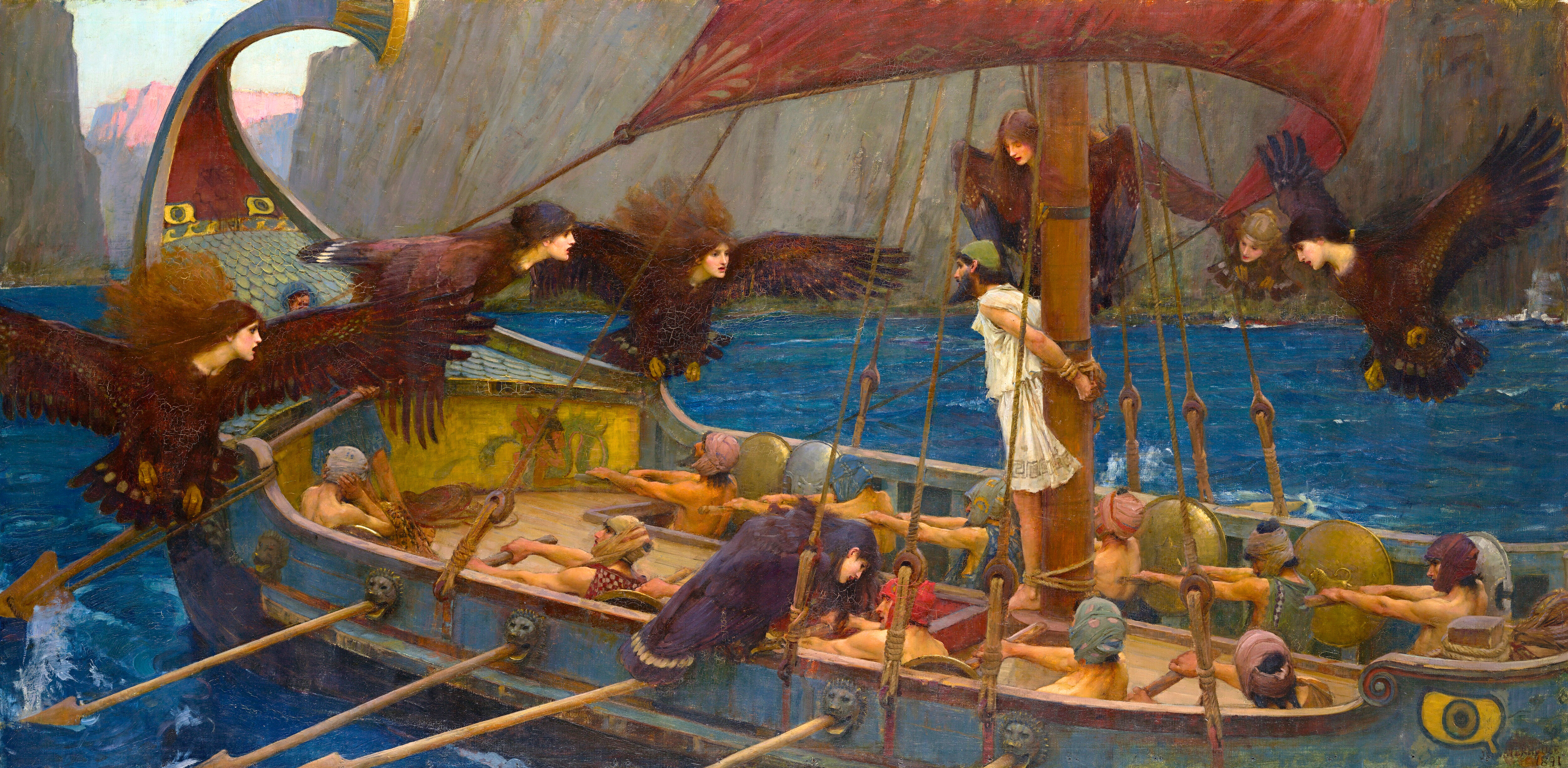
In grad school I took a rapid-reading course on Homer’s Odyssey. We read the whole thing in Greek in one semester. It was my first year in the program, and it was exhilarating. I used Heubeck, West, and Hainsworth’s Commentary on Homer’s Odyssey to help make sense of it as we went, and all these years later—nearly 30, to be exact—I still remember one remark vividly. It’s this (in volume 2, p. 179, on Odyssey XIII.256–86):
“In his made-up tales Odysseus always pretends to be a Cretan.”
That caught my attention because I knew the expression “All Cretans are liars”, and I wondered whether Homer knew it too and if that was part of the joke, or whether the expression originated in these made-up tales Odysseus tells in the Odyssey.
But all the time I spent thinking about that led me up a garden path, and it was a long time before I realized what went wrong.
Can you guess, or already see, what the problem is?
There’s no point being coy, so the problem is this: the remark implies that any time Odysseus tells a story and does not say he’s from Crete, he’s telling the truth.
And that implication had me misreading the entire epic for a long, long time.
The Romans have a saying: falsus in uno, falsus in omnibus (“untruthful on one occasion, untruthful as a matter of course”). Our legal system subscribes to the same idea. You see it when a witness gets caught in a contradiction or lie, and the opposing counsel angrily demands to know, “Were you lying then, or are you lying now?”
If you think back to the whole Odyssey, you’ll see where I’m going with this.
The problem, see, is that the most interesting and memorable part of the Odyssey is the central section, Books 9–12. That’s when Odysseus takes over the narrative. He’s just washed up naked on the island of Scheria and been brought to the palace of the Phaeacians.
“What happened?” he’s asked by King Alcinous, flanked by Queen Arete and their daughter and a roomful of Phaeacian courtiers, at the very end of Book Eight. “Tell us everything.”
Odysseus goes on to tell all kinds of stories—amazing stuff! Giants, cannibals, horrific deaths, daring escapes, bravado, sirens, enchantresses, vortexes, winds in a bag, thermonuclear wine, Scylla, Charybdis, men turned into pigs…
Now, for many years, in my wide-eyed innocence, I assumed that all this is true within the story. In fact, I realize now that a great deal of modern scholarship—maybe most of it—shares that assumption. Students routinely do. It’ll be interesting to see what Christopher Nolan does with it in his new movie.
In this connection, though, it’s worth noting that Homer himself tells us right at the start that Odysseus’s tale isn’t true. It’s basically the first thing he says—and he isn’t shy or subtle about it. In Daniel Mendelsohn’s fine new translation, Homer says (Odyssey 1.1–2, 5–9):
Tell me the tale of a man, Muse, who had so many roundabout ways
To wander, driven off course, after sacking Troy’s hallowed keep…
As he struggled to safeguard his life and the homecoming of his companions.
But he did not save his companions even so, though he longed to,
For their heedlessness destroyed them, theirs and nobody else’s—
Fools that they were, like children, who devoured the sun-god Hyperion’s
Cattle, and so he [i.e. Hyperion] took from them the day of their homecoming.
That sounds pretty conclusive: the men got themselves killed because they heedlessly devoured the sun-god’s cattle. Homer even calls them idiots (nēpioi) for doing it!
But that’s pretty far from what Odysseus says happened.
Remember, Odysseus’ goal is to get out of here and get back home. He has no way to do that—no boat, no money, not even a pair of underwear. All he has is his metis, his cunning. He’s good at telling lies that look true—lies that might be partly true, or sort-of true, or that can engage people’s emotions. And he knows, because Athena told him in Odyssey 6.4–10, that the Phaeacians once dwelt near the Cyclopes, and had been plundered continually by them until their king removed and resettled them in Scheria.
A skeptic might wonder if that’s one reason the Cyclopes come across as so monstrous in Odysseus’ account.
And don’t forget, Odysseus is the sole survivor. I mean, it’s not like any of his men are there with him who might contradict his story.
(This is a huge difference, by the way, from Aeneas’ situation when he washes up in Dido’s court in Aeneid 1–3 — and it’s one of many reasons why Aeneas’ lies there are even more skillful and impressive than Odysseus’ here.)
By the time it finally dawned on me that with these crazy stories, Odysseus probably isn’t telling the Phaeacians the truth, the whole truth, and nothing but the truth, I realized I was late to the party. A few modern scholars had already pointed this out. Ahl and Roisman’s The Odyssey Re-Formed is especially good on this. What most don’t mention, as far as I know, is that in later antiquity it was simply taken for granted that Odysseus is lying in Odyssey 9–12.
In antiquity, Lucian (a satirist of the Roman era, writing in Greek) says so in the introduction to A True Story (trans. Fowler & Fowler):
Many others have written about imaginary travels and journeys of theirs, telling of huge beasts, cruel men and strange ways of living. Their guide and instructor in this sort of charlatanry is Homer’s Odysseus, who tells Alcinous and his court about winds in bondage, one-eyed men, cannibals and savages; also about animals with many heads, and transformations of his comrades wrought with drugs. This stuff, and much more like it, is what our friend humbugged the illiterate Phaeacians with!
He says it again in Book 2:
Iambulus’s Oceanica is full of marvels; the whole thing is a manifest fiction, but at the same time pleasant reading. Many other writers have adopted the same plan, professing to relate their own travels, and describing monstrous beasts, savages, and strange ways of life. The fount and inspiration of their humor is the Homeric Odysseus, entertaining Alcinous’s court with his prisoned winds, his men one-eyed or wild or cannibal, his beasts with many heads, and his metamorphosed comrades; the Phaeacians were simple folk, and he fooled them to the top of their bent.
Well, fine, you say. Sure. But come on—Lucian was a huge skeptic! He didn’t believe anything. So his disbelief is just part and parcel of that.
Not so fast, though. Juvenal, the Roman satirist who wrote in Latin—and who died right around the time Lucian was born—says basically the exact same thing, and he emphasizes the crucial reason why Odysseus can get away with it (Satire 15.13–26, tr. G. G. Ramsay modified, emphasis added):
When Odysseus told a tale (facinus) like this over the dinner table to the amazed Alcinous, he stirred some to anger, some perhaps to laughter, as a lying virtue-signaler (mendax aretalogus). “What?” one would say, “will no one hurl this fellow into the sea?
He deserves a terrible and true Charybdis, with his inventions of monstrous Laestrygones and Cyclopses! I could sooner believe in Scylla and the clashing Cyanean rocks and bags full of stormwinds, or in the story how Circe, by a gentle touch, turned Elpenor and his comrades into grunting pigs. Did he think we Phaeacians are so devoid of brains?”
That’s how someone might justly have spoken who wasn’t tipsy yet, and had taken only a small drink of wine from the Corcyraean bowl, because the Ithacan’s tale was all his own, with none to bear him witness.
So what do you think? Is the most famous part of the Odyssey—the part that dominates every children’s book, every modern retelling, every graphic novel, and even the Simpsons parody—is that whole section a recitation of the facts, like you get from a messenger in Greek tragedy? Or is it more likely a pack of self-serving lies Odysseus tells to aggrandize himself, to get away from the princess who hopes to marry him, and to score a free ride back to Ithaca?