

Love Again
Ibycus on getting back out there
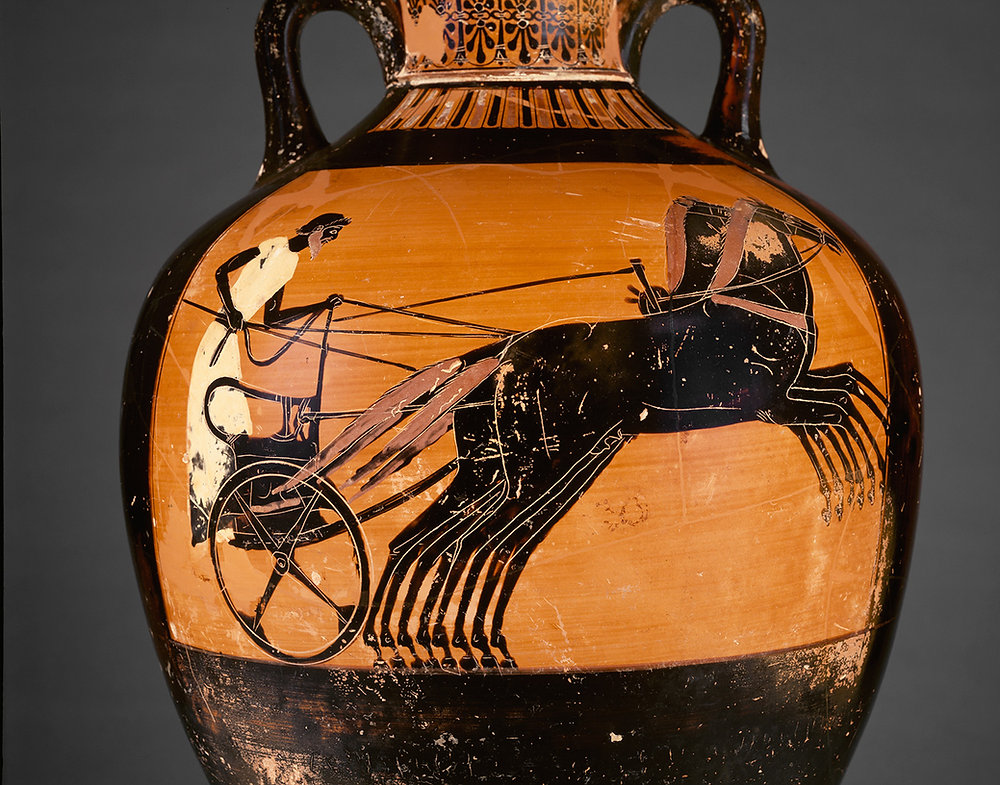
Love again! Another year passes, and Valentine's Day returns, and at IMR we now have the beginnings of a tradition. Last year, I invited Kirk Ormand and Joy Connolly to share their thoughts about Plato's Symposium. This year, I invited them to pick one of their favorite love poems from antiquity and reflect on why they like it. As you'll see, and as Joy Connolly pointed out to me, we all happen to focus on the feelings of vulnerability love instills in us, the nervousness and raw openness to others that is bound up in love's symptoms. We offer these in the hope that a reader or two might be inspired to share a love poem, ancient or not, with their inner circles, perhaps even one of the three we have analyzed here, with as much care and love as we are able.
Ἔροϛ αὖτέ με κυανέοισιν ὑπό
βλεφάροις τακέῥ ὄμμασι δερκόμενος
κηλήμασι παντοδαποῖσ’ ἐς ἅπειρα
δίκτυα Κύπριδι βάλλει.
ἦ μὰν τρομέω νιν ἐπερχόμενον,
ὥστε φερέζυγος ἵππος ἀεθλοφόρος ποτί γήρᾳ
ἀέκων σὺν ὄχεσφι θοοῖσ’ ἐς ἅμιλλαν ἐβα. (Ibycus 7)
Love again, looking out at me from beneath dark eyelids with those eyes, making me melt, hurls me into the boundless nets of Aphrodite, using every kind of charm. Naturally, I tremble at his approach, just as a prize-winning horse, bearing the yoke, on the edge of old age, goes unwillingly into the struggle with its swift chariot. (my translation)
There is something beautiful about the world-weariness that opens this poem. Love? Again? Really? At my age? Hinting at the banality of the same old story, it nevertheless asks us to come along for one last go. Later, we find Eros hurls him into the limitless nets of Aphrodite, and the recognition of love’s spatial power mirrors the temporal power in the opening words. Love knows no limit of time either; there’s no peaceful retirement into a safe old age. Instead, love insists and insists, keeps coming at you, keeps forcing you to get ready for the fight. Love again.
There are two marvellous details I’d like to examine. First, the poet personifies love as Eros, the behind-the-scenes orchestrator of the whole show. The poet sees, beneath the eyelids, the love god himself, shooting arrows in the guise of glances at the subject from a safe hiding place beneath the lids. The eyes themselves are not his eyes, but rather his instrument, part of his bag of endless tricks to keep the game of love alive. So neither lover nor love-object is in control; the lover is Eros’ victim, but so too is the love-object, their eyes simply a tool to entangle them both in the immensity of the lover’s discourse. The speaker knows this, but it’s not at all clear that the knowledge matters, or can offer protection.
Second, the almost unnoticeable adjective ‘swift’ describes the chariot to which the lover is yoked. Chariots, of course, just are swift, as in Homer, Achilles is always swift-footed, even when at a standstill. It looks like an empty epithet. But of course it isn’t. Epithets never are. The chariot is swift, but will the old horse be able to keep up? Will the performance be able to match the sleek, snazzy chariot equipment? The motif of chasing and catching for love is already a cliche in Greek poetry by the time of Ibycus. But here it’s internalized. The problem is not trying to catch a lover who runs away, but instead to keep up with one’s own image, and in particular the image of the ‘equipment’ you are yoked to, which makes you look younger, faster, more competent than you probably are. It’s a love poem wrapped up in performance anxiety.
Is the poetic ‘I’ in this poem male? That is, is it an examination of male sexual performance anxiety? Marx, in the famous opening lines of The Grundrisse, talks of the speed and power of Achilles only to question whether such power matters in the modern age. Is Achilles even possible in ‘the age of gunpowder and lead?’ To translate for Valentine’s Day, what is male performance anxiety in the age of Viagra or Cialis, nifty tricks to match biological inside with the projected cultural self on the outside, and counter the limitless power of the love-god? But Marx surprises us. The real problem, he claims, is why Achilles still gives us artistic pleasure and remains an ‘unattainable model’ of aesthetic perfection. The more equipment you bring into the love battle, just as with the greater productive power you bring into an economy, the closer you get to asking yourself what we all do it for. For me, Ibycus’ poem is as good an examination of the kind of self-doubt love can engineer as it gets.
But before we rush to make our speaker masculine, we should at least note the lack of any gender markers in the poem. Scholars love to historicize poetry, to fill in the blanks of the dramatic situation by, for example, using biographical snippets about Ibycus as a pederast to suggest the love object is a boy. But should we? Irving Berlin, in his 20th-century ‘rules’ for writing a hit song, suggests that the ‘I’ should never be gendered. If anyone could sing it, market share remains as wide as possible. Anyone can sing this lyric poem: the split between inside and outside figured via the swift chariot can easily be applied to women, and this, I suspect, is deliberate. Will you still love me tomorrow, when the expensive make-up, the metaphorical war-paint, has worn off? Perhaps the ‘I’ is not even literally old. Old age appears only in the analogy: the lover is like an aging race-horse. A year ago, I suggested that love makes children of us all. Perhaps it also makes old people of us all. It confronts us with the fragility of our body, the way it escapes our control, ‘surrounds us with its own decisions’, and is too often caught up in a mismatch with our desires. But this is just as true for the young as the geriatric. Ibycus’ old soul probably understood.
Sign up to receive email updates about new articles

Comment
Sign in with