

Sic Semper Tyrannis Revisited
A closer look at George Wythe's Latin motto on the Virginia seal
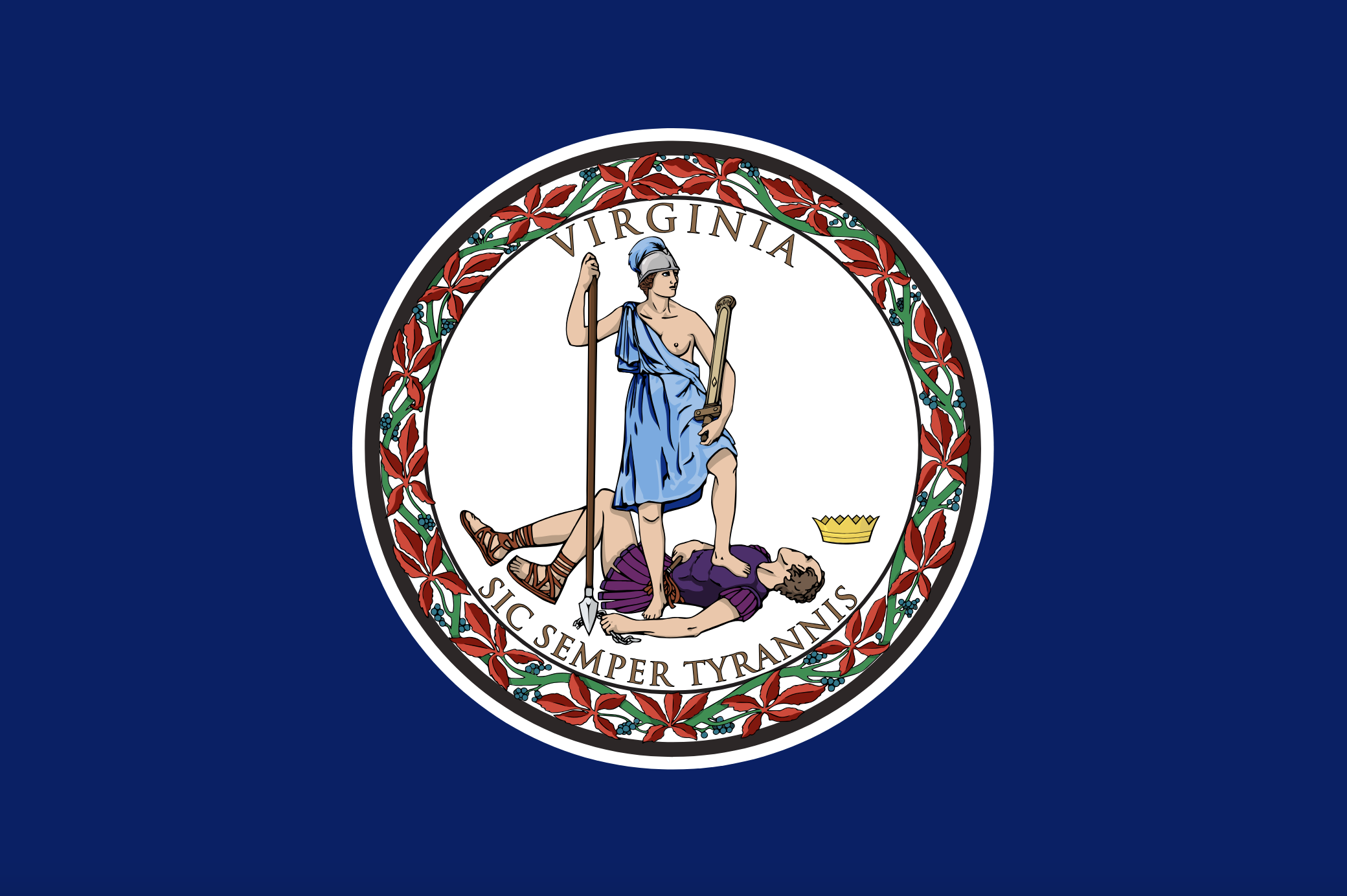
In 2021, in this very magazine, Mike Fontaine made a compelling argument that Virginia Founding Father and classicist George Wythe came up with the famous motto on Virginia’s seal, Sic Semper Tyrannis (thus always to tyrants), by translating a Greek line from Homer, as quoted in Plutarch, into Latin. As Professor Fontaine notes, Plutarch reports that when the Roman general Scipio Aemilianus had heard that his own relative Tiberius Gracchus had been assassinated by Roman senators, he responded by quoting a line from Homer (Plutarch Life of Tiberius Gracchus 21.4 quoting Homer Odyssey 1.47):
ὡς ἀπόλοιτο καὶ ἄλλος, ὅτις τοιαῦτά γε ῥέζοι.
May any other person who does these types of things die in the same way.
Professor Fontaine’s article traces a sequence of borrowings in which Plutarch uses the original Homeric line, which refers to the usurper Aegisthus, to characterize the Roman statesman Tiberius Gracchus who seemed to some (including Scipio Aemilianus) to have become tyrannical. Then, George Wythe takes the line from Plutarch (while slightly altering it and translating it into Latin) and uses it to characterize Great Britain’s recent overreach against the American colonies.
While I was totally convinced by Professor Fontaine’s view that Wythe adapted the line from the Plutarch quotation (put in the mouth of Scipio Aemilianus) rather than the original Odyssey passage, I wondered if there might be some evidence from Wythe’s intellectual background that made the theory even more secure. Luckily, the scholars at the Wolf Law Library of William & Mary, where Wythe was the first law professor, have meticulously documented all surviving evidence concerning Wythe’s intellectual life and have even recreated Wythe’s library using inventory records.1
It should be noted that Wythe was an excellent classicist and reader of Greek, who often engaged with ancient works in their original languages. To provide just one example, he consulted Demosthenes when deciding a case as a judge on Virginia’s High Court of Chancery. He had an impressive library of classical works both in their original languages and in translation. Luckily, an inventory survives of the books which were bequeathed to Wythe’s student, Thomas Jefferson, after the former’s death in 1806. The inventory records multiple copies of the Odyssey – both in Greek and in translation – but only a set of Plutarch’s Lives in translation.
While I find it very likely that Wythe also owned a copy of the Lives in Greek which, for some reason, was not inventoried, I admit I have no evidence to back up this hunch. Thus, I decided to have a look at the editions of the Odyssey and the Lives that we know Wythe definitely owned to see if I could find some more clues pointing to either Homer or Plutarch quoting Homer as the inspiration for the Virginia motto. I first consulted Wythe’s Odyssey edition, of which luckily Archive.org has an electronic copy online. The edition has a corresponding Latin translation right next to the Greek, which renders 1.47 in this way:
Sic pereat & alius, quicunque talia fecerit!
May thus any other die who has done these types of things.
The Latin translation is close to the original Greek and, as Professor Fontaine notes, Sic is the typical word a Latin translator would use for the Greek ὡς (thus). While Wythe could have certainly adapted the motto directly from either the Greek or the Latin translation of this volume of the Odyssey, there is nothing that explicitly points that way.
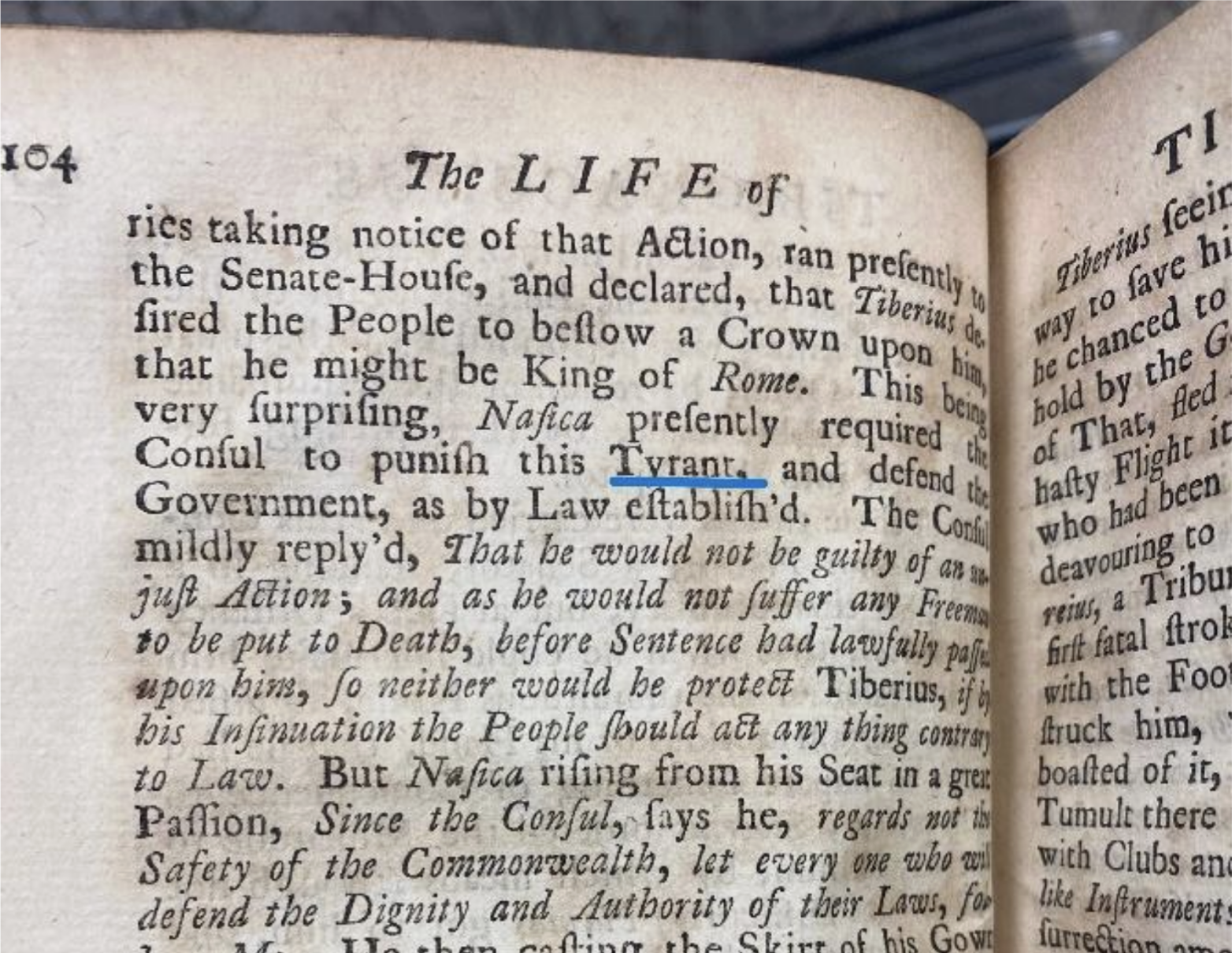
Even though the only recorded edition of Plutarch’s Lives owned by Wythe is in translation, I decided to head over to William & Mary’s Wolf Law Library to have a look at it (and specifically the Life of Tiberius Gracchus) just in case it might have some clues on the motto. First, I went to section 19.3 to confirm that the translator did in fact use the English word “tyrant” to render the τὸν τύραννον, which, according to Plutarch, Scipio Nasica uses to characterize Tiberius Gracchus. Unsurprisingly, the translator, André Dacier, does so (I’ve underlined it in the picture below). Thus, even if Wythe is only working from this translation, while reading it he could have connected the figure of a tyrant with the quotation of Homer by Scipio Aemilianus that comes a few sections later.
Next, I checked section 21.4, where the quotation of Homer, which Professor Fontaine thinks inspires the motto, is located. Incredibly, Dacier, who writes the entire rest of the Life of Tiberius in English translation, felt the need to provide the actual Greek of Scipio quoting Homer (ὡς ἀπόλοιτο καὶ ἄλλος, ὅτις τοιαῦτά γε ῥέζοι; Odyssey 1.47).
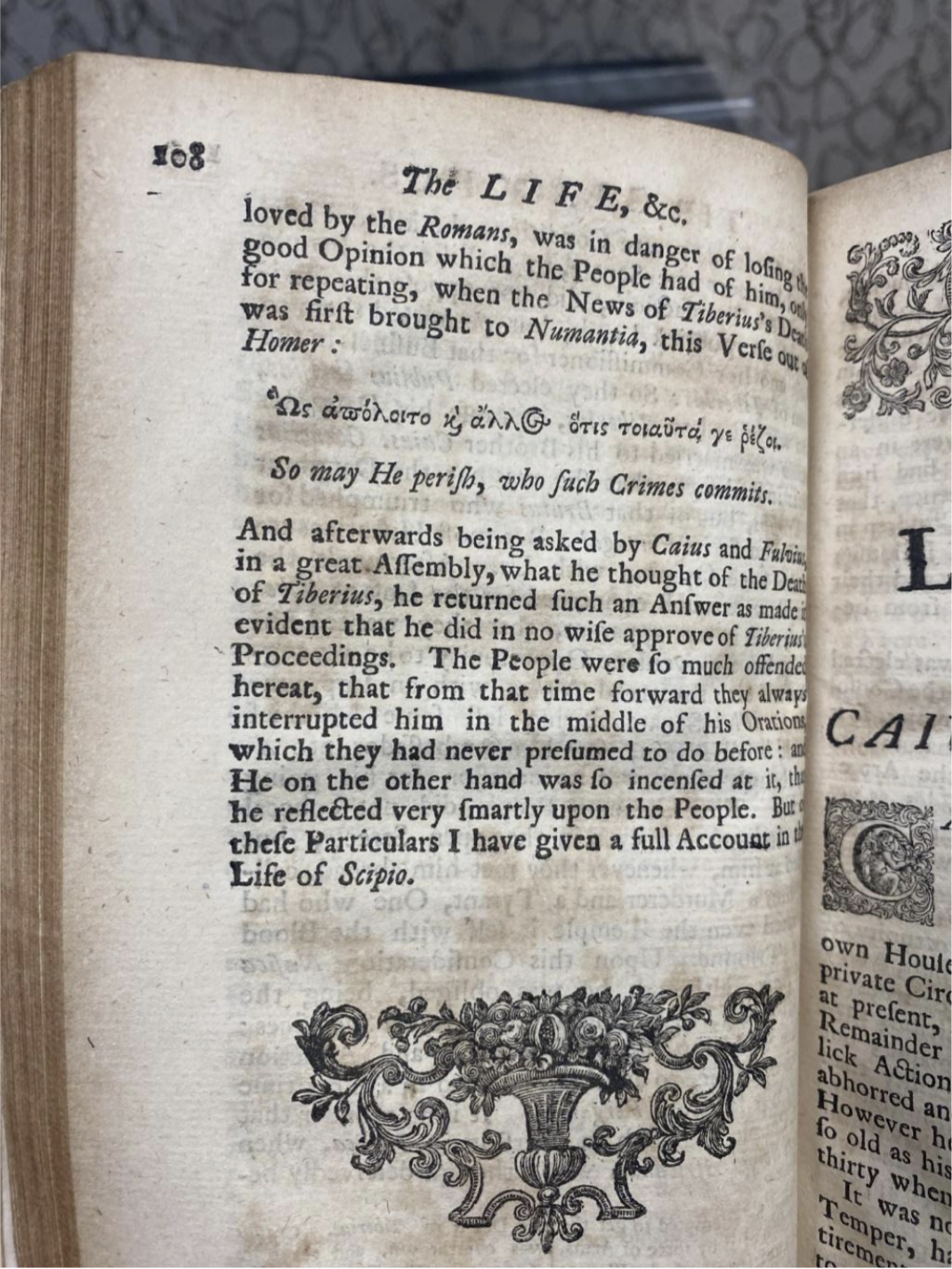
The fact that Wythe’s translation of The Life of Tiberius features this line in Greek further supports Professor Fontaine’s theory that he is getting the motto from Plutarch rather than the Odyssey. In addition to the tyrant connection already noted by Professor Fontaine, the line itself would have clearly stood out to Wythe as the only Greek in a sea of English as he finished up Tiberius’s biography. Also, Dacier takes a liberty in his English translation of the line:
So may He perish, who such crimes commits.
“Crimes” is not in the original Greek, which just has the direct object τοιαῦτά (“these things”).2 Nevertheless, such a characterization of the tyrant’s actions would have been appealing to Wythe when he was searching for a motto to describe resistance to Great Britain. In 1776, around the same time he would have been creating the seal and writing the motto, Wythe also drafted a preamble to a resolution on privateering. While the preamble was never published, multiple copies exist, and Wythe’s prose describes Great Britain as partaking in “open Robbery.” In this text, Wythe also compares Great Britain to a Roman tyrant, describing the nation as the “enemies of the human race” (hostes humani generis), which is a quotation of Pliny the Elder describing Nero (Natural History, 7.45). While variations of the phrase hostes humani generis were common in colonial era publications, Wythe’s devotion to classical literature makes it likely that he knew the source of the Latin even if his other contemporaries who used the phrase did not.
Thus, while Wythe himself was an enthusiastic Hellenist, he seemed to prefer Roman events and figures as lenses to interpret his own times during the tumultuous 1770s.3 On a more personal level, he quotes Virgil’s Aeneid to console Thomas Jefferson after a house fire had destroyed his estate and library. Since the Roman goddess of Virtus slays the tyrant, the committee tasked with designing the seal by Virginia Convention of 1776 was clearly aiming to use Roman motifs (“the Genius of the commonwealth” is how the committee describes her). Wythe, the great classicist of his day, seems to have found his inspiration for the motto in Plutarch, a Greek writer of Roman history. Through interpretation and translation Plutarch’s quotation of the line (as well as inspiration from Dacier’s loose English rendering), he created a motto that remains on Virginia’s flag today and has been quoted by figures as distant in time and space as John Wilkes Booth and characters from Seinfeld.
1. Throughout the rest of this piece, I often link to Wythepedia, William & Mary’s Wolf Library database on George Wythe. I am grateful to Wythepedia’s Managing Editor, Linda K. Tesar and Site Administrator/Associate Editor, Steve Blaiklock, who both run the site and provide me with invaluable insights whenever I have inquiries about Wythe.
2. I must credit Professor Fontaine, who pointed out the importance of “crimes” to me.
3. I should note that Wythe was willing to put Greek on a seal. In 1791, he uses an Aeschylus quote while creating the seal for Virginia’s High Court of Chancery. I imagine that, for the state seal, Wythe feels the need to create a motto in Latin since Latin language learning was more widespread in the colonies than that of Greek. He himself was the judge for the High Court of Chancery and perhaps felt the freedom to use a Greek quotation for a seal that would have a much smaller audience within the colonies.
Sign up to receive email updates about new articles

Comment
Sign in with