

Teaching Roman Elegy through Taylor Swift
Catullus, Propertius, and Tibullus decoded by Swifties
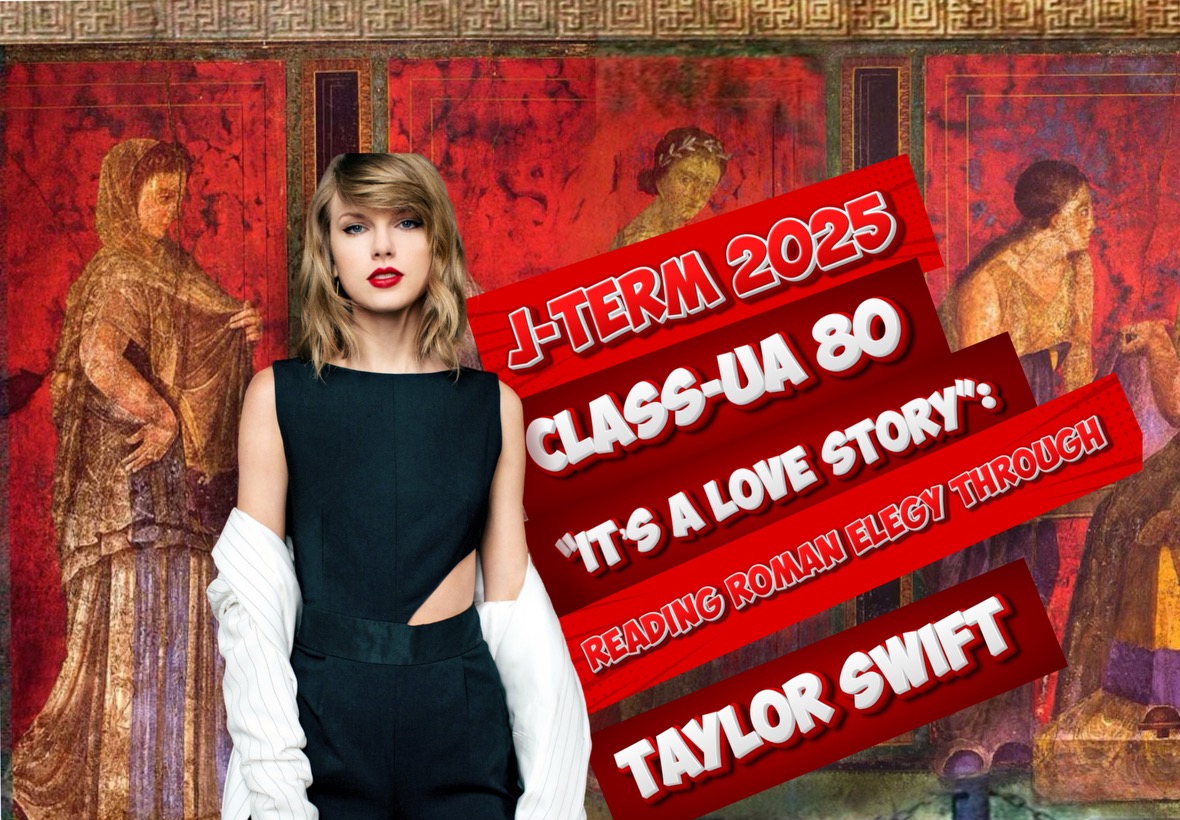
This is a ridiculous idea.
That was the thought that went through my head, as soon as the idea came into it. Totally ridiculous. No one could possibly take this seriously.
It was November 2023, and I had just been reading a newspaper article about an English professor at Harvard, Stephanie Burt, who was planning an undergraduate course on Taylor Swift. In some sense this was hardly surprising news: Taylor Swift had dominated the cultural scene in the previous few months, with her world-spanning Eras Tour, which would eventually continue until the autumn of 2024, and the whole of public media had been full of breathless commentary touching every aspect of her life and work and reception. But still, an English course at Harvard, by a serious, respected professor. This was something different.
It was not Professor Burt’s course that seemed ridiculous to me: on the contrary, it made perfect sense. That popular music could be the stuff of literary criticism was hardly a new idea, and after 2016, when Bob Dylan was enshrined in the modern poetic canon by being awarded the Nobel Prize, few people would ever question the appropriateness of it. And I, like most classicists of my generation, was well aware that, long before the Nobel Prize, Richard Thomas, himself at Harvard, had pioneered the study of Dylan with a famous course, and subsequently a book, relating Dylan’s songs to a classical background.
No. The ridiculous idea was not Professor Burt’s course, nor the other Taylor Swift themed courses to which the newspaper alluded. The ridiculous idea was: “I could do this. I could teach a Classics course on Taylor Swift”.
There were reasons this seemed ridiculous. I thought there might be a struggle to persuade people to take such a course seriously. An English professor could pair the study of Taylor Swift with writers by whom she was overtly influenced: the early Romantic poets, or Charlotte Bronte, or Daphne Du Maurier. The key to Professor Thomas’s Classics-themed examination of Dylan was a series of claims about Dylan’s own background in and interest in Classical literature, and a demonstration of extensive intertextual relationships between Dylan and the Greek and Roman poets. I am a keen and careful listener to Taylor Swift, and I feel confident in saying that there is no such intertextual connection here. There are occasional references to commonplaces originating in antiquity: the “Midas touch” in Champagne Problems, the “Achilles heel” in State of Grace. But that is not the stuff of which a university course is made.
And yet.
Contrary to what many assume, comparative literature, like comparative history, does not require any kind of linear connection, whether direct or indirect, between the things compared. The intellectual justification for making the comparison is that, by comparing similar things from different cultures, one can defamiliarize elements of literature or life which may otherwise seem unremarkable, inviting a new perspective and different kinds of explanations for them.
What parallels might a classicist find in Taylor Swift?
Taylor Swift is a songwriter of spectacular brilliance, but the devotion she has generated among her millions of followers extends beyond that. Famously, her songs invite autobiographical interpretations, encoding in teasing ways aspects of her relationships, of her public and private life – but at the same time entwining them with fictional stories of invented people. And it is not hard to find an analogy for that in antiquity. The Roman elegists, above all Catullus, Propertius, and Tibullus, present through their works sequences of poems which invite us to read them as real affairs, with real women. Centuries later a speech by Apuleius purports to decode the women for us, but even without that decoding, the invitation is there, as the fictional names weave through a created world with real people.
When Catullus tells us that Lesbius est pulcher (79.1: “Lesbius is handsome”) he is himself teasingly inviting the reader to link the identity of “Lesbia” to “Clodia” via Clodius Pulcher. Nothing in Propertius or Tibullus is quite that neat, at least from the perspective of our limited knowledge, but we can at least note that “Cynthia” and “Delia” and “Nemesis” inhabit not a fictional world, but a world populated by easily identifiable Romans with familiar names. Any reader who is part of that world will be drawn into the act of decoding, of attempting to disentangle fiction from fact. Lesbia = Clodia is real – perhaps – but what about Catullus’ male lover Juventius? What about Septimius and Acme (Catullus 45)? Where do we draw the lines?
And Taylor Swift invites something similar. If the “John” of Dear John is the singer-songwriter John Mayer, as the song itself strongly hints (the unusually lengthy guitar opening is a pitch-perfect parody of Mayer’s style), then are we to assume that when, a decade later, Taylor Swift alludes back to that song in Would’ve, Could’ve, Should’ve, that too is “about” John Mayer? What of the further allusion in the song Honey on Swift’s latest album, “The Life of A Showgirl”: is that indeed, as appears to be the case, filling out an unexplained detail in the narrative of Dear John? If the lover of Taylor Swift’s epic song All Too Well is indeed, as widely canvassed online, the actor Jake Gyllenhaal, then surely The Moment I Knew, on the same album, which centres on a party which sounds like one alluded to in passing in All Too Well, must also be about him. But how far can we take that through the album? Several other songs on it reference love affairs, and various of them have been proposed to be about Gyllenhaal – but the grounds are sometimes flimsy, and it is hard to create a picture of a single love-affair out of the separate narratives of all of these songs.

Yet asking such questions, whether of the Roman poets or of Taylor Swift, is not a biographical fallacy, precisely because of the parasocial relationship between author and audience which constantly draws the audience into a constructed version of the author’s life, even though any attempt to create a consistent picture of that life through the works is repeatedly stymied.
That was the basic idea that generated the course – but once there, the parallels start to multiply. Taylor Swift does paraklausithyron! She does militia amoris! She does the pathetic fallacy! Almost any trope, any image from the Roman writers, seems to find its parallel in Taylor Swift – but analyzing any such trope or image throws up revealing constrasts as well as similarities. Taylor Swift is female rather than male (and, almost without exception, her songs are written from a female perspective): moreover, while the dynamic of romantic and sexual relationships frequently throws up an asymmetry between the sexes in both antiquity and today, that asymmetry is very different nowadays from what it was then. The modern life of a celebrity singer – or even of an independent woman who is not a celebrity – is vastly different from that of an upper class Roman man. Any one of those tropes and images is going to play itself out differently: and exploring the differences gives endless scope for close and careful analytic reading, reading which can illuminate both Taylor Swift and the Roman elegists in different ways.
With that in mind, I constructed my course, albeit with much hesitation. While (as far as I am aware) this was the first ever Classics course on Taylor Swift, it was far from the first university course on her, as I knew well, and – especially after the sensational attention devoted to Swift in 2023-2024 – I was afraid that it would be dismissed as a crass attempt to jump onto a bandwagon. But my NYU colleagues greeted it with enthusiasm, as did the university administration. My course “It’s A Love Story: Reading Roman Elegy Through Taylor Swift” was formally approved, and I taught it for the first time, as an intensive winter term course, in January 2025; I will be repeating it in January 2026, though I’m also planning to transfer it to a regular semester course, in order to make it accessible to a broader range of students.
So what was my experience of teaching this course for the first time?
First, the basic fact: I had a wonderful time teaching it. Perhaps unsurprising – I was spending hours discussing some of my favourite Roman poets in conjunction with my all-time favourite songwriter – but I left every class totally energized by the experience.
Second, I quickly realized that I had misjudged the likely students. I had imagined a class full of passionate Swifties, who would need no introduction to her, but a lot of work to bring them into the Roman poets (whom we were, of course, reading in translation). Surprisingly, that was not always the case: there were students taking the class out of general interest, who knew little or nothing about Swift, and needed almost as much of an introduction to her work as they did to Propertius and Catullus. Indeed, even the Swifties in the class knew less about the technicalities of her work than I had assumed: it was one thing to be able to survey the “Eras” of her career, another to consider her relationship to her various collaborators, or to assess the contribution of the producers of her albums to the final sound.
Third, I was over-optimistic about how much students might be willing to go beyond what was required. For the Roman texts, I provided them with dual-language editions, so that they could at least look at the Latin and try to work out how it related to the English we were primarily studying; I also gave them access to piano scores of Swift’s songs, and insisted that they listen to them on YouTube or Spotify rather than simply reading the text. I announced at the beginning of the course that, although I did not expect any knowledge of Latin or of music, any students who introduced anything of either into their analyses would receive extra credit. Hardly any did. Both the Latin and the music played a substantial role in the class, but it was via my own commentary rather than something the students themselves brought into the discussion: I would note places where the translation failed to capture the nuances of the Latin, or where the texture of the music added unexpected dimensions to the meaning of a line. It was enjoyable for me to do this, but I wish more of the students had introduced the material spontaneously.
So there were disappointments: but to set against them were hours and hours of insightful discussion, of presentations by the students which explored the comparisons: I thought I knew the material well, but I was repeatedly made to think about details that I had not previously noticed. At the end, I knew a lot more about both Taylor Swift and the Roman elegists. For example ...
... As I noted above, actual classical references in Swift’s work are rare, although in the year between my devising the class and my first teaching it, she brought out a new album, The Tortured Poets Department, which, for the first time in her oeuvre, contained a classically themed song, Cassandra. That song received excellent analysis in this very journal from Mark Buchan, to which I have little to add – except perhaps to emphasize that Swift’s reworking of Cassandra’s story (in her version, Cassandra is killed as a false prophet) is much more in the irreverent spirit with which the Greeks and Romans themselves often approached their myths than with that of many of their epigones, for whom the story as transmitted by canonical ancient writers took the shape of canon themselves. Dio Chrysostom (Or. 11) was willing to offer a version of the Trojan War in which Hector killed Achilles and the Trojans were victorious. By that standard, a Cassandra killed not by Clytemnestra, but by her fellow citizens for her unwelcome prophecies, is little more than a mild revision.
But let us leave Cassandra aside: what of the “Midas touch”? A familiar trope, and certainly not used in any anomalous way by Swift. But ... while not anomalous, the potency of the image in the song makes it far from an inert cliché. One of the underlying themes in Champagne Problems is money and class. A girl is musing on the marriage proposal she has just rejected, and the symbol that runs through it is champagne: champagne as an extravagance to be brought out on a celebratory occasion, but also a symbol of wealth and class. So when, in the bridge of the song, memories of her relationship to her rejected lover flash through her mind, the first thing she remembers is “your Midas touch on the Chevy door”: an inexpensive car turned by him into gold, but also an omen of the stifling lifelessness which will ultimately doom his champagne-accompanied proposal.
The Midas touch is one way for Swift to mark the destruction of a love-affair, but she has many others: as anyone knows who has more than a passing familiarity with her work, failed and failing relationships are the single dominant theme. Take, for example, the 2023 song You’re Losing Me; in that song the metaphor that runs through it is one of sickness. Punctuated by a soundtrack that includes Swift’s own heartbeat, she sings of the cure that won’t come in time, she is dying, she can’t find a pulse, she is bleeding to death like a wounded soldier (an instance of the militia amoris trope to which she constantly recurs); in another classical allusion she refers to herself as a phoenix rising from the ashes – but this phoenix has reached the final end of the cycle of her existence.
Of course, failing relationships are the stuff of Roman elegy as well. Catullus 76 is a heartrending account of one – and he, too, illustrates it with an extended metaphor of sickness:
o di, si vestrum est misereri, aut si quibus umquam
extremam iam ipsa in morte tulistis opem,
me miserum aspicite et, si vitam puriter egi,
eripite hanc pestem perniciemque mihi,
quae mihi subrepens imos ut torpor in artus
expulit ex omni pectore laetitias.
non iam illud quaero, contra me ut diligat illa,
aut, quod non potis est, esse pudica velit:
ipse valere opto et taetrum hunc deponere morbum.
o di, reddite mi hoc pro pietate mea.O gods, if it is your job to pity, or if even you have brought the ultimate help to anyone right on the point of death, look at me in my wretchedness and, if I have lived my life in purity, take away this danger and ruin from me, which has, like a numbness, crept deep into my limbs and driven joy from my whole heart. I no longer seek that, namely that she should love me in return, or the impossible thing, that she should want to be chaste. I myself want to be healthy and to put aside this foul disease. O gods, grant me this in return for my piety.
Disease metaphor in Catullus; disease metaphor in Swift. Obvious, maybe even a trite commonplace. But I invited the students to think more about it. What kind of disease do they assume? What is the likelihood of recovery? What does “recovery” even mean in the two cases? What is the phoenix doing in Swift, and the gods in Catullus? Who is actually the one who is sick in the two cases – is it the speaker, or the lover, or both? And what do the answers to those questions tell us about how the two writers conceive of the relationship that is coming to an end?
I will not be answering these questions: the class was a dialogue, not a lecture, and the point was not for me to impose my own interpretations, but to explore the ideas in conjunction with the students. This approach makes especial sense for Taylor Swift, where there is a vast community, online and elsewhere, exchanging ideas and understandings and insights into her work, building together a collective reception, but it works well with the Roman elegists also, especially in the context of this class, where the comparative methodology enables us to address these familiar poems through a new frame. But I can at least (in the spirit of adding Latin and music, as I did in the class) note ways in which the two authors ratchet up the sense of loss and betrayal. The chiasmically alliterative antithesis in Catullus of non potis est, esse pudica – with the unexpected velit putting the seal on the fault of the beloved; in Swift the endless, repetitive loop of “Stop – you’re losing me” – the halting, staccato rhythm punctuated by soft, intermittent chords – but on the second chorus the chords disappear, matching the literal heartbeat that is failing.
In the final class, we rounded off the story with places where the artists look to their posterity. I would obviously have liked to centre the discussion on Horace, Odes 3.30 – but that is not a Roman elegy, though I did manage to sneak it into the class for comparative purposes. But one can find similar celebrations of their own future in our elegists as well, notably Propertius 3.2, which very obviously draws on Horace’s poem:
fortunata, meo si qua es celebrata libello:
carmina erunt formae tot monumenta tuae.
nam neque pyramidum sumptus ad sidera ducti,
nec Iovis Elei caelum imitata domus,
nec Mausolei dives fortuna sepulcri
mortis ab extrema condicione vacant.
aut illis flamma aut imber subducet honores,
annorum aut tacito pondere victa ruent.
at non ingenio quaesitum nomen ab aevo
excidet: ingenio stat sine morte decus.Fortunate are you, any girl celebrated in my book; the poems will be so many monuments to your beauty. For neither the expense of the pyramids built to the stars, nor the home of Jupiter of Elis which imitates heaven, nor the rich fortune of the tomb of Mausolus, are free from the final state of death. Either their glory is removed by flame and storm, or they collapse, conquered by the silent weight of the years. But a name achieved by genius, will not perish through time: the glory of genius stands deathless.
Propertius’ celebration of his lover will outlast the pyramids, offering immortality to the girl, but also to Propertius himself: his fame will outlast his lifetime, and indeed the age in which he lives. And indeed, this can resonate with any modern reader of Propertius: the pyramids still stand in Egypt, but the other buildings Propertius mentions are lost, and here we are, still reading Propertius in a new world which he could hardly have conceived of.
Taylor Swift looks to her future fame as well – but with far less certainty. In her recent song Clara Bow she recalls the silent movie star of that name, and the singer-songwriter Stevie Nicks, and how each one inspires imitators who will eclipse the original. The song ends
“You look like Taylor Swift
In this light
We’re loving it.
You’ve got edge she never did
The future's bright
... Dazzling.”
as she imagines herself superseded by the new rising star. This has been a constant theme within her work. Her exhilarating 2010 anthem Long Live repeatedly offers the rousing assurance that “we will be remembered” – but that remembering will be at an unspecified “one day”, and the final repetition of that line is a hollow, unaccompanied abrupt close. Just before that she has imagined a world where she is all but forgotten, even by those who loved her:
Will you take a moment?
Promise me this
That you’ll stand by me forever
But if, God forbid, fate should step in
And force us into a goodbye
If you have children someday
When they point to the pictures
Please tell them my name
Both Swift and Propertius focus on their name – nomen – as a key signal of the preservation of memory. But while Propertius is confident that his name will survive, Swift envisages that it will be forgotten, and all that will be left is a picture, unless the people she is addressing consciously keep her memory alive by telling her name to the next generation.
But once again, in the class, that observation of the difference between Propertius’ and Swift’s contemplation of their future fame was only a starting point. We considered the different nature of cultural production in the Roman world compared with today, and how that might lead to the paradox that the fragility of the chain of preservation might – if one survived it – generate more durable celebrity than today, where we have endless means of preserving our culture, but also an infinitely greater number of cultural products competing for our attention. It is rarely remarked how paradoxical it is that a world in which the means of cultural transmission were so flimsy, the future looked forward to by writers is one of everlasting fame: those two facts are usually taken as an obvious given. Only through comparing them to the different way in which fame is conceptualized in a modern writer does the paradox spring to the attention.
Taylor Swift’s constant hints at her potential ephemerality reveal a truth about our world also. No one today knows which artists will be remembered a century from now. Bob Dylan won the Nobel Prize for Literature in 2016. In 1916, the winner of the Nobel Prize was the Swedish poet Verner von Heidenstam, now hardly known outside Sweden, and little read even there. Catullus and Propertius and Tibullus have survived this long without Taylor Swift to back them up, and will doubtless continue to be read, if only by a specialized minority of classical scholars: it would not be surprising if, in the longer run, their popularity exceeds hers. But while her star is in the ascendant, the method of comparison can illuminate her and the Romans alike – and bring students to appreciate both, with a careful ear and a careful eye.
Sign up to receive email updates about new articles

Comment
Sign in with