

The Bed and the Battlefield
Joy Connolly·February 13, 2026
The violence of love

Propertius! Few poets so brilliantly capture the contradictory crosswalks through which love makes itself known. Though we might fall in love many times in our lives, each time feels special, even unique: think of how frequently this comes up in pop songs (“I’ve never felt this way before,” “Nothing has ever felt like this”). When we try to express our feelings or describe what we’re going through, we find ourselves repeating words that have been said countless times before. Desire, longing, adoration, uncertainty (“Am I really in love?” “Do they love me?”), fear of betrayal, jealous rage: whatever the feeling, there’s a script for it. In A Lover’s Discourse, Roland Barthes writes about being “caught” by love, “stuffed into the role, like a statue.”
Artifice has its uses. Love makes us feel intensely bound up in ourselves (“I’ve never been so happy!”) even as its intensity can chip away at our sense of self – an experience that is sometimes wonderful and sometimes unsettling (“I’m going to die without them!”). When love threatens to overwhelm us, elaborate declarations of passion can put up a shield of words to shelter our fragile selves. When love starts to falter, pretense can take its place for a time, while we figure out what we really feel, if we can. And artifice can dress up the desire to dominate or submit that colors (and for some, constitutes) the experience of love.
Propertius 2.15 is about all these things.
O me felicem! o nox mihi candida! et o tu
is a perfect first line. The explosion of exultation in the first phrase; the balanced pairing of “o me” and “o tu” at start and finish; the resplendent night right in the middle. The line casts the speaker (call him Propertius) as a bit of a tease: you might think the last three words “oh and you—” address the beloved, but the second line reveals that they are directed to the bed the lovers lie on:
lectule deliciis facte beate meis!
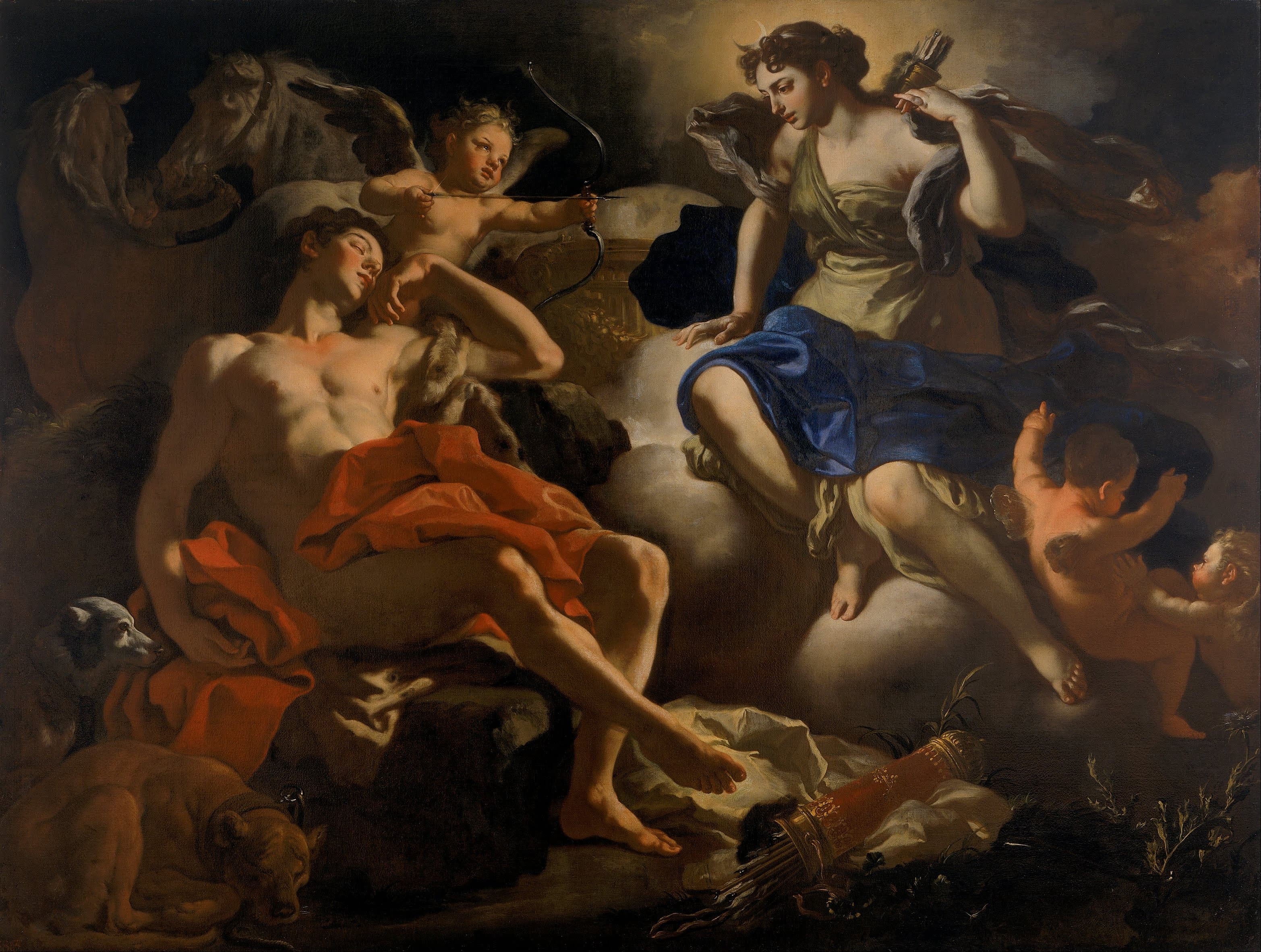
In the next few lines the couple appears equally ardent and interested in one another: conversation flies back and forth between them, as important as the contest of erotic wrestling that begins when the light fades. Curled up on the bed, they embrace, and the sense of reciprocity deepens: the beloved’s breasts are revealed while she wrestles with Propertius, and she twitches her dress closed, but then she dives in to kiss his eyelids open, teasing him for being a sleepyhead. They gaze at one another intently: Venus resents lovers groping in the dark. They are Helen and Paris, Diana and Endymion.
Ezra Pound introduced me to this poem in the 1917 assemblage he called “Homage to Sextus Propertius,” when I was a teenager in love for the first time.
Me happy, night, night full of brightness;
Oh couch made happy by my long delectations;
How many words talked out with abundant candles;
Struggles when the lights were taken away;
Now with bared breasts she wrestled against me,
Tunic spread in delay;
And she then opening my eyelids fallen in sleep,
Her lips upon them; and it was her mouth saying:
Sluggard!
And so on. But Pound chose to skip the next section of the poem (lines 17-22) entirely. Here’s my translation:
If, feeling obstinate and proud, you lie there with your clothes on,
you will feel my hands ripping your clothes apart:
even more, if anger carries me further,
you will hold out bruised arms to your mother.
And don’t let drooping breasts stop you from playing:
leave worry about that to any woman shamed by having given birth.
quod si pertendens animo vestita cubaris,
scissa veste meas experiere manus:
quin etiam, si me ulterius provexerit ira,
ostendes matri bracchia laesa tuae.
necdum inclinatae prohibent te ludere mammae:
viderit haec, si quam iam peperisse pudet.
Scored in my memory, Pound’s adaptation helped me mostly ignore these lines for years. Today, facing head-on the violence latent in them, the sense that men possess the unquestionable right to use and judge women’s bodies however they like, threatens to make the poem unreadable. Keep going, though, and in some of the most extravagant protestations of love of the “seize the day” type that exist in Roman poetry, you find that Propertius hands power, including the ability to wreak violence, over to the beloved. And here, in the lines I italicize below, Pound performs an interesting mistranslation:
While our fates twine together, sate we our eyes with love;
For long night comes upon you
and a day when no day returns.
Let the gods lay chains upon us
so that no day shall unbind them
The gods are not the agents in Propertius’ verses – the word doesn’t even appear; that’s the role he gives to the beloved. And in Latin nos frequently means not “us” but “me.” Here’s my translation:
If only you would like to dominate me, held fast with a chain,
so that no day would ever let me go!
atque utinam haerentis sic nos vincire catena
velles, ut numquam solveret ulla dies!
Here Pound’s inventive addition of “gods” to the action prompts me to see the beloved herself as a goddess, controlling the heavens so that daytime itself is an accomplice to Propertius’ imprisonment. Next he praises doves, who live “male and female” in a perfect bond (totum coniugium), and spends several lines wishing that the beloved will grant him the gift of time with her. Finally, he says in language drawn straight from Roman epic, if only more Romans devoted themselves to love, they would stop waging wars foreign and civil, which make the goddess Roma grieve with her hair undone. Let’s indulge in love: tomorrow might be our last day anyway.
The artifice of exaggeration and cliché is everywhere in this poem. Does its presence undo or mitigate Propertius’ threat of violence? Does it make his vision of a dominant woman a joke? Is it his way of simultaneously conveying and cloaking the sensation of fatal vulnerability that falling in love can create – for himself, for her, for both of them? Whatever the answer, and of course there is no final right answer, his transfer of power and the operatic over-the-top feeling of every line in this poem keep me a curious rereader.
Originally published in In Medias Res on Substack. Read it there or subscribe to get new articles by email.